Reference sheet
Motor types
DC, stepper, servo, brushless: control and drivers
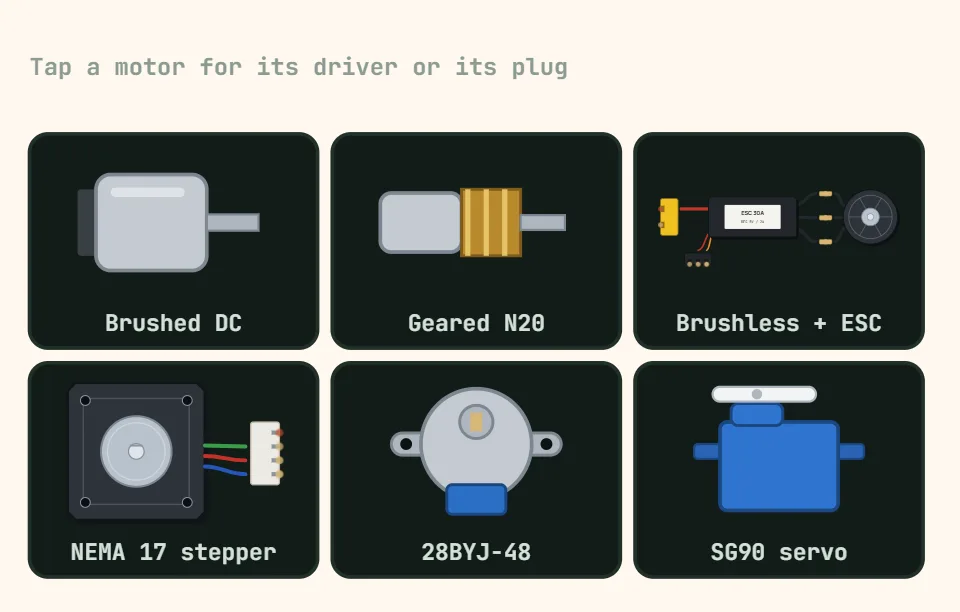
Motor types
The question that decides the family is not power or speed, it is whether you need to know where the shaft is. A stepper assumes its position and never checks; a servo manages position internally but tells you nothing; DC and brushless motors report nothing at all until you bolt on an encoder. Size drivers and supplies for stall current, not for the running figure on the label.
| Type | Control | Holding torque | Feedback | Typical driver | Watch out |
|---|---|---|---|---|---|
| Brushed DC | PWM for speed, polarity for direction, via an H-bridge | None — it free-wheels | None; add an encoder | L298N, TB6612FNG, DRV8871, MOSFET bridge | Stall current is 5–10× running current, from the first instant |
| Geared DC (N20, TT) | Same as brushed DC | Gearbox friction only; worm drives self-lock | Optional rear-shaft encoder | Same as brushed DC | Quoted rpm is no-load. Plastic gears strip at stall, and backlash blurs position |
| Brushless (BLDC) | Three-phase commutation, via an ESC or an FOC controller | None sensorless at rest; FOC with an encoder holds | Back-EMF, Hall sensors, or an encoder | Hobby ESC, or DRV8313 with SimpleFOC | Sensorless has almost no torque near zero speed, and ESCs need arming first |
| Stepper, bipolar (NEMA 17) | Step and direction pulses into a current-limited driver | Full rated torque while energised, ≈ 0.4 N·m | Open loop — nothing confirms it moved | A4988, DRV8825, TMC2209 — set Vref first | Loses steps silently if over-accelerated, and runs hottest standing still |
| Stepper, unipolar (28BYJ-48) | Four phases sequenced by a ULN2003 board | Holds, but only ≈ 0.03 N·m | Open loop | The ULN2003 board it ships with | ~15 rpm flat out, and the gear ratio is 63.68:1, not the 64:1 usually quoted |
| RC servo (SG90, MG996R) | 50 Hz PWM; a 1.0–2.0 ms pulse maps to 0–180° | Holds actively, 1.8–9.4 kg·cm | Internal pot; the MCU gets nothing back | None — a GPIO drives the signal wire | Needs its own supply: the current step on each move browns out the MCU |
| Continuous-rotation servo | Same PWM, but the pulse sets speed; 1.5 ms means stop | None — the pot no longer tracks the output | None at all | None — direct GPIO | The 1.5 ms neutral point drifts, so it creeps when told to stop |