Reference sheet
Battery charging
CC-CV per chemistry, and the mistake that starts fires
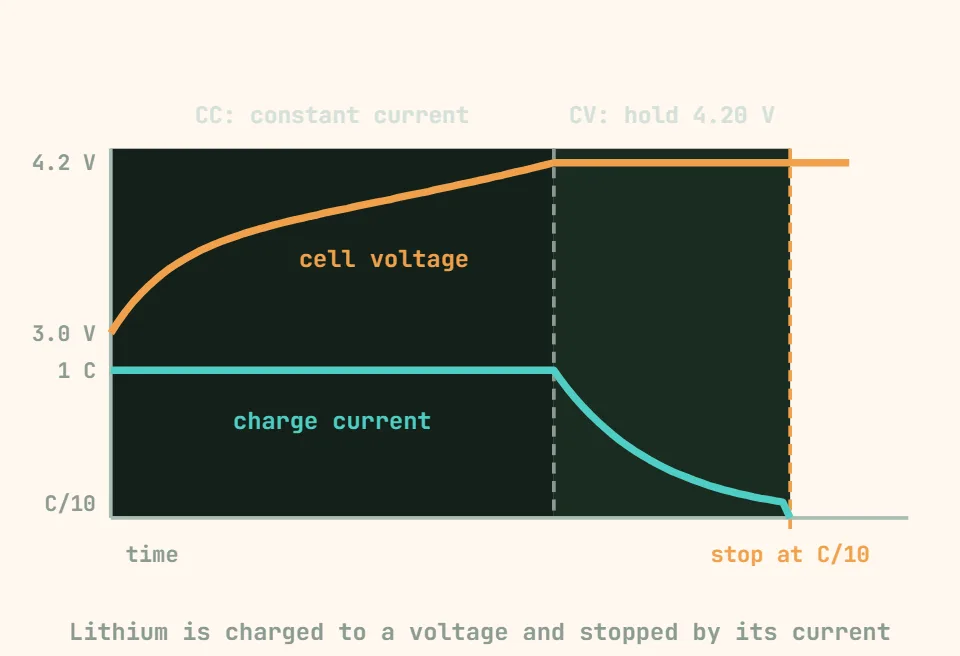
Battery charging
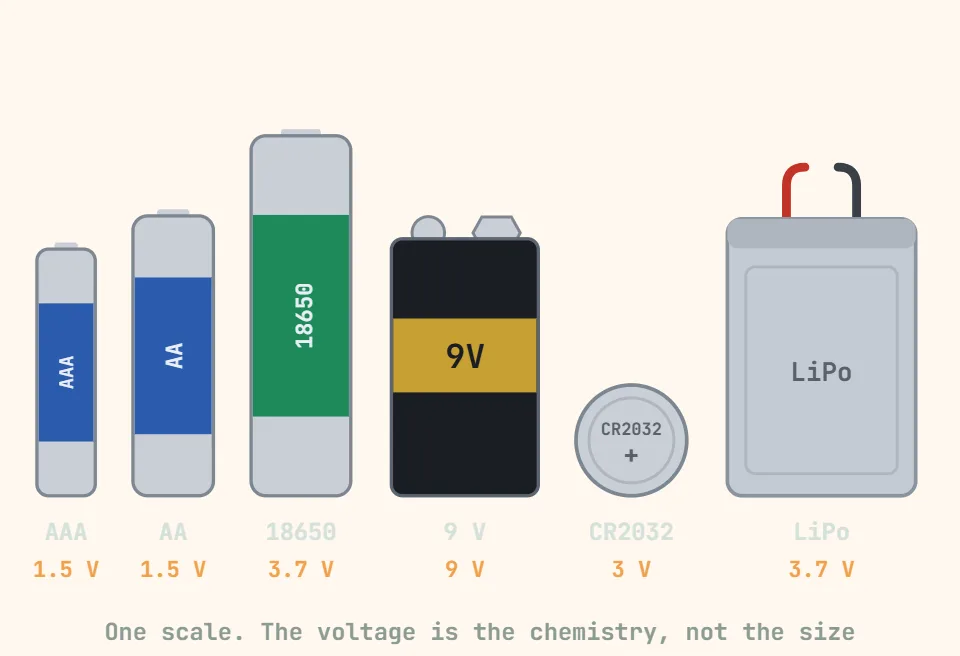
Each chemistry has its own idea of "full". Lithium is charged by voltage and stopped by current — CC-CV: constant current until the cell reaches its target voltage, then constant voltage until the current tapers away. Nickel is charged by current and stopped by spotting the voltage dip or the temperature rise. Lead-acid is charged by voltage and then held there indefinitely. Applying one chemistry's rule to another is how packs get destroyed. C is the pack capacity in amp-hours, so 0.5 C on a 2000 mAh cell means 1 A.
| Chemistry | Charge voltage per cell | Charge current | Termination | Temperature window |
|---|---|---|---|---|
| Li-ion / LiPo (cobalt) | 4.20 V ±0.05 | 0.5–1 C | CC-CV: hold 4.20 V, stop when the current falls to C/10–C/20 | 0–45 °C charge, −20…60 °C discharge |
| LiPo "HV" / LiHV | 4.35 V | 0.5–1 C | Same CC-CV taper — a 4.20 V charger simply leaves it part-full | 0–45 °C |
| LiFePO4 (LFP) | 3.65 V max (3.55–3.60 typical) | 0.5–1 C | CC-CV, stop at C/10. The flat curve means terminal voltage tells you almost nothing about state of charge | 0–45 °C charge, −20…60 °C discharge |
| Lithium pack in series | cells × the figure above | pack-rated | Per-cell balancing. The pack voltage can look correct with one cell already sitting at 4.3 V | Same as its cells |
| NiMH, fast charge | No voltage target (≈1.45–1.50 V/cell while charging) | 0.5–1 C | −ΔV of 5–10 mV per cell, or dT/dt above 1–2 °C/min; always back it with a timer and a 50 °C cut-out | 10–45 °C |
| NiMH, slow charge | Same | C/10 for 14–16 h | Timer only — the −ΔV dip is too small to detect below about 0.3 C | 0–45 °C |
| NiMH, maintenance | Same | C/40 or less | Continuous trickle. C/20 and above cooks the cell over days | 0–45 °C |
| NiCd | No voltage target | 0.5–1 C | −ΔV of 10–20 mV per cell — a stronger, easier signal than NiMH gives | 0–45 °C |
| Lead-acid, flooded | 2.40–2.45 V/cell absorption (14.4–14.7 V on a 12 V battery), 2.25–2.30 float | 0.1–0.2 C | Hold absorption until the current drops to about C/50, then fall back to float — lead-acid is the one chemistry that likes being held there | −20…50 °C, compensated |
| Lead-acid, AGM | 2.40–2.45 V/cell cyclic, 2.25–2.30 float | 0.1–0.3 C | Same profile, but it is sealed: gas driven off by overcharge never comes back | −20…50 °C, compensated |
| Lead-acid, gel | 2.30–2.40 V/cell cyclic (14.4 V ceiling on 12 V), 2.25–2.30 float | 0.1–0.2 C | The least overcharge-tolerant of the three — an AGM profile dries it out | −20…50 °C, compensated |
| Alkaline, CR2032, primary lithium | Not chargeable | — | None. These vent, leak or rupture | n/a |
The mistakes that start fires. The first row is the one nobody sees coming, because nothing happens at the time.
| Mistake | What it actually does |
|---|---|
| Charging a lithium cell below 0 °C | Lithium plates out as metal on the anode instead of intercalating. The dendrites stay there and can pierce the separator weeks later, in a drawer, with nothing plugged in. This is the classic delayed fire, and the charge itself looked completely normal. |
| Float or trickle charging lithium | A Li-ion or LiFePO4 charger must terminate, not hover. Holding a full cell at its CV voltage keeps plating and gassing going; there is no lithium equivalent of a lead-acid float. |
| A 4.2 V charger on a LiFePO4 pack | 0.55 V per cell of overcharge, every single cycle. A 3S LiFePO4 pack and a 3S Li-ion charger share the same connector and are not the same battery. |
| Reviving a deeply discharged cell at full current | Below roughly 2.5 V (2.0 V for LFP) the copper current collector dissolves and re-plates as internal shorts. Pre-charge at 0.05 C or less; if it will not climb to 3 V, recycle it. |
| A series pack with no BMS or balancer | Cells drift apart a little every cycle. The pack terminal voltage is an average, and it hides the one cell that is already over its limit. |
| Charging a swollen, dented or previously overheated cell | The separator is already compromised. There is no bench test that makes this cell safe again. |
| Lead-acid with no temperature compensation | Roughly −3 to −5 mV/°C per cell, about −20 mV/°C on a 12 V battery. Uncompensated, a battery in a hot engine bay is chronically overcharged and one in the cold never fills. |
| Leaving lithium stored full | Store at 3.7–3.8 V per cell, around 50–60 %, and cool. A pack left at 4.20 V for a year loses capacity permanently. |
A lithium charger needs three things you cannot leave out: a per-cell voltage limit, a current limit, and a temperature sensor on the cells themselves. Charge on a non-flammable surface, not unattended overnight, and not sealed inside an enclosure that gives a venting cell nowhere to go.