Reference sheet
Fuses & protection
Fast vs slow blow, polyfuses, TVS and reverse-polarity guards
Fuses & protection
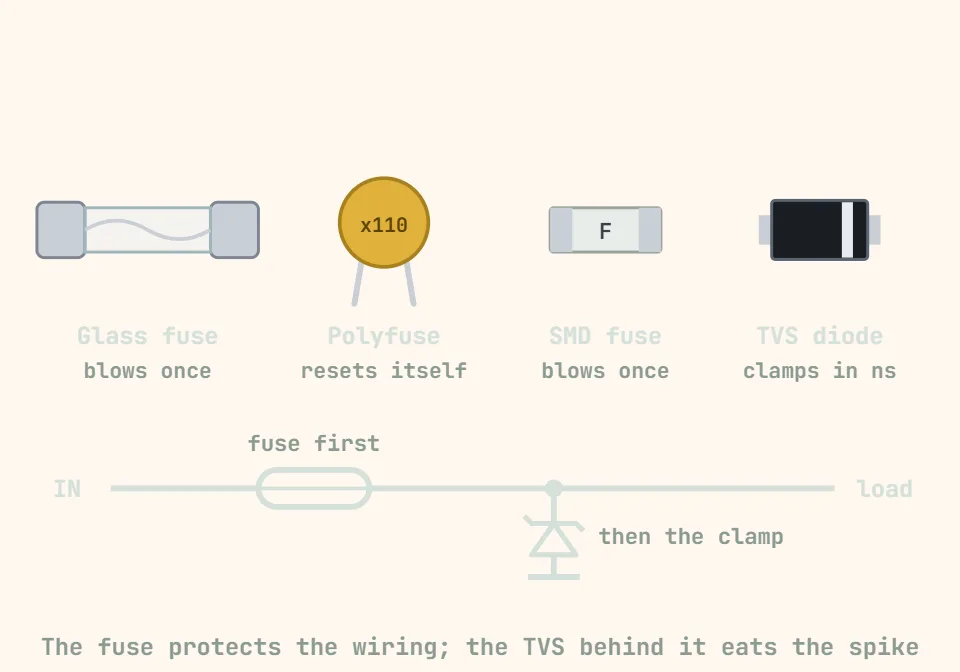
Size a fuse above the real steady current (typically 1.5–2×) and below what the weakest wire can survive — a fuse protects the wiring, not the clever part downstream. Its voltage rating must match or exceed the circuit, and for DC it must be a DC-rated fuse: DC arcs do not self-extinguish the way AC does.
| Device | Package | Reaction | Typical use | Notes |
|---|---|---|---|---|
| Fast-blow (F) | Glass / SMD | Milliseconds | Semiconductors, logic supplies | Protects parts, nuisance-trips on inrush |
| Slow-blow (T) | Glass / ceramic | Seconds | Motors, transformers, big capacitors | Rides through inrush, protects wiring |
| PTC resettable (polyfuse) | Disc / SMD | Seconds, self-resets | USB ports, hobby boards | Holding current ≈ half the trip current; never fully off |
| TVS diode | SMD / axial | Nanoseconds | Surge and ESD clamping | Not a fuse: clamps voltage, pair it with one |
| Zener clamp | Axial | Microseconds | Small overvoltage limiting | Cheap crowbar with a series fuse |
| Reverse-polarity P-MOSFET | SMD / TO-220 | Instant | Battery inputs | Loses far less than the classic series diode |