Reference sheet
Voltage regulators
7805, LM317, LDOs and buck modules side by side
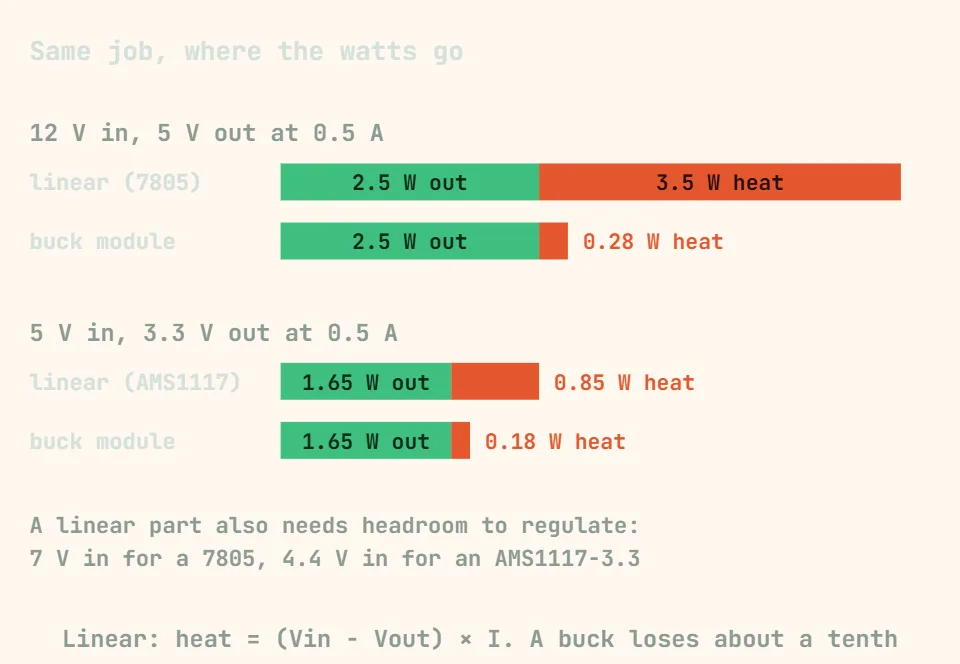
Voltage regulator comparison
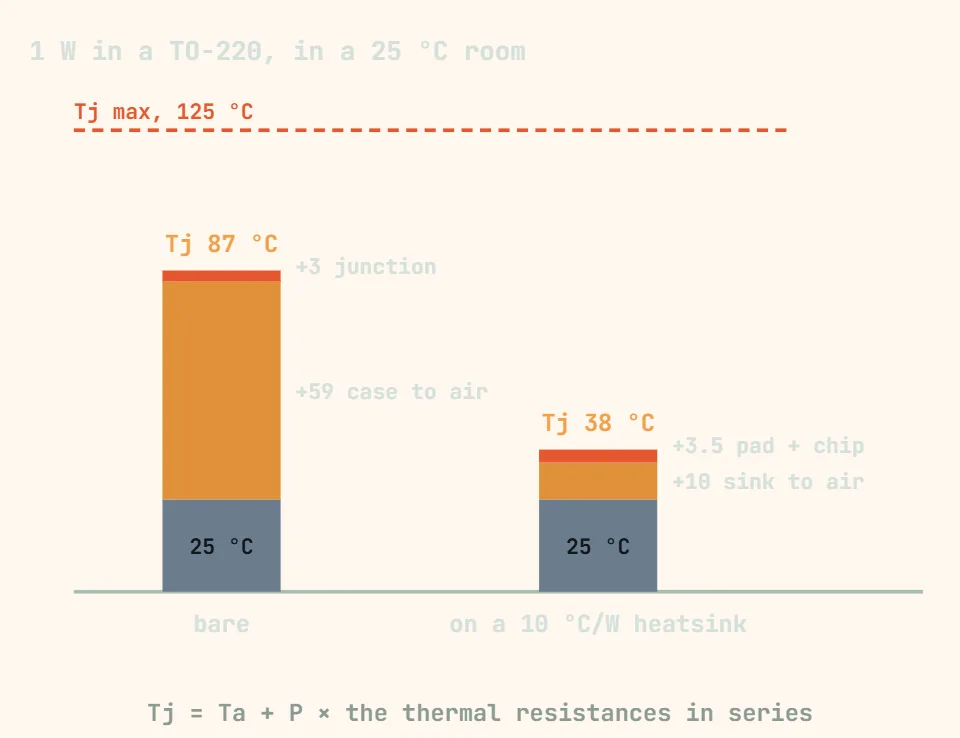
Dropout = the minimum Vin−Vout headroom the regulator needs to keep regulating. A linear regulator turns the rest of that headroom straight into heat (P = (Vin−Vout) × Iload) — for a large voltage drop at real current, a switching regulator is usually the better fit.
| Part | Type | Output | Max current | Dropout | Notes |
|---|---|---|---|---|---|
| 7805 | Linear, fixed | 5V | 1 A | ≈ 2 V | The classic — simple, noisy-free, wastes power as heat above small Vin−Vout gaps |
| 7812 | Linear, fixed | 12V | 1 A | ≈ 2 V | Same family as the 7805, higher output |
| LM317 | Linear, adjustable | 1.25–37V | 1.5 A | ≈ 2 V | Needs two resistors to set Vout — flexible, same efficiency trade-off as any linear reg |
| AMS1117-3.3 | Linear LDO, fixed | 3.3V | 1 A | ≈ 1.1 V | Very common on cheap dev boards and breakouts |
| LD1117 / similar LDOs | Linear LDO, fixed | 3.3V / 5V | 0.8 A | ≈ 1.1 V | Low-dropout alternative when Vin is close to Vout |
| Buck converter module (e.g. MP1584) | Switching (buck) | Adjustable | 2–3 A typical | N/A | Much more efficient than linear when Vin−Vout is large — adds switching noise |