Reference sheet
Multimeter guide
Every dial position, burden voltage, and that fuse
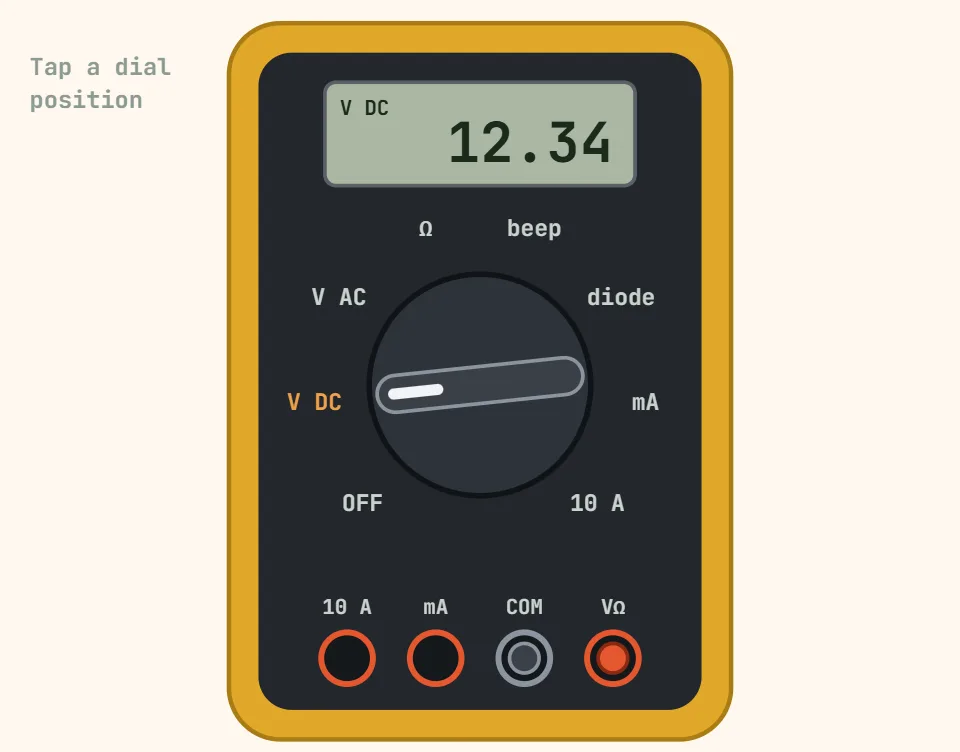
Using a multimeter
Two rules cover most of it: voltage is measured in parallel, current in series. What changes underneath is the meter itself — on volts it is a 10 MΩ resistor you hang across the circuit, on amps it is a wire you insert into it.
| Measurement | Lead jacks | How to connect | What it gets wrong |
|---|---|---|---|
| DC voltage (V⎓) | COM + VΩ | In parallel, across the two points | The input is 10 MΩ on almost every meter — high enough for most circuits, but it loads a megohm-scale divider, and it is not a scope: anything moving faster than a few hertz reads as an average |
| AC voltage (V∼) | COM + VΩ | In parallel | A cheap meter is average-responding and calibrated for a sine. On PWM, a triangle or a chopped mains waveform it is wrong by tens of percent unless the case says True RMS. Most also ignore any DC offset entirely |
| DC current (A⎓) | COM + mA or 10 A | In series — break the circuit and put the meter in the gap | In this mode the meter is close to a piece of wire. Putting it across a supply instead of in series is the most common way one dies |
| AC current (A∼) | COM + mA or 10 A | In series | Same rule. For mains, use a clamp meter and leave the conductor intact |
| Resistance (Ω) | COM + VΩ | Across the part, with the power removed | Lift one leg. In-circuit you are reading your resistor in parallel with everything else, so it always comes out low. A charged capacitor, or your own fingers across both probes, skews it too |
| Continuity (beep) | COM + VΩ | Across the joint | Most meters beep anywhere below 30–50 Ω. A beep proves "not open", not "shorted" — read the ohms on the display, not the noise |
| Diode test | COM + VΩ | Red on the anode, black on the cathode | Forces roughly 0.5–1 mA and shows the forward drop: 0.55–0.75 V silicon, 0.15–0.45 V Schottky, 1.8–3.4 V for an LED. Reverse should read OL. Many meters only supply 2–3 V, so blue and white LEDs read OL both ways and look dead |
| Capacitance | COM + VΩ (or a dedicated jack) | Across the capacitor, discharged first | In-circuit readings are meaningless. Large electrolytics take seconds to settle, and the meter cannot see ESR at all — a capacitor that reads its full value can still be the fault |
| Frequency / duty cycle | COM + VΩ | In parallel | Needs a clean signal of a volt or more. It counts threshold crossings, so a noisy or slow edge is counted several times and multiplies the reading |
| Temperature (K-type) | Thermocouple jack | Bead pressed against the surface | The bead reads its own temperature, not the part’s. Poor contact reads low, and any air movement reads much lower |
| hFE socket | Dedicated socket | Leads into E-B-C | One point on the curve at a fixed, low collector current. Good for telling an NPN from a PNP, or a dead device from a live one, and nothing more |
Burden voltage. A current range works by measuring the drop across an internal shunt, and that drop comes out of your circuit. It is why a current reading can be perfectly accurate and completely useless: you measured a circuit the meter had already changed. If the number matters, use a shunt you chose yourself and measure the millivolts across it in voltage mode.
| Range | Typical shunt | Drop at full scale | Where it bites |
|---|---|---|---|
| µA range | ≈100 Ω | 0.1–0.5 V | Measuring sleep current on a 3.3 V board: the meter alone can drag the rail under the brownout threshold, so the MCU resets every time it wakes and the average you record is fiction |
| mA range | ≈1–10 Ω | 0.2–0.5 V | A 100 mA load through a 10 Ω shunt loses a whole volt. The circuit then runs slower and draws less than it really would — the reading is accurate for a circuit that only exists while you are measuring it |
| 10 A range | ≈0.01 Ω | 0.1–0.3 V | Usually harmless to the measurement. On cheap meters this is also the jack with nothing behind it |
The fuse. The mA and µA jacks sit behind a small fast fuse, often 200–500 mA, and on a properly rated meter it is a sand-filled HRC ceramic type rather than glass. That fuse is not protecting the meter, it is protecting you: leave the red lead in the current jack after a current measurement, touch the probes across a live supply, and you have placed a near short-circuit across it — on a mains circuit, an arc flash. A glass fuse fitted as a replacement is blown apart by that arc instead of quenching it. Replace like for like, matching current, voltage and interrupt rating, and build the habit of moving the red lead back to the VΩ jack the moment you are done. Meters also carry a CAT rating — CAT II for wall outlets, CAT III for distribution panels, CAT IV at the service entrance — and both the category and its stated voltage have to cover where you are working.