Reference sheet
Flux types
Rosin, no-clean, water-soluble, and which must be washed off
Solder flux types guide
Flux strips surface oxide off copper and component leads and keeps new oxide from forming while the joint is molten, which is what lets solder actually wet the metal instead of beading up. IPC J-STD-004 sorts fluxes along two axes: the vehicle (rosin, synthetic resin, organic acid, or inorganic acid) and the activity level — roughly how aggressive the built-in cleaning chemistry is. Almost everything you'll meet on a bench falls into three families: rosin-based (R/RMA/RA), no-clean synthetic, and water-soluble organic-acid, plus a couple of application-specific forms like paste and rework gel.
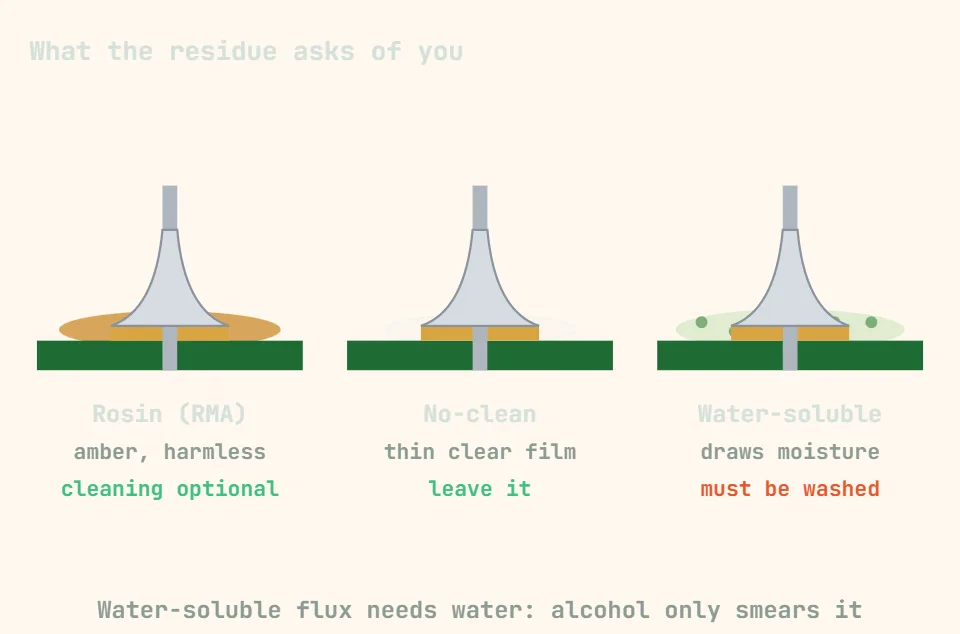
The rule worth memorizing: water-soluble flux is made more aggressive on purpose so it can clean tarnished boards fast on an automated line, and that same aggressiveness makes its residue hygroscopic and mildly ion-conductive if left in place — it must be washed off with actual water, not just wiped with alcohol. No-clean flux is the opposite by design: its residue is low-solids and formulated to stay electrically inert, so it's allowed to stay on the board for most consumer and general-purpose work. Classic rosin/RMA sits in between — not corrosive under normal humidity, but not as chemically inert as no-clean, so it's often cleaned anyway before conformal coating or high-reliability work.
When reverse-engineering or repairing a board with unknown history, treat any white, crusty, or greenish residue as a corrosion risk regardless of which flux family made it — by the time residue looks visibly dirty it has usually already had time to attack whatever it's sitting on.
| Flux Type | IPC J-STD-004 Class (typical) | Activator / Halide Level | Typical Residue | Cleaning Required? | Typical Use |
|---|---|---|---|---|---|
| Rosin, non-activated (R) | ROL0 | None — no halides | Clear amber, hard/brittle, non-conductive | No — residue is inert | Legacy/mil-spec grade; rarely sold alone today, mostly superseded by RMA |
| Rosin Mildly Activated (RMA) | ROL0 / ROL1 (halide-free to <0.5%) | Mild organic activators, low or no halide | Amber, semi-tacky to hard; non-corrosive at normal humidity | Optional — fine to leave for general/consumer work; clean before conformal coating or RF/high-voltage boards | The classic rosin-core wire and liquid flux for hand soldering and general rework |
| Rosin Activated (RA) | ROM1 (~0.5-2% halide) / ROH1 (>2% halide) | Stronger halide activators (chlorides/bromides) | Darker; mildly hygroscopic/corrosive if left long-term | Recommended, especially for long-term or high-reliability assemblies | Oxidized or hard-to-wet leads, salvaged parts, tougher rework RMA can't handle |
| Water-Soluble / Organic Acid (OA, WS) | ORL0-ORH1 (varies; often moderate-high) | Organic acids (adipic, glutamic, etc.), frequently with halides | Hygroscopic and ionically conductive — draws moisture, corrodes copper and leads if left | Mandatory — hot water wash (ideally DI, often with a saponifier and brush) within hours of soldering | High-volume wave/reflow lines with inline aqueous cleaning; risky by hand unless you can actually wash it off |
| No-Clean, low-solids synthetic resin | REL0 / REL1 (halide-free to <0.5%, low activity) | Mild synthetic activators, minimal solids | Thin, clear/translucent film engineered to be non-conductive and non-corrosive | Not required for most consumer/general electronics; clean before conformal coating, underfill, or medical/aerospace builds | Default flux in most modern SMT reflow paste, flux pens, and everyday hand soldering |
| No-Clean tacky gel (rework/BGA flux) | ~REL0/REM0-equivalent, tuned for tack and thermal stability | Synthetic, mild; survives multiple reflow passes without charring | Sticky when hot, thin dry film after; usually safe to leave | Optional; worth cleaning after BGA/QFN reballing to clear residue trapped under the package | BGA/QFN reballing, hot-air rework, tacking small parts before reflow |
| No-Clean SMT paste flux (carrier in solder paste) | Usually REL0/REL1-class (paste powder particle size, e.g. Type 3-5, is a separate J-STD-005 spec, not the flux class) | Synthetic, low-activity, tuned to survive the reflow profile | Light matte or glossy film around joints | Not required for typical boards; clean if conformal coating or optical/AOI inspection needs bare pads | Stencil-printed SMT assembly and paste-based rework |
| Inorganic acid flux (zinc chloride, "killed spirits") | INx — not rated for electronics | Zinc chloride/ammonium chloride, very aggressive | Highly corrosive and conductive; actively attacks copper and leads over time | Mandatory, immediate, thorough — best avoided on a PCB entirely | Plumbing/sheet-metal soldering only; a common hidden cause of green corrosion on boards someone "fixed" with the wrong flux |
Rosin and no-clean residue come off with 90%+ isopropyl alcohol and a brush or lint-free swab, but water-soluble residue doesn't — it needs actual water (ideally deionized) to dissolve, and wiping it with only IPA can just smear the corrosive film around instead of removing it, a common rework mistake. Exact halide content and IPC class vary by manufacturer even within the same flux name, so treat the classifications here as typical, not guaranteed for any specific product.