Reference sheet
Soldering & rework
Alloys, iron temperatures, tip choice and flux
Soldering & rework
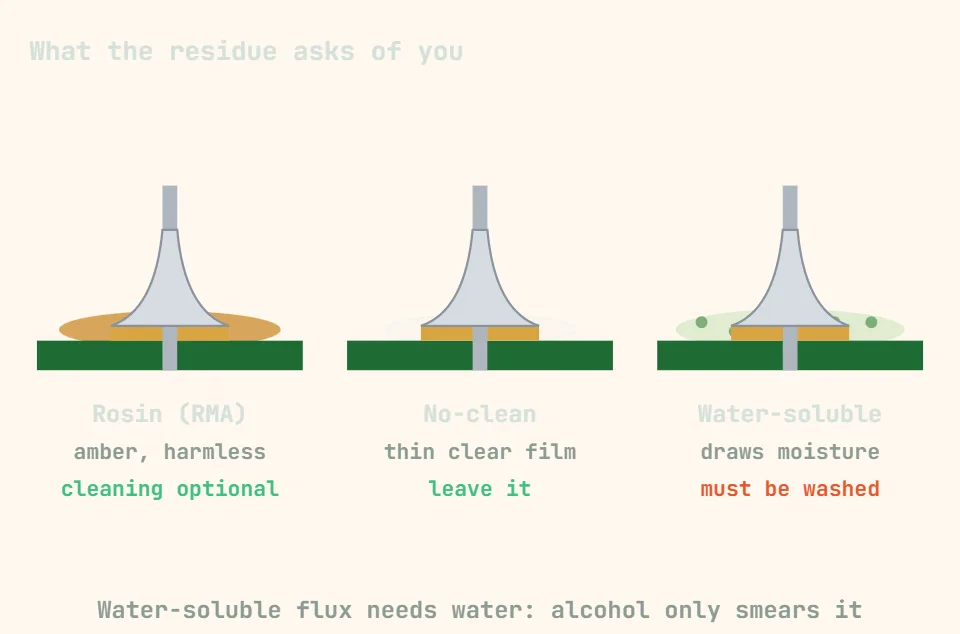
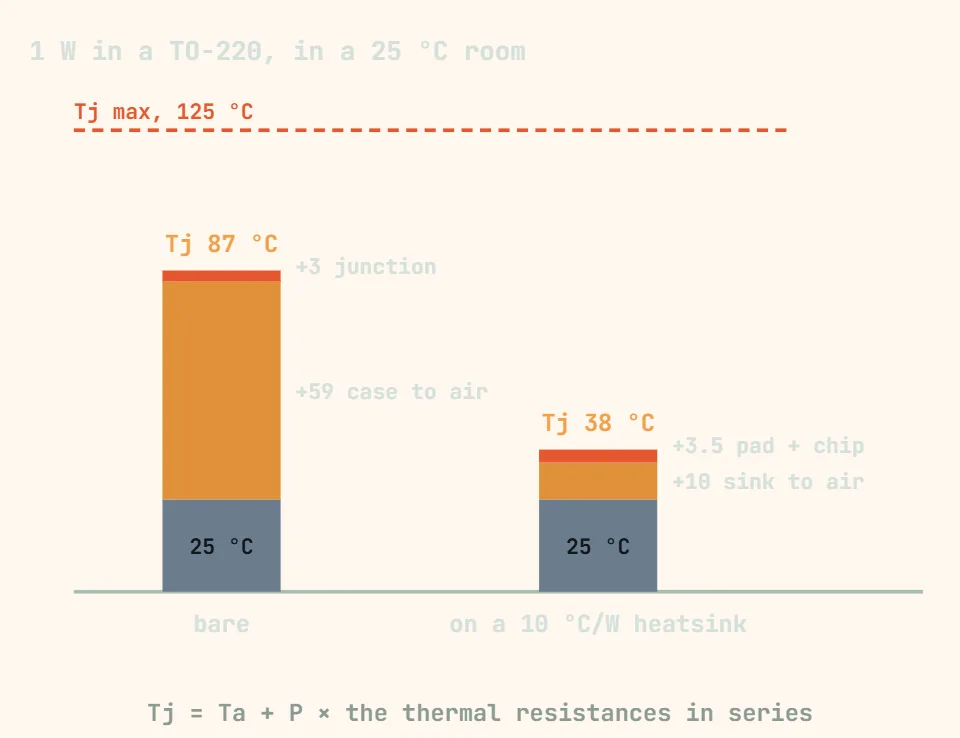
Iron temperature is not the real variable — thermal mass is. A big joint on a ground plane needs a bigger tip, not a hotter one. Flux is what makes solder wet the pad: rosin (RMA) for general work, no-clean for quick jobs, water-soluble only if you can wash the board.
| Alloy | Type | Melting | Iron setting | Notes |
|---|---|---|---|---|
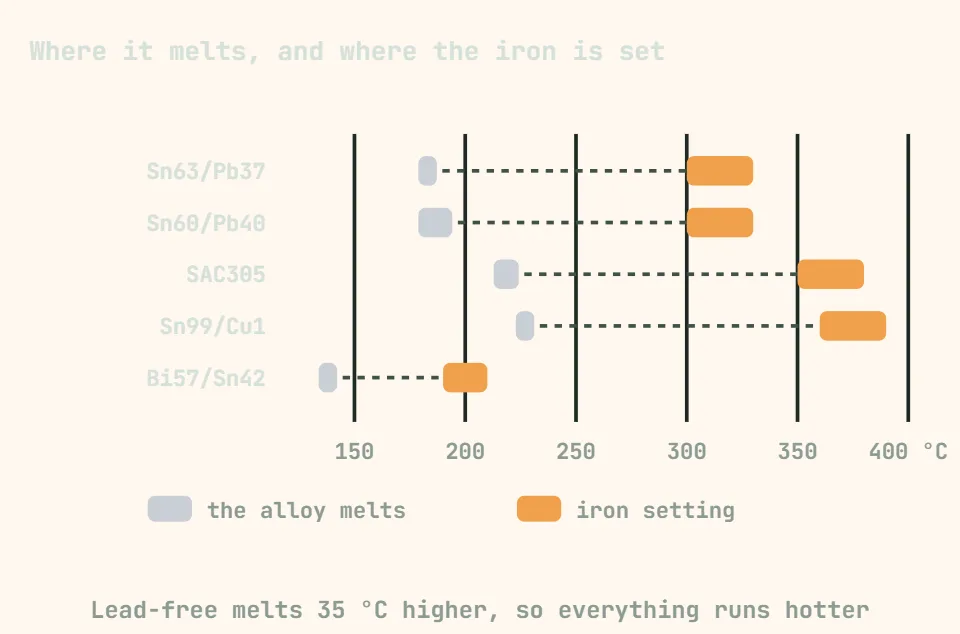
| Sn63/Pb37 | Eutectic tin-lead | 183 °C (no plastic range) | 300–330 °C | The easiest to work with: melts and freezes at one temperature, shiny joints |
| Sn60/Pb40 | Tin-lead | 183–190 °C | 300–330 °C | Slight pasty range; nearly as forgiving |
| SAC305 (Sn96.5/Ag3/Cu0.5) | Lead-free | 217–220 °C | 350–380 °C | RoHS default. Duller joints, needs more heat and better flux |
| Sn99/Cu1 | Lead-free, cheap | 227 °C | 360–390 °C | Harsher to hand-solder than SAC305 |
| Bi57/Sn42/Ag1 | Low-temperature | 138 °C | 190–210 °C | Rework near heat-sensitive parts; brittle, do not mix with leaded solder |
| Job | Tip temperature | Tip shape | Dwell |
|---|---|---|---|
| Fine SMD (0402…0805, SOIC) | 300–320 °C leaded / 340–360 °C lead-free | Conical or micro-chisel | 1–2 s per joint |
| Through-hole, small pads | 320–340 °C / 350–370 °C | 2 mm chisel | 2–3 s |
| Ground planes, big pads, shields | 350–380 °C / 380–400 °C | 3–5 mm chisel — mass beats temperature | 4–6 s |
| Desoldering braid | 340–370 °C | Wide chisel, add flux | Move on if the pad greys |
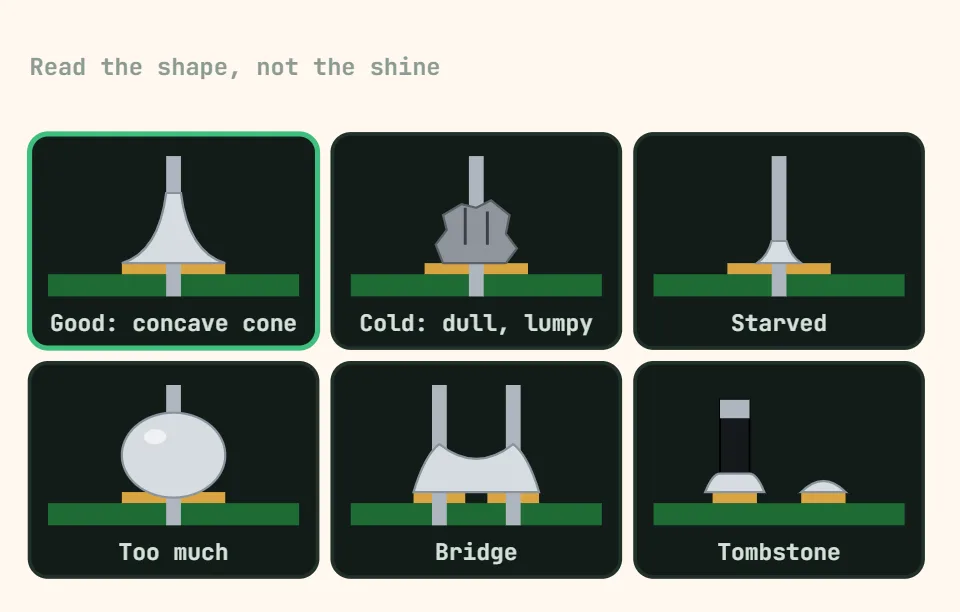
A cold joint looks dull and lumpy and often shows a gap at the lead; reheat it with fresh flux rather than adding solder. Lead-free needs roughly 30–40 °C more everywhere.