Reference sheet
ESD & handling
What really kills parts, and what the bags actually do
ESD & handling
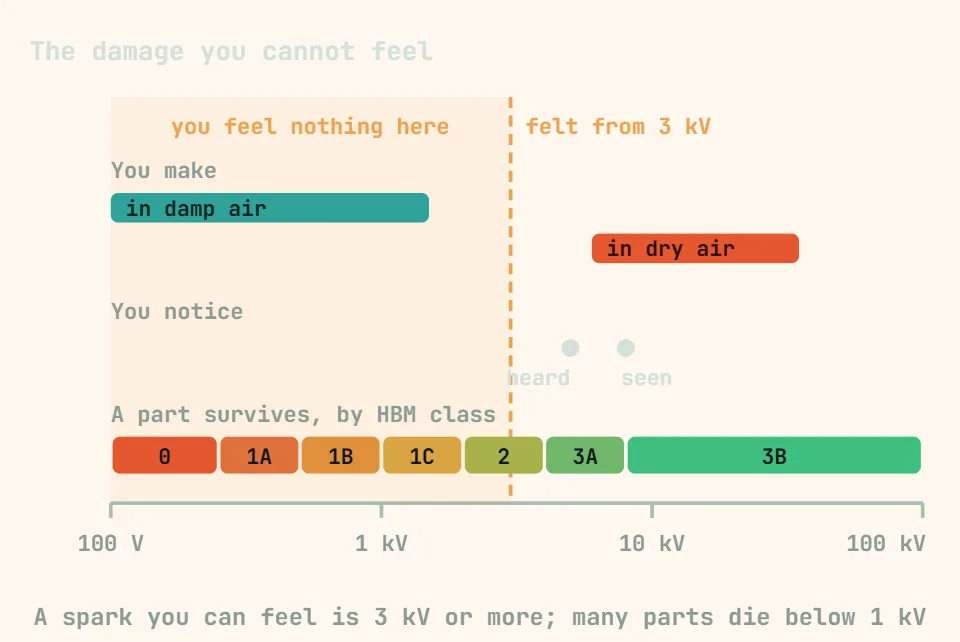
You cannot feel a discharge below roughly 3 kV, cannot hear one below about 5 kV, and cannot see the spark below something like 8 kV. A Class 0 part is destroyed below 250 V. Every damaging event you will ever cause is one you did not notice. Worse, most of them do not kill the part outright — they thin an oxide or melt a corner of a junction, the board passes test, and the fault turns up in the field weeks later. That latent damage is what ESD control is really buying you.
Human body model (HBM) is 100 pF discharged through 1.5 kΩ, the standard stand-in for a person touching a pin. Charged device model (CDM) is the other half of the story: the part itself picks up charge, then dumps it out through one pin in under a nanosecond the instant that pin touches ground. CDM ratings are typically a few hundred volts, and CDM is the mechanism that dominates on an automated line, because machines handle parts far more than people do.
| HBM class | Withstand | Parts that live here |
|---|---|---|
| Class 0 | Under 250 V | GaAs MMICs and RF low-noise amplifiers, laser diodes, magnetoresistive sensors, bare die and wafer-level packages |
| Class 1A | 250 – 500 V | High-speed interface pins (USB 3, HDMI, DDR), some RF front ends, precision analog inputs |
| Class 1B | 500 – 1000 V | Small-signal JFETs and MOSFETs, MEMS microphones, fast ADCs and DACs |
| Class 1C | 1 – 2 kV | Plenty of modern MCUs and mixed-signal parts, especially their analog and crystal pins |
| Class 2 | 2 – 4 kV | General logic (74HC/AHC/LVC), common op-amps, most MCU digital GPIO |
| Class 3A | 4 – 8 kV | Parts built with deliberate on-chip protection: line transceivers, rugged interface chips |
| Class 3B | Over 8 kV | Dedicated TVS and ESD-protection diodes, power discretes, ordinary passives |
Where the charge comes from. Humidity is the cheapest control available — the same action generates one to two orders of magnitude less charge in a damp room than in a dry one, which is why ESD failures cluster in winter and in air-conditioned offices.
| Action | At 10–20 % humidity | At 65–90 % humidity |
|---|---|---|
| Walking across a carpet | 35 kV | 1.5 kV |
| Walking across a vinyl floor | 12 kV | 250 V |
| Getting up from a foam-padded chair | 18 kV | 1.5 kV |
| Someone simply working at a bench | 6 kV | 100 V |
| Picking a poly bag up off the bench | 20 kV | 1.2 kV |
| Opening a vinyl envelope | 7 kV | 600 V |
| Item | What it is | Use it for | Do not |
|---|---|---|---|
| Metallised shielding bag (silver) | A Faraday cage — a buried metal layer keeps external fields off the contents | Anything with a die inside it, in transit and in storage | Reuse one that is creased, punctured or has a torn seal. The shield is that metal layer, and a hole is a hole |
| Pink antistatic poly bag | A dissipative surface and nothing else — no shielding whatsoever | Inner wrap and cushioning, ESD-safe hardware, enclosures | Ship boards or loose ICs in it. The antistatic treatment is a surface coating that wears off with age and handling |
| Black conductive bag or tote (carbon-loaded) | Conductive, under 1×10⁴ Ω | Moving assemblies around inside the building; bins and trays | Treat it as a moisture barrier, or let it touch a powered board — it is a conductor |
| Black conductive foam | Conductive, under 1×10⁴ Ω | Shorting the pins of DIPs, MOSFETs and unprotected discretes to each other | Store parts in it for years — it leaves residue and corrodes leads |
| Moisture-barrier bag with desiccant and humidity card | Shielding plus a sealed moisture barrier | MSL-rated packages before reflow: trapped moisture flashes to steam and cracks the package | Open it early. The floor-life clock starts the moment the seal breaks |
| Ordinary clear zip bag, bubble wrap, sticky tape | Insulative, above 1×10¹² Ω, and an energetic charge generator | Nothing that goes anywhere near a component | Everything. This is the most common way good parts arrive dead |
| Dissipative bench mat | 1×10⁶ – 1×10⁹ Ω, grounded through 1 MΩ | The work surface — it bleeds charge away slowly rather than dumping it | Bond it straight to earth with no resistor |
| Wrist strap | 1 MΩ in series; the whole path to ground should measure under 35 MΩ | You, any time a part is out of its bag | Wear one while working on anything live at mains potential |
The 1 MΩ resistor in a wrist strap is not there for the parts — it limits you to a fraction of a milliamp if the strap ever finds mains. Test the strap itself, not just the cord: a dry wrist or a loose band reads open while looking perfectly normal. And grounding yourself does nothing about the insulators still on the bench — the tape roll, the coffee cup, the plastic tray, the polystyrene packing. Remove them, or aim an ioniser at whatever cannot be removed. At a hobby bench the honest minimum is a grounded mat and strap, a room that is not bone dry, parts left in their shielding bags until the moment they are fitted, and the habit of holding a package by its body instead of its pins.