Reference sheet
Solder joint quality
Read a joint by its shape: cold, dry, bridged, tombstoned
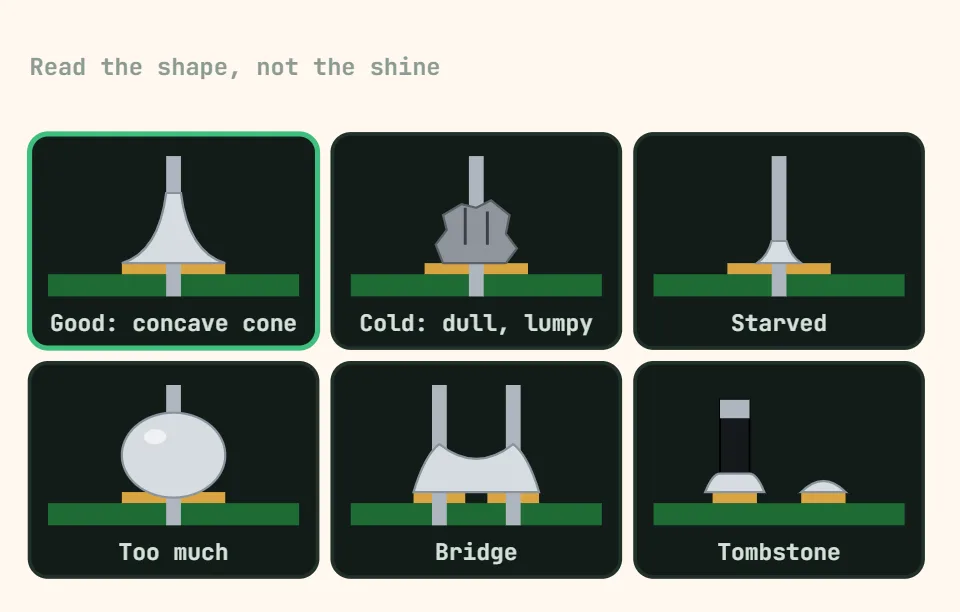
Solder joint quality guide
Most solder-joint problems can be diagnosed by eye before a multimeter ever comes out — the surface texture and shape of a joint reveal whether it reflowed properly, moved while cooling, or never bonded to the metal underneath at all. IPC-A-610, the standard the assembly industry uses for visual inspection, groups these by root cause rather than by how alarming they look, which is the approach this table follows.
A few of these terms overlap in everyday use — "cold joint" and "dry joint" are treated as plain synonyms in a lot of hobbyist and UK writing — so where a real distinction exists it's called out below, and where it doesn't, that's said too. The mechanical test still beats the visual one: a sound joint shouldn't move when the lead is pressed gently, and a hairline crack around the base of a lead is worth reflowing even if it measures fine electrically.
| Defect | What it looks like | Likely cause | Risk / what to do |
|---|---|---|---|
| Cold joint | Dull, grainy or frosted gray instead of a shiny cone; often a lumpy, irregular blob rather than a smooth tapered fillet. | Not enough heat reached the joint — iron too cool, contact too brief, or a nearby ground plane/large pad wicking heat away before the solder could flow. | Weak and often high-resistance or intermittent. Reheat with the correct temperature and fresh flux until it actually flows — piling more solder on top does not fix it. |
| Dry joint | Very similar dull, matte texture to a cold joint, but the solder clearly touched the metal without bonding to it — looks like it is "sitting on" the pad or lead rather than fused into it. | Heat was often adequate; the surface was not — oxidised or contaminated pad/lead, or flux exhausted before the joint finished. Many hobbyist and UK sources just use "dry joint" as a synonym for cold joint — treat the two as overlapping unless the cause is clearly chemical rather than thermal. | Same intermittent/high-resistance risk as a cold joint. Clean the surfaces and reflow with fresh flux rather than just adding solder. |
| Non-wetting | Solder beads up into isolated mounds, leaving bare, unwetted copper or lead visible in patches instead of a continuous coating. | Oxidation, grease, or contamination on the base metal stopped the solder from adhering at all, even where the heat itself was fine. | No real bond where the metal is bare. Clean the surfaces (isopropyl alcohol or light abrasion) and re-solder with fresh flux. |
| Dewetting | Solder that clearly did wet at first has pulled back into a mottled, scalloped surface with uneven thickness and thin spots — different from non-wetting because it covered the metal briefly before retreating. | Contamination trapped under the solder (old flux residue, grease) or an overly aggressive heat profile that broke the wetted film as it cooled. | Thin, uneven coverage is a red flag for board contamination even where the joint still conducts. Worth cleaning the area before further rework. |
| Tombstoning | A small two-terminal SMD part (commonly 0402/0603 resistors and capacitors) standing up on end like a headstone, with one pad completely unsoldered. | One pad reflowed before the other — uneven solder-paste deposit, uneven heating (one pad tied to a large copper pour), or a part nudged off-centre — so surface tension on the first molten pad pulled the light part upright. | Open circuit. Reheat, press the part flat, and add a touch of fresh solder to the lifted pad. |
| Bridging (solder bridge) | A blob, whisker, or thin web of solder joining two pads or leads that should be separate — most visible between fine-pitch IC legs or closely spaced pads. | Too much solder fed in, heat carrying it sideways, or an iron dragged across pins without enough flux to keep the flow controlled. | A short circuit. Clear it with desoldering braid and flux rather than scraping with a blade, which can leave whiskers that reappear later. |
| Disturbed joint | A rough, crystalline or "frosted glass" texture with irregular ridges or a fine crack around the base of the lead. The overall fillet shape is normal — unlike a cold joint's lumpy, underfilled blob, here it's the surface texture that's fractured, not the joint's shape. | The joint was moved (bumped board, flexed lead, a part settling) while the solder was between liquid and solid, fracturing the crystal structure as it finished setting. | Looks intact but is mechanically weak and can fail later under vibration or flex. Reflow it fully and let it cool without being touched. |
| Solder ball | A small stray sphere of solder sitting apart from the joint, loose on the board or wedged under a low-clearance part. | Spatter during reflow or hot-air rework, or paste that separated from the main deposit and never joined the fillet. | Can roll and bridge nearby pads, especially under fine-pitch parts or BGAs. Remove with tweezers or a vacuum rather than assuming it is harmless. |
| Insufficient solder (starved joint) | Solder only partly covers the pad or lead — the metal's outline is still visible through a thin, concave, almost-absent fillet. | Too little solder fed in, a joint pulled away too early, or a wave/reflow process with too thin a paste or dip deposit. | Reduced mechanical strength and less contact area. Add solder and reflow rather than leaving thin coverage that just looks "clean." |
| Excess solder (bulbous joint) | A thick, rounded blob that hides the lead outline and pad shape instead of a smooth, tapered fillet. | Too much solder fed in, often to compensate for a joint that looked incomplete, or simply favouring "more solder is safer." | Usually still conductive, but it can hide a crack or void underneath and may bridge a neighbour if it slumps. Worth reflowing down if it blocks inspection. |
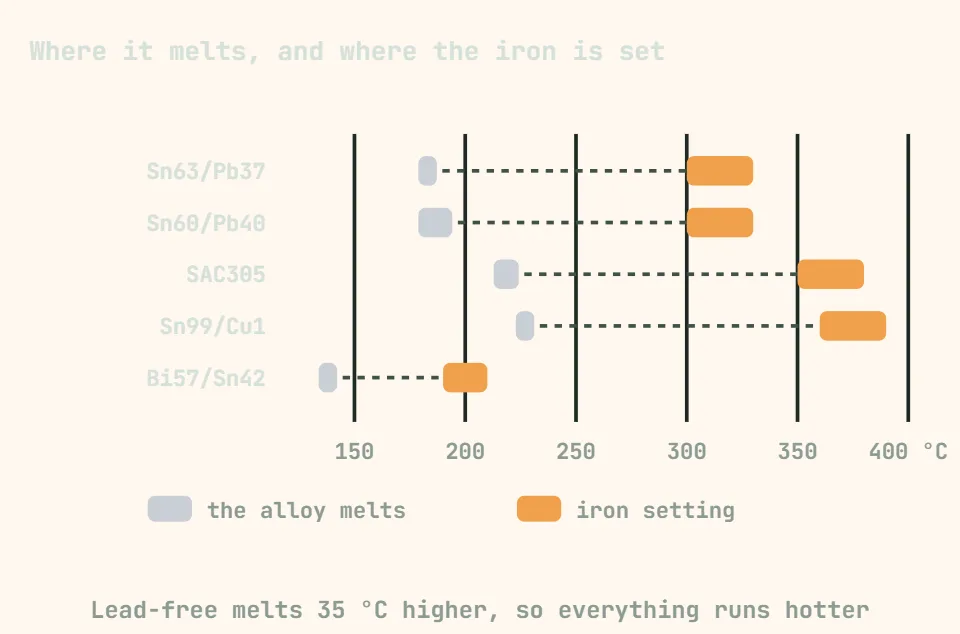
On lead-free (SAC305) solder, a normal good joint is already duller and more satin-textured than a shiny leaded one — don't mistake that baseline dullness for a cold joint; judge lead-free joints by shape (a smooth concave fillet) and mechanical firmness, not shine.