Reference sheet
Connector gender & keying
Male or female, and what stops it going in backwards
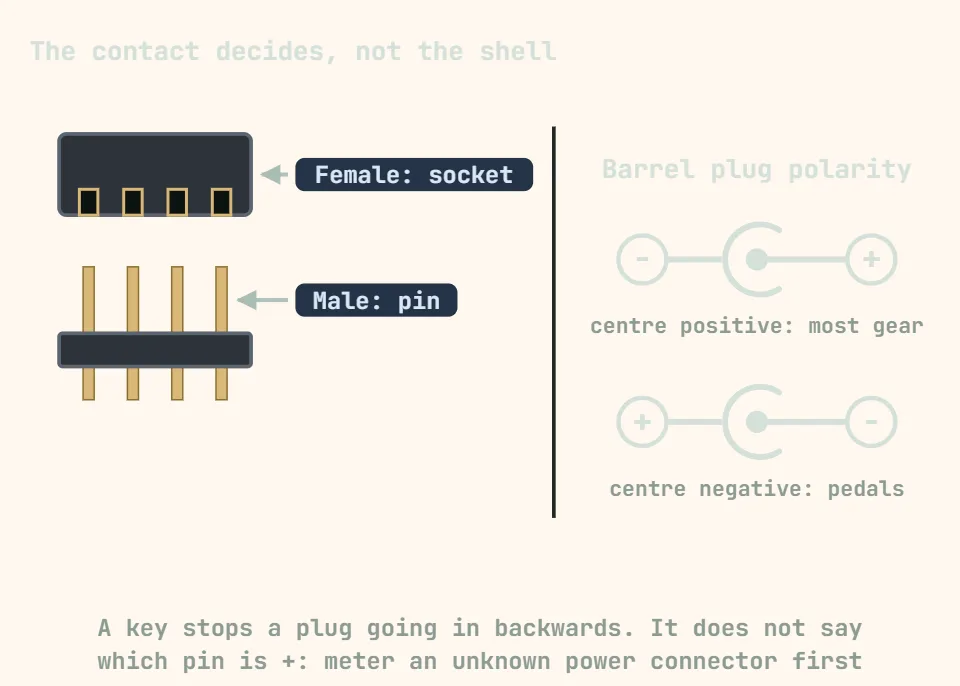
Connector gender & keying reference
Male and female describe the contacts, not the housing size or which end of a cable looks like "the plug." A male contact is a pin or blade that protrudes and inserts into something; a female contact is a socket or receptacle that receives it. That rule holds across almost every connector family below, even where everyday habits — like calling a power-adapter cable end a "jack" — get the term backward.
Keying, also called polarization, is any physical feature — a rib, a notch, an offset pin, an asymmetric shell — that forces a connector to mate only one way, or only with its correct counterpart. It guards against two different mistakes: inserting a connector rotated or upside-down, and plugging two connectors together that were never meant to pair. Not every connector family has it; some, like bare 0.1-inch headers or older Deans/T-connectors, rely entirely on the person assembling it getting it right.
Keying matters most on power connectors because the failure mode is worse than on a signal connector. A reversed signal line usually just fails silently or corrupts data, while a reversed power connector can put a supply backward across a regulator, short V+ to ground, or feed the wrong voltage into an unprotected rail — so a missing key risks a dead board or a fire rather than a bad reading.
| Connector type | Male side (pins/blades) | Female side (sockets) | Keying / anti-reversal feature | Common mix-up |
|---|---|---|---|---|
| Pin header / Dupont jumper wire (2.54 mm / 0.1" pitch) | Header pins on the PCB, or the tip of a Dupont wire where a bare pin protrudes | Dupont wire end with a recessed socket that slides over a pin; a female-female jumper has a socket at both ends | None inherent — a plain straight header has no polarity feature at all; keying only appears if a shrouded/keyed header is used instead of bare pins | Judging gender from the housing's color or size instead of checking the actual tip of the wire |
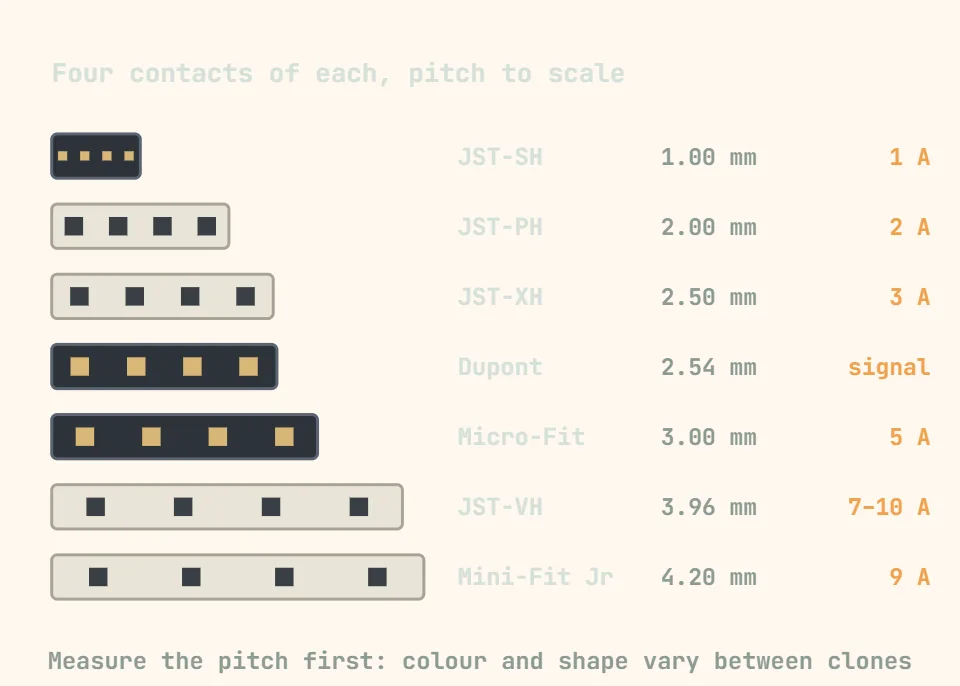
| JST-XH (2.50 mm pitch, PCB header + wire housing) | The PCB-mounted header — the row of pins, even though it looks like the smaller part | The crimped-wire housing with the friction latch; this is also the standard connector for multi-cell LiPo balance leads, with the sockets hidden inside the shroud | Housing has a polarizing rib and a latch, so it only enters one way and can't sit half-inserted unnoticed | Assuming the bulkier plastic housing is "male" because it looks like the plug; also, many parts sold as "JST XH" are pitch-compatible clones, not genuine JST Co. connectors |
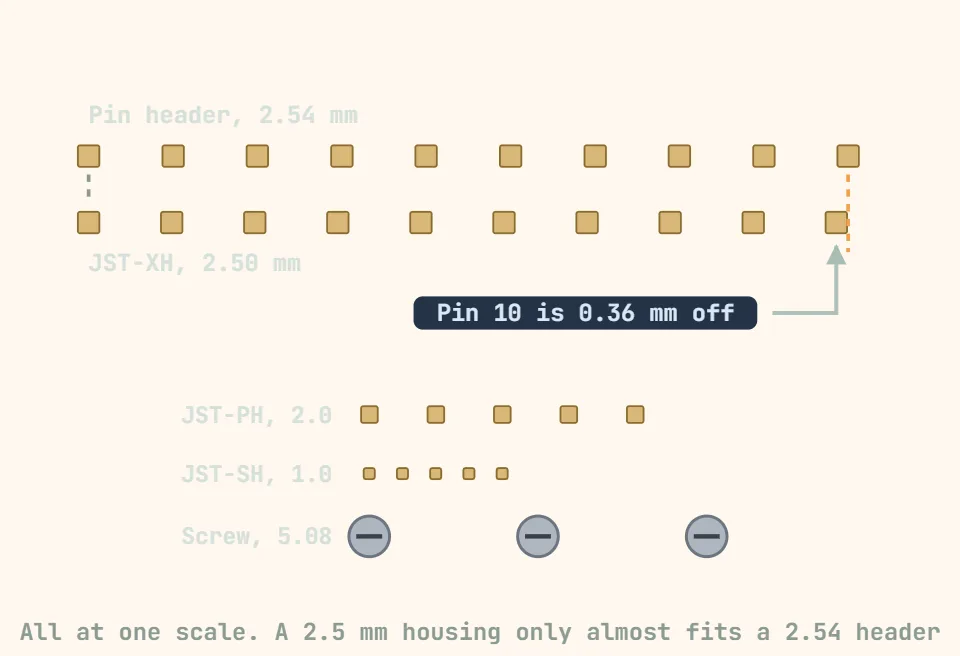
| JST-PH (2.00 mm pitch) | PCB header pins | Wire housing; the common 2-pin main power connector on small single-cell (1S) LiPo batteries and micro drones — not the balance-lead connector, despite looking similar to XH | Same polarizing-rib-and-latch approach as XH, just scaled down | PH and XH look similar at a glance and get swapped in conversation — XH is the multi-cell balance-lead standard, PH is the 1S main-power standard — and forcing a PH housing onto an XH header (or the reverse) can look like it almost fits and damages the contacts |
| 2-pin battery/LED-strip connector, often sold as "JST" SM/SYP (2.50 mm) | Plug half, usually molded onto the battery pack or LED strip lead | Socket half, on the mating lead | Shell is polarized so it can't be plugged in reversed | The connector can't be inserted backward, yet packs from different vendors can still swap which pin is + and which is − internally — keying guarantees orientation, not correct polarity |
| Molex KK / 2510-series header (2.54 mm) | Shrouded PCB header — pins inside a keyed plastic shell | Crimp housing with a locking tang | Shroud has a polarizing rib matched to a notch in the housing | Confusing it with a plain unshrouded 0.1" header — the shroud is what actually blocks a reversed or offset-by-one-pin mating |
| DC barrel / coaxial power jack | The plug on the power-supply cable (despite being casually called a "power jack") | The barrel receptacle mounted on the PCB or enclosure | Only the barrel and center-pin diameters (for example 5.5x2.1 mm vs 5.5x2.5 mm) — nothing keys against reversed polarity | The single biggest mix-up on this list: center-pin polarity (center-positive vs center-negative) is not fixed by the connector's shape, so a same-size plug from a different supply can be wired backward and damage the board — check the polarity glyph on the adapter or the board's silkscreen, don't assume |
| XT30 / XT60 (Amass bullet-style) | Bullet-pin half, conventionally on the battery pack's output lead | Socket half, conventionally on the ESC or power-distribution board input | Housing is asymmetric (offset pin position), so it only mates with the opposite gender in one orientation | Which side is male vs female isn't standardized across every supplier — a correctly keyed connector will still simply refuse to mate with the wrong accessory instead of being wired wrong |
| USB Type-A / Type-B / Micro-B | Plug on the cable | Receptacle on the device or PCB | Shell shape only allows correct-side-up insertion; Type-A's looser tolerances mean it can still be forced upside-down with enough force, damaging the port | Assuming USB-C works the same way |
| USB Type-C | Plug on the cable | Receptacle on the device or PCB | Deliberately symmetric and reversible by design — both plug orientations are electrically valid, so there is no wrong way to key against | Calling Type-C "keyed" in the traditional sense — it's the one modern connector purpose-built to not need that |
| Pluggable screw-terminal block (commonly 5.08 mm pitch) | Pin header soldered to the PCB | Plug body with screw clamps that field wiring lands on | Varies by part — many include a small guide tab or offset mounting ear; low-cost clones sometimes omit it entirely | Trusting the connector to prevent a reversed multi-pin plug when the specific model actually has no keying feature |
| Shrouded IDC / ribbon header (e.g. 2x5 pin) | Shrouded pin header on the PCB | Ribbon cable's IDC socket | A notch on one side of the header shroud with a matching bump on the socket aligns pin 1 automatically | On unshrouded bare-pin headers, common on older or budget boards, there is no mechanical key at all — only the ribbon's red-stripe wire marks pin 1, so it can be seated backward or shifted a row with no resistance |
| Deans / T-connector (RC battery packs) | Half with two flat exposed blades | Half with recessed blade sockets | Historically almost none — the classic T shape lets male and female halves be forced together rotated 180 degrees, swapping + and − into a dead short; later clones sometimes add a small keying nub to fix this | Assuming the T shape itself prevents reversal the way XT60's offset pin does — the original design doesn't, without an added key feature |
Keying only guarantees a connector can't be forced in backward or mated to the wrong counterpart — it does not guarantee the pinout inside is correct. Two connectors that are physically identical and correctly keyed can still have swapped polarity between manufacturers, so ring out any new or unlabeled power connector with a multimeter before applying power, especially on barrel jacks, 2-pin battery leads, and Deans/T-connectors.