Reference sheet
Connector families
JST XH / PH / SH, Molex, Dupont: pitch, current, where found
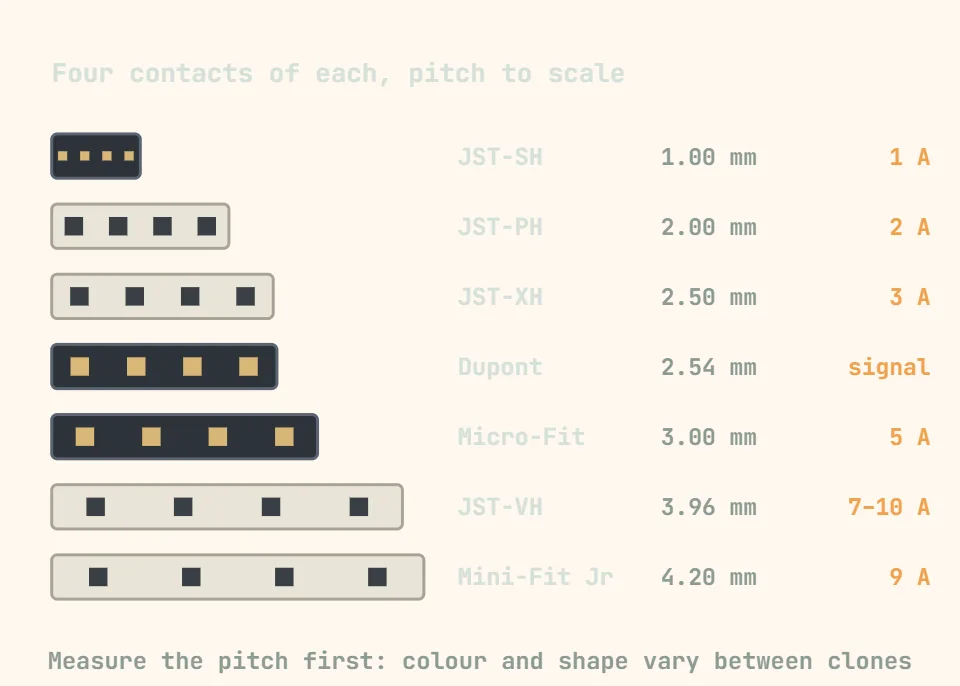
JST / Molex / Dupont connector family comparison
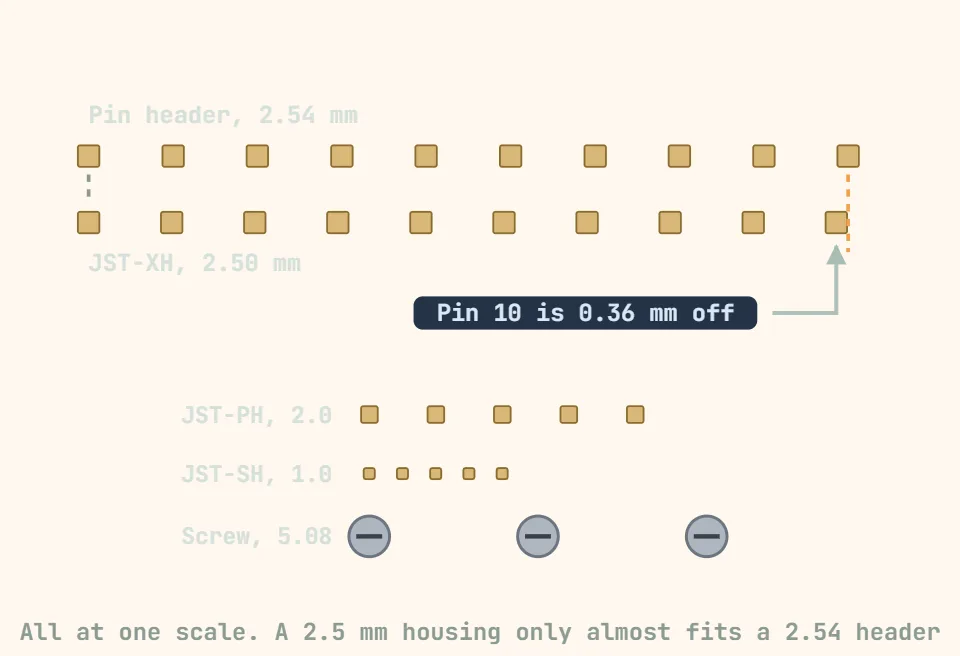
Most of the small white or black multi-pin connectors inside hobby electronics look alike at a glance, but they come from a handful of distinct families that are not interchangeable — different pitch, different latch mechanism, and sometimes incompatible pin shapes even at the same pitch. Measuring the pitch (center-to-center spacing between adjacent pins, with calipers if you have them) and looking at the latch style is the fastest way to narrow down which family you're holding.
The table below covers the connectors you'll actually run into on battery packs, sensor boards, LED strips, and internal PC wiring, ordered roughly from smallest to largest pitch. Current ratings are per contact from manufacturer datasheets under ideal conditions (correct wire gauge, single circuit, moderate ambient temperature) — real-world safe current is often lower, especially with cheap clone connectors or thin wire.
| Connector family | Pitch | Typical current rating | Common uses | How to identify it |
|---|---|---|---|---|
| JST-XH | 2.50 mm | ~3 A per contact (JST's rated maximum at 250V AC/DC with AWG22-24 wire) — treat this as a datasheet ceiling, not a continuous-duty headroom figure | LiPo/Li-ion balance leads on 2S+ packs, general 2-20 pin wire-to-board wiring, RC hobby electronics | White nylon housing with a small locking tab; the connector you see on nearly every multi-cell battery balance lead |
| JST-PH | 2.00 mm | ~2 A per contact | Single-cell LiPo battery connectors on small boards (Adafruit, SparkFun and similar), compact sensor/module headers | Visibly smaller than XH; usually the 2-pin white plug coming off a small LiPo pouch cell |
| JST-SH | 1.00 mm | ~1 A per contact | Very compact wire-to-board links in cameras and small sensors; the base connector behind Qwiic/STEMMA QT 4-pin I2C cables | Tiny, roughly a third the pitch of a standard 0.1" header; side-latch housing, often black on Qwiic/STEMMA QT leads |
| JST-VH | 3.96 mm | ~7-10 A per contact (varies by source and temperature derating) | Main power leads on larger battery packs, motor wiring, power distribution where XH/PH is too small for the current | Clearly larger than XH/PH; pin spacing matches 0.156" — used wherever real current, not just balance or signal, needs to pass |
| JST-SM (and the many unbranded clones sold under this name) | 2.50 mm | ~3 A per contact on 2-12 pin versions, ~2 A on the 18-pin version | De facto standard for addressable LED strip power/data connectors (WS2812, SK6812), also seen on RC battery wiring | Similar size to XH but a different arm-lock latch shape; near-universal on LED strip pigtails, and frequently an inexact clone rather than genuine JST |
| Dupont / 0.1" jumper header | 2.54 mm | Often sold as ~3 A, but real socket-side crimp quality varies a lot — treat as signal-duty unless you've verified the crimp | Breadboard jumper wires, the standard pin header on almost every Arduino/ESP32/dev board, general prototyping | The connector everyone already owns: bare 0.1" pins in a single-row plastic shell held by friction only, no positive lock, so it pulls apart easily |
| Molex KK (254/396 series) | 2.54 mm (KK254) or 3.96 mm (KK396) — these are two distinct product lines sharing the KK name, not one part at two pitches | KK254 (2.54mm): up to ~4 A per contact. KK396 (3.96mm): up to ~13 A per contact standard, commonly derated to ~7 A with 18AWG wire — notably higher than KK254, so don't assume the same current headroom just because it says "KK" | Internal PC wiring (case fans typically use KK254, older drive/power headers often KK396), hobby power-distribution boards, LED strip power | Black nylon housing with a small flexible latch tab you press to unplug — the main visible difference from a Dupont housing at the same 2.54 mm pitch; check the pitch to tell KK254 from the chunkier KK396 |
| Molex Micro-Fit 3.0 | 3.00 mm | ~5 A per circuit standard (higher-current terminal options reach ~8.5 A with 18AWG wire) | Higher-power hobby and automotive wiring, 3D-printer mainboard power inputs, motor-controller power leads | Boxier and more robust than KK, with a stronger positive latch; sits between KK/Dupont and Mini-Fit Jr in both size and current capacity |
| Molex Mini-Fit Jr | 4.20 mm | ~9 A per contact standard (up to ~13 A with a heavy-duty terminal) | PC power-supply connectors (ATX 24-pin, GPU 6/8-pin), higher-current motor and battery leads in robotics | The largest and most solid-feeling connector of this group, with square pin contacts and a thick keyed housing — if it looks like it belongs inside a desktop PC, it probably is this |
Pitch is the most reliable first identifier since colors and exact housing shape vary between manufacturers and clones — measure center-to-center spacing rather than guessing by eye. Also be aware that a lot of "JST" connectors sold online (especially XH and SM) are unbranded clones that only approximate genuine JST tolerances, so a clone plug can feel loose or occasionally not mate at all with a genuine part from the same nominal family. And don't assume two connectors with the same family name share a current rating — Molex's own KK254 and KK396 differ by more than 3x despite both being called "KK."