Interactive simulation
Transformer simulation
Turns ratio in action — step the voltage up or down.
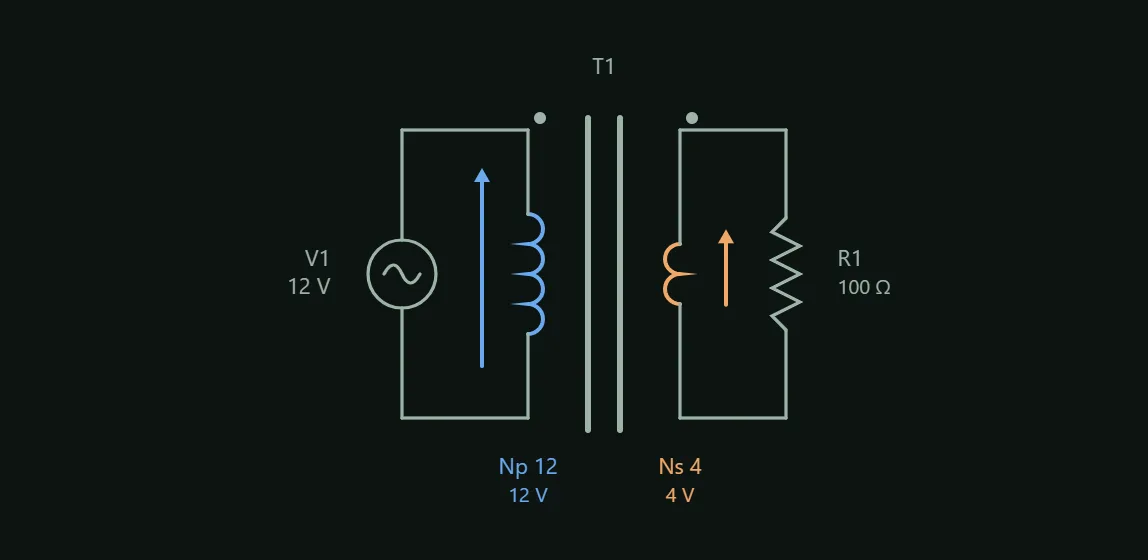
The secondary stays exactly in phase with the primary — the dots on the sketch mark the ends that go positive together — while voltage scales by Ns/Np and current scales the other way, by Np/Ns, so power in equals power out (minus real-world losses this ideal model does not have). Push Ns above Np to watch it step up. Push the Load R slider down and watch Is (and, through the turns ratio, Ip) climb along with it — the half of this circuit a voltage-only reading can never show. Core flux is proportional to Vin / (turns × frequency) — a real core saturates past some fixed flux density, which is why a transformer built for 60 Hz needs a bigger core (or runs hotter with the one it has) fed the same voltage at 50 Hz.
What you can change
- Vin peak
- Load R