Reference sheet
Serial protocols
UART, I2C, SPI, CAN and friends: wires, speed, reach
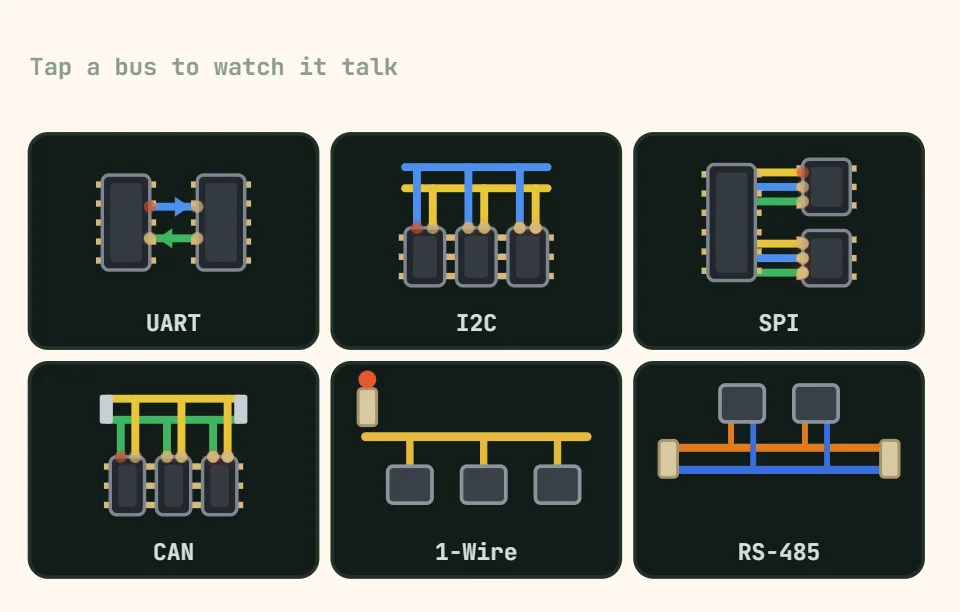
Serial protocols
Which bus for which job: wire count, realistic speed, how many devices share it, and how far it reaches before the signal gives up. Full pin-by-pin details for each live in the Pinouts tab.
| Bus | Wires | Speed | Devices | Reach | Notes |
|---|---|---|---|---|---|
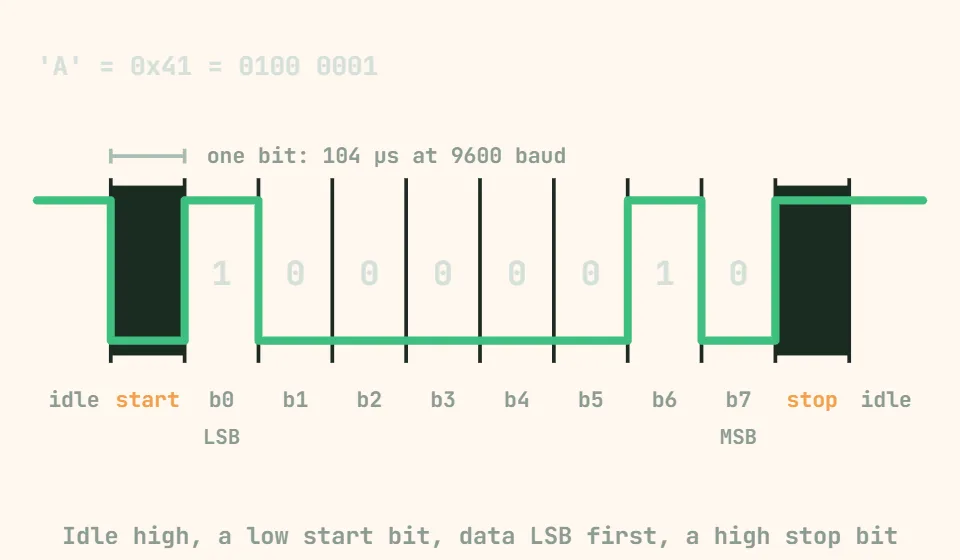
| UART | 2 (TX/RX) | up to ~1 Mbaud typical | point-to-point | ~15 m at low baud | No clock — both ends must agree on the baud rate |
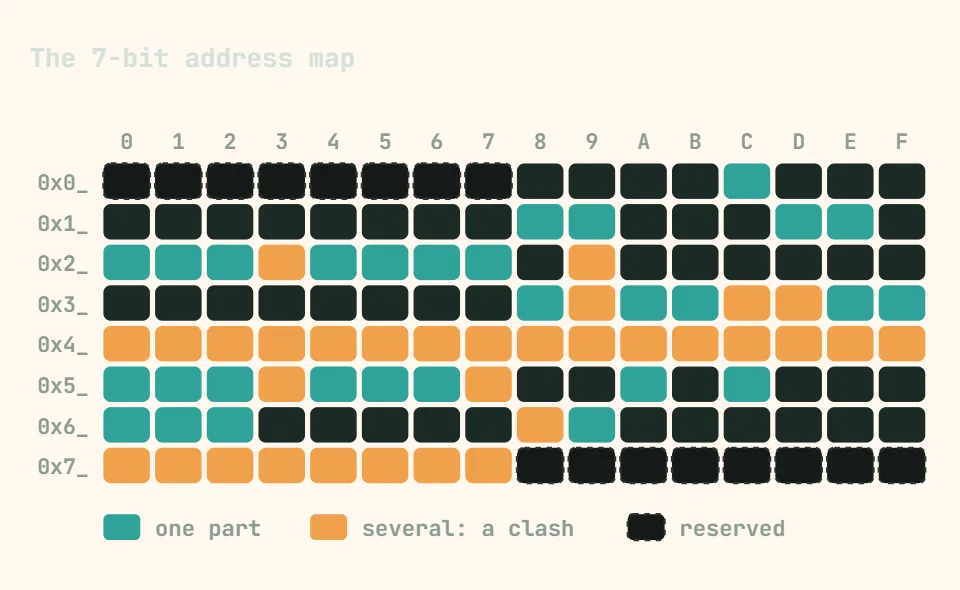
| I2C | 2 (SDA/SCL) | 100k / 400k / 1M | ~112 devices (addresses) | < 1 m | Open-drain: needs pull-ups (4.7k typical); addresses clash — see |
| SPI | 4 (COPI/CIPO/SCK/CS) | 10–80 MHz | one CS line per device | < 0.5 m | Fastest simple bus; displays and SD cards live here |
| 1-Wire | 1 (DQ) | ~16 kbps | many (64-bit IDs) | ~30 m | DS18B20 territory; single 4.7k pull-up, can even steal power parasitically |
| CAN | 2 differential (H/L) | 125k–1 Mbps | ~110 nodes | ~40 m at 1 Mbps | Cars and industry: survives noise, needs 120Ω terminators at both ends |
| RS-485 | 2 differential (A/B) | up to 10 Mbps | 32–256 nodes | ~1200 m | The long-haul UART: half-duplex, terminate both ends |