Reference sheet
Radio bands
ISM bands, power limits and what lives on each
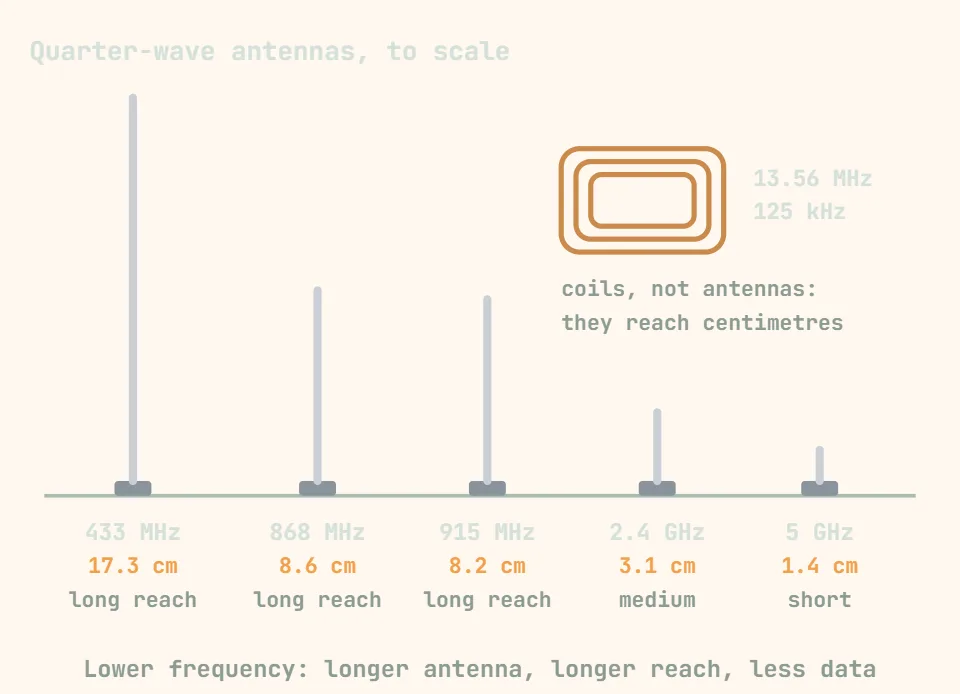
Radio bands
Which licence-free band a module lives in, and what that costs you. Lower frequency travels further and through more walls but carries less data; 2.4 GHz is everywhere and therefore noisy. Legal limits are regional — the same module is sold as 868 or 915 MHz for exactly this reason.
| Band | Region | Typical power limit | Range class | Used by |
|---|---|---|---|---|
| 433 MHz ISM | Europe / Asia | 10 mW ERP typical | Long | Cheap ASK/OOK remotes, LoRa, weather stations |
| 868 MHz ISM | Europe | 25 mW ERP, duty-cycle limited | Long | LoRaWAN EU, Z-Wave EU, smart meters |
| 915 MHz ISM | North America | ~1 W with frequency hopping | Long | LoRaWAN US, Zigbee sub-GHz |
| 2.4 GHz ISM | Worldwide | 100 mW EIRP typical | Medium | Wi-Fi, BLE, Zigbee, NRF24L01 — crowded |
| 5 GHz U-NII | Worldwide (channel rules vary) | 200 mW – 1 W | Short | Wi-Fi 5/6, less crowded, poorer through walls |
| 13.56 MHz | Worldwide | Near-field only | Centimetres | NFC / RFID (RC522) |
| 125 kHz | Worldwide | Near-field only | Centimetres | Old proximity cards (EM4100) |
Antenna length matters as much as power: a quarter-wave whip is ~17 cm at 433 MHz, ~8.6 cm at 868 MHz and ~3.1 cm at 2.4 GHz.