Reference sheet
Display types
LCD, OLED, TFT, e-paper: speed, power, sunlight
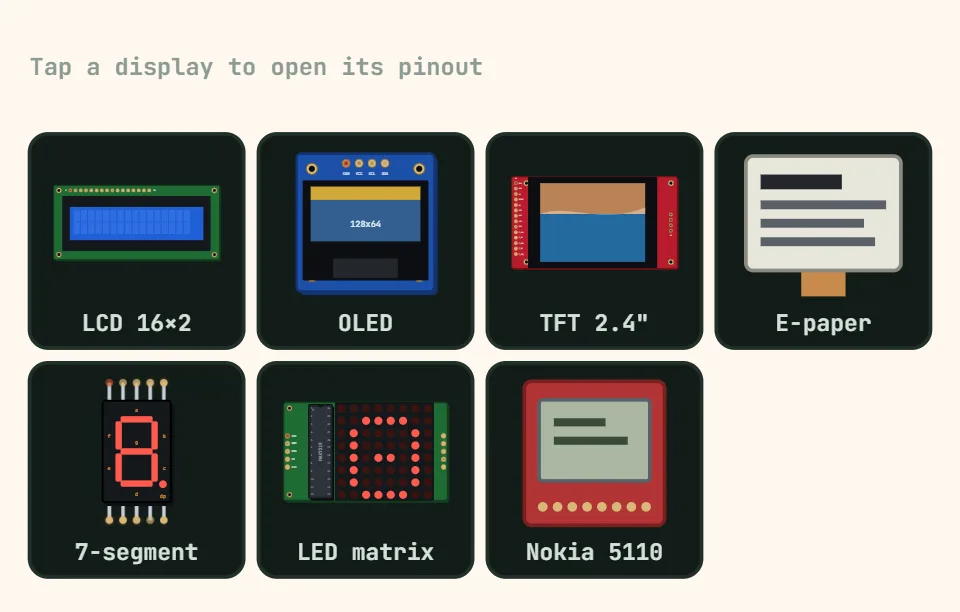
Display types
Two things decide this and neither is resolution. First, RAM: a framebuffer is 1 KB for the OLED but 150 KB for the TFT, which is why small MCUs draw straight to the panel. Second, emissive or reflective — OLED and LED make their own light and lose to the sun, while e-paper and plain LCD reflect it and get easier to read the brighter it gets. Current figures are with the backlight on, which is nearly all of it.
| Display | Size | Interface | Refresh | Current | Sunlight | Watch out |
|---|---|---|---|---|---|---|
| Character LCD (HD44780) | 16×2 or 20×4 chars | 4/8-bit parallel, or I2C backpack | Instant, no frame to push | 1 mA + 15–25 mA backlight | Fair | No contrast pot on V0 and it looks dead. Text only |
| OLED 0.96" (SSD1306 / SH1106) | 128×64 px | I2C 400 kHz–1 MHz, or SPI | ~20 fps full frame on I2C | 10–20 mA lit, under 1 mA blank | Poor | Static pixels burn in, and the 1 KB buffer eats AVR RAM |
| TFT 2.4" (ILI9341 / ST7789) | 240×320 px, 16-bit colour | SPI, 27–40 MHz typical | 15–30 fps full redraw | 50–100 mA, mostly backlight | Poor | 150 KB framebuffer, so small MCUs draw direct. Touch is a separate chip |
| E-paper 2.9" (SSD1680) | 296×128 px, mono or 3-colour | SPI | 2–4 s full, 0.3–1 s partial | ~10 mA refreshing, ~0 holding | Excellent | Cannot animate, and partial refreshes ghost until a full one clears them |
| 7-segment LED | 1–8 digits, 0.36"–0.56" | GPIO multiplex, or MAX7219 / TM1637 | Multiplex above ~100 Hz | 10–20 mA per lit segment | Good | Digits only. Common-anode and common-cathode parts look identical |
| LED matrix 8×8 (MAX7219) | 8×8 px, chainable | SPI, up to 10 MHz | ~800 Hz internal scan | 150–300 mA per module | Good | Give the modules their own supply, never the MCU 5 V pin |
| Graphic LCD (Nokia 5110, PCD8544) | 84×48 px | SPI, up to 4 MHz | Fast enough to animate | 250 µA, +20–80 mA backlight | Good | 3.3 V only, and the spring-contact frame fades in patches if knocked |