Reference sheet
Dev-board comparison
Every board in the Pinouts tab, spec for spec
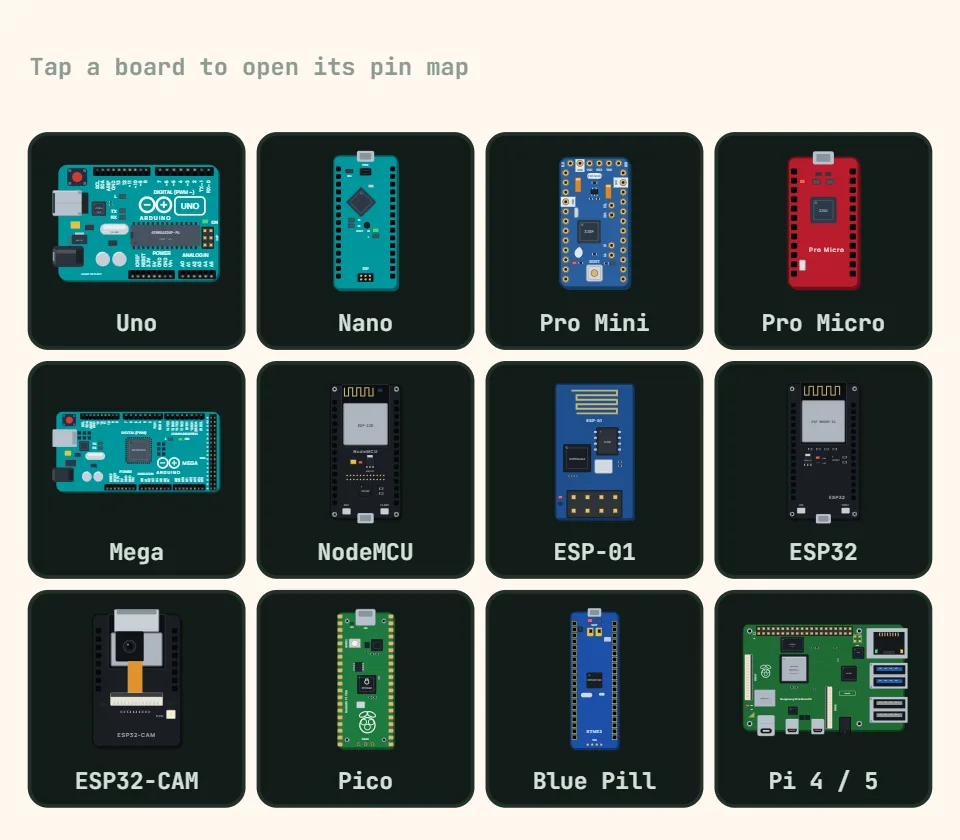
Dev-board comparison
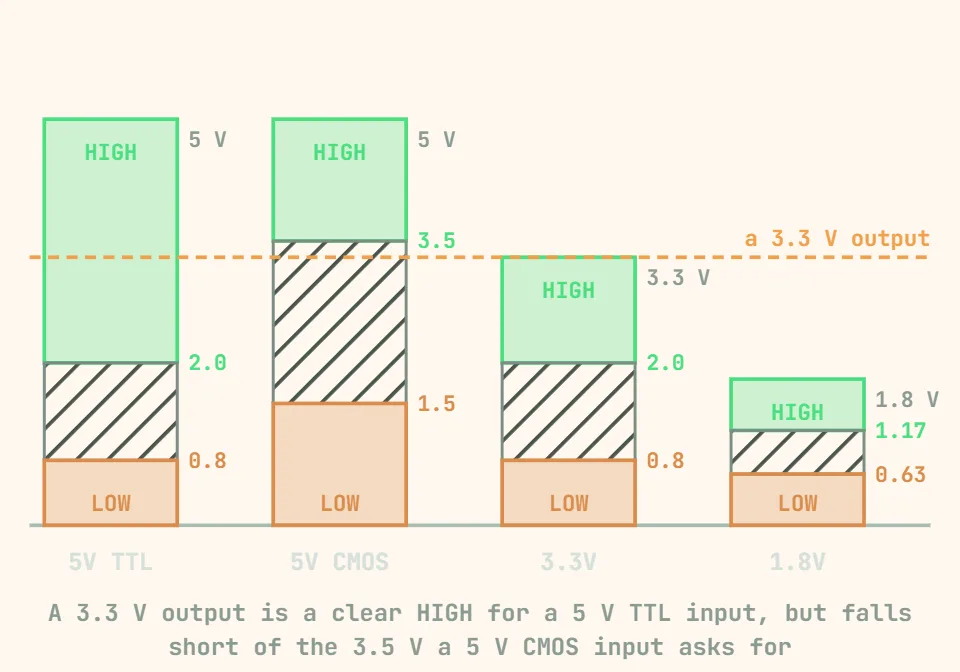
The boards from the Pinouts tab side by side. GPIO counts are usable pins, not package pins; flash on the ESP/Pico boards is external SPI flash. Logic level is the number that breaks things — a 5V Uno output into a 3.3V ESP32 input needs a divider.
| Board | MCU | Clock | Flash | RAM | GPIO (dig/PWM) | ADC | Logic | Radio | Why pick it |
|---|---|---|---|---|---|---|---|---|---|
| Arduino Uno R3 | ATmega328P | 16 MHz | 32 KB | 2 KB | 14 / 6 | 10-bit ×6 | 5V | — | The classroom standard; every shield fits it |
| Arduino Nano | ATmega328P | 16 MHz | 32 KB | 2 KB | 14 / 6 | 10-bit ×8 | 5V | — | Uno guts on a breadboard-friendly stick |
| Arduino Pro Mini | ATmega328P | 16 MHz (8 MHz on the 3.3V variant) | 32 KB | 2 KB | 14 / 6 | 10-bit ×8 | 5V (3.3V variant) | — | No USB, no regulator to spare — the bare-minimum 328P for a battery-powered build |
| SparkFun Pro Micro | ATmega32U4 | 16 MHz (8 MHz on the 3.3V variant) | 32 KB | 2.5 KB | 18 / 5 | 10-bit ×9 | 5V (3.3V variant) | — | Native USB — no separate USB-serial chip to reset when a flash stalls |
| Arduino Mega 2560 | ATmega2560 | 16 MHz | 256 KB | 8 KB | 54 / 15 | 10-bit ×16 | 5V | — | 4 UARTs and pins for days — big builds |
| ESP8266 NodeMCU | ESP8266 | 80–160 MHz | 4 MB | ~80 KB | ~9 usable | 10-bit ×1 | 3.3V | Wi-Fi | Cheapest way onto the network |
| ESP-01 | ESP8266 | 80–160 MHz | 1 MB | ~80 KB | 2 usable | — (not broken out) | 3.3V | Wi-Fi | The whole radio on an 8-pin breakout, for a project with pins to spare |
| ESP32 DevKit V1 | ESP32 (2 cores) | 240 MHz | 4 MB | 520 KB | ~25 | 12-bit ×15 | 3.3V | Wi-Fi + BT | The default choice for connected projects |
| ESP32-CAM | ESP32 (2 cores) | 240 MHz | 4 MB + 4 MB PSRAM | 520 KB | ~6 free (rest claimed by camera/PSRAM) | 12-bit (ADC2 only — conflicts with Wi-Fi) | 3.3V | Wi-Fi + BT | OV2640 camera and Wi-Fi in one $6 board — no separate frame-buffer chip |
| Raspberry Pi Pico | RP2040 (2×M0+) | 133 MHz | 2 MB | 264 KB | 26 | 12-bit ×3 | 3.3V | — | PIO state machines drive weird protocols in hardware |
| Raspberry Pi Pico W | RP2040 + CYW43439 | 133 MHz | 2 MB | 264 KB | 26 | 12-bit ×3 | 3.3V | Wi-Fi | Same RP2040 as the Pico, plus Wi-Fi on the same 26 header pins |
| STM32 Blue Pill | STM32F103C8T6 | 72 MHz | 64 KB | 20 KB | ~30 | 12-bit ×10 | 3.3V (some 5V-tolerant pins) | — | Real ARM debugging over SWD for pocket change |
| Raspberry Pi 4/5 | BCM SoC (4×A72+) | 1.5–2.4 GHz | SD card | 1–8 GB | 26 usable | — (no ADC) | 3.3V | Wi-Fi + BT + Ethernet | A Linux computer, not an MCU: no analog in, not hard-real-time |