Reference sheet
Logic levels
VIH / VIL per family — what damages what
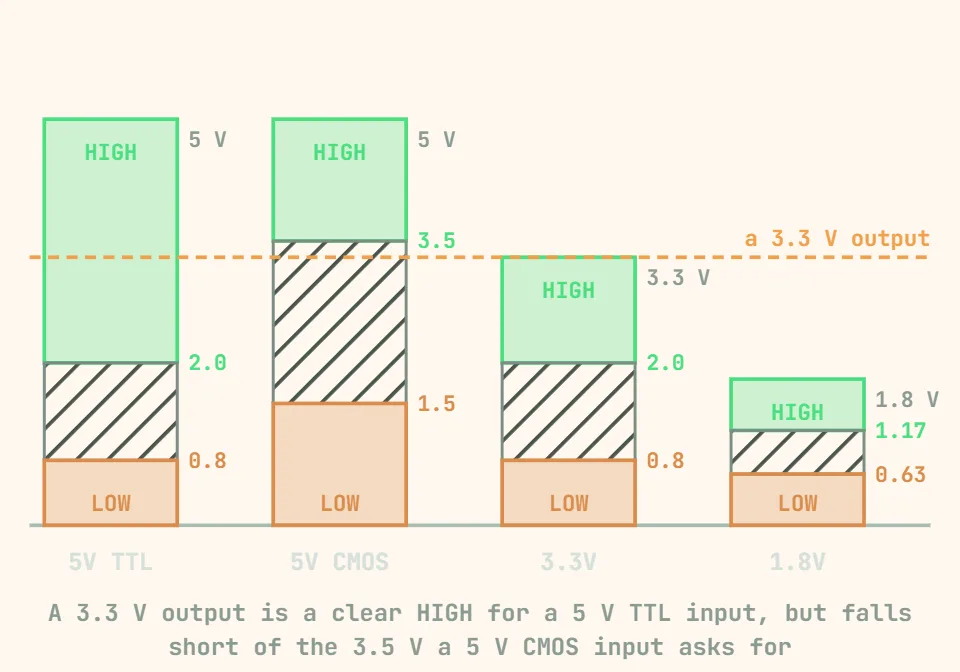
Logic voltage levels
VIH min = the minimum voltage still read as a logic HIGH. VIL max = the maximum voltage still read as a logic LOW. Typical figures — always confirm against the exact part's datasheet. Mixing families without checking these (e.g. driving a 3.3V-only input straight from 5V logic) is one of the most common ways to damage a board.
| Family | Supply | VIH min | VIL max | Notes |
|---|---|---|---|---|
| 5V TTL (74LS-series) | 5V | 2.0 V | 0.8 V | Classic 5V logic — mostly legacy now |
| 5V CMOS (4000/74HC-series) | 5V | 3.5 V | 1.5 V | Rail-to-rail output, thresholds scale with VCC (~70%/30%) |
| 3.3V LVCMOS/LVTTL | 3.3V | 2.0 V | 0.8 V | Most modern MCUs — STM32, most Arduino 3.3V boards |
| 1.8V logic | 1.8V | 1.17 V | 0.63 V | Common on low-power MCUs and memory chips |
| Arduino Uno (ATmega328P) | 5V | 3.0 V | 1.5 V | Runs at 5V — not directly safe to drive from a 3.3V-only input in reverse |
| ESP32 / ESP8266 GPIO | 3.3V | 2.0 V | 0.8 V | NOT 5V tolerant on most pins — use a level shifter or divider from 5V logic |