Pinout
Screw terminal block (2/3/5.08mm pitch) pinout
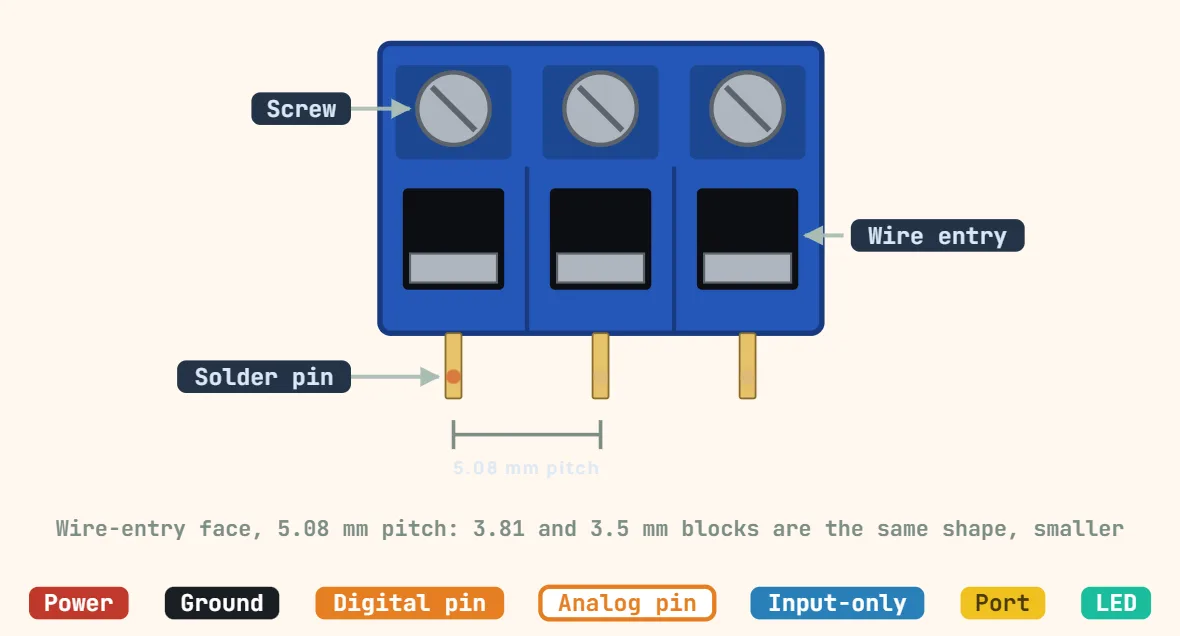
Pins
- 2.54mm (0.1") pitch — the smallest common screw-terminal spacing; typically rated around 6A (UL) / 8A (IEC) at 130–150V and accepts about 18–26 AWG wire, so it's used for low-to-moderate-current signal and small-load wiring rather than mains-level power
- 3.5mm / 3.81mm pitch — the size on most Arduino shields, stepper/motor-driver breakouts (A4988, DRV8825, TB6600) and small power modules; typically rated 8–10A at up to 250–300V and accepts about 16–28 AWG wire (0.08–1.5mm²)
- 5.0mm / 5.08mm (0.2") pitch — the largest and most current-capable of the three; typically rated 10–15A at up to 300–320V and accepts about 12–24 AWG wire (0.2–2.5mm²) — the usual pick for PSU output, relay, and motor power wiring
- Screw — a captive slotted or Phillips screw drives a metal clamp plate straight down onto the bare conductor; it never needs to come fully out, only backed off far enough for the stripped wire to slide under the plate
- Wire entry — the chamfered hole on the wire-facing side, sized to that pitch's rated gauge range; strip length is rarely printed on the part itself but is commonly around 5–7mm
- Pluggable plug + header — many 3.5mm and 5.08mm blocks split into a header soldered to the board and a matching plug that unplugs for off-board wiring; a non-pluggable ("fixed") block instead has the wire land directly in a housing that is itself soldered down
Specifications
| Common pitches | 2.54, 3.5, 3.81, 5.0, 5.08 mm |
|---|---|
| 2.54 mm (typical) | 6–8 A, 130–150 V, 18–26 AWG |
| 3.5 / 3.81 mm (typical) | 8–10 A, 250–300 V, 16–28 AWG |
| 5.0 / 5.08 mm (typical) | 10–15 A, 300–320 V, 12–24 AWG |
| Strip length | ≈ 5–7 mm |
| Screw torque | ≈ 0.2–0.5 N·m |
| Variants | Fixed or pluggable (plug + header) |
| Note | Ratings are new, free-air figures; derate |
Notes
- 3.5mm and 3.81mm pitch blocks look almost identical but are not interchangeable — a block cut for one pitch will not seat cleanly on a PCB footprint made for the other, a common mismatch on cheap import boards whose silkscreen doesn't state which one was used.
- The screw only clamps the bare conductor; it gives no strain relief to the insulation, so a cable that flexes or gets tugged right at the block will eventually work a strand loose or break it even with the screw fully torqued — tie or clip the cable near the block on anything exposed to movement or vibration.
- Overtightening strips the small screw threads or cracks the block's plastic housing, while undertightening leaves a connection that heats and arcs under load; manufacturer datasheets commonly recommend on the order of 0.2–0.5 N·m for these small block sizes, even though that figure is rarely printed on the part itself, so snug-plus-a-firm-tug is the practical field check.
- The printed current/voltage rating is a new-connector, free-air number — terminals ganged side by side, heat from nearby components, and gradual clamp relaxation over time all lower the safe continuous current, so treat the datasheet figure as a ceiling to stay well under rather than a target to run at continuously.