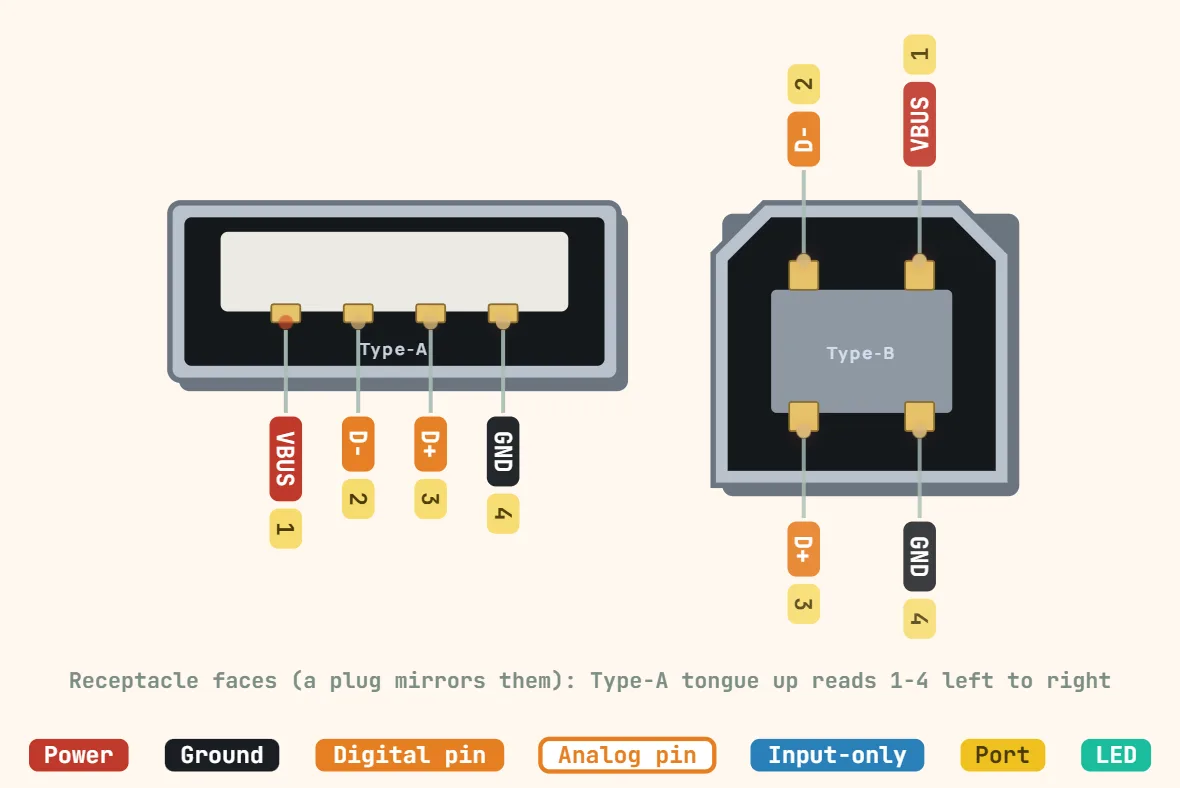
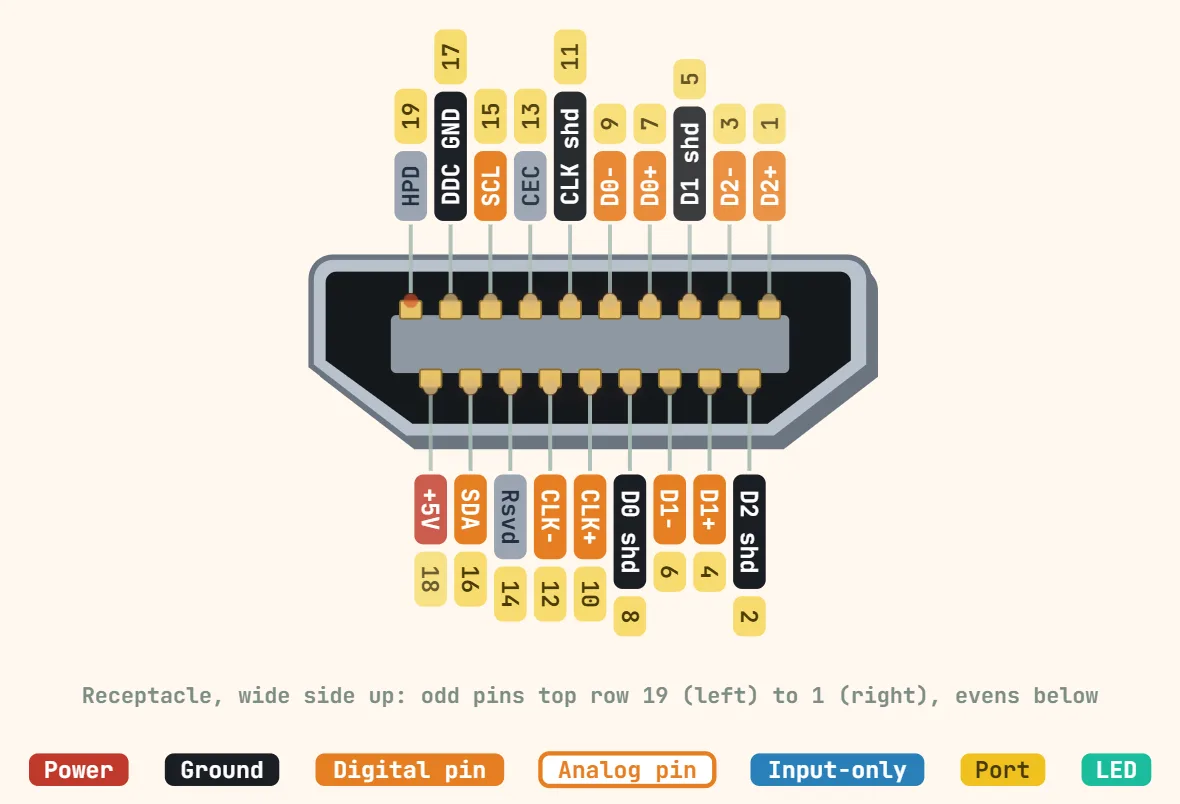
Pinout
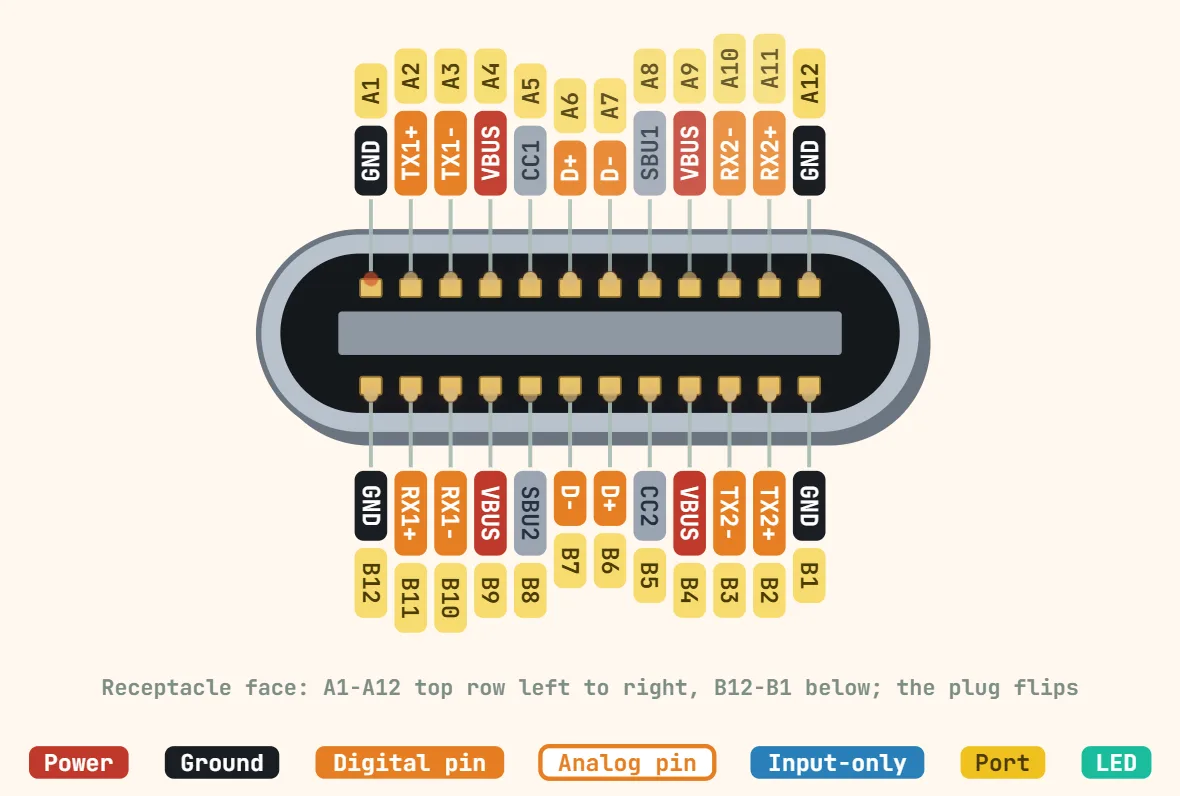
USB-C (receptacle, key pins) pinout
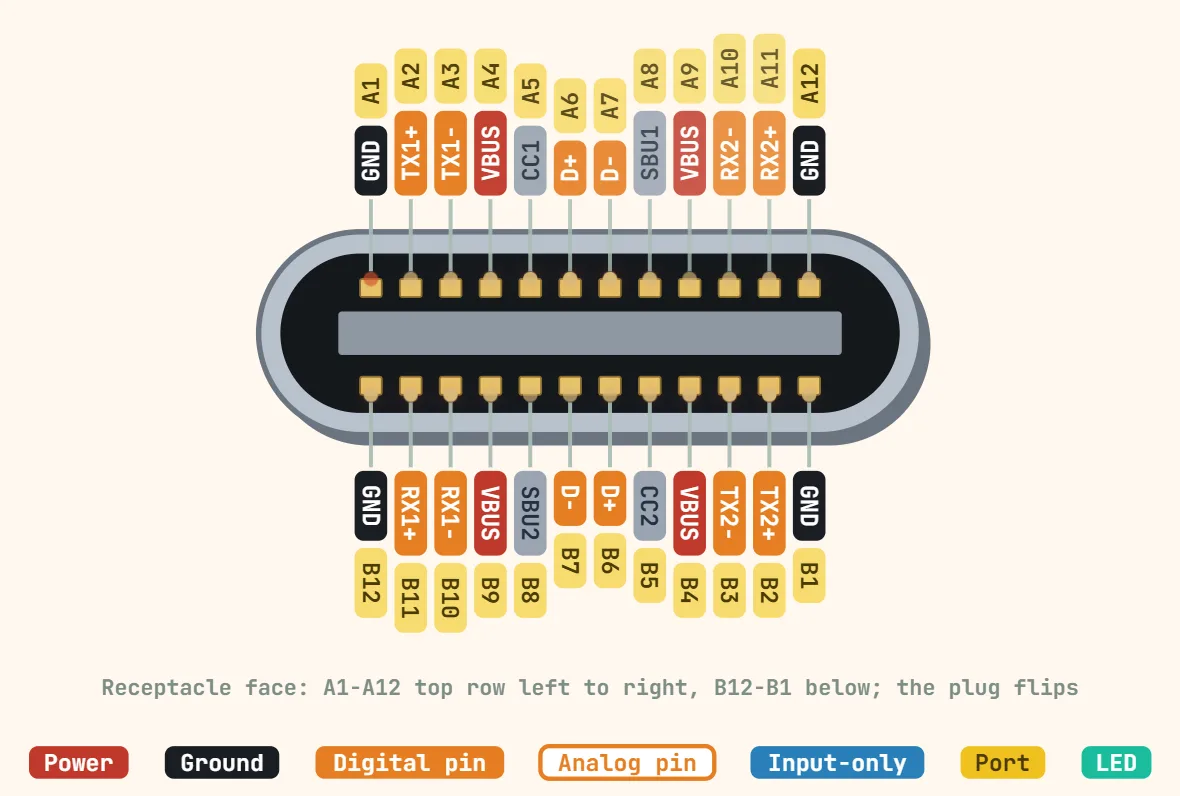
Pins
- A4/B4, A9/B9: VBUS (+5V, reversible)
- A1/B1, A12/B12: GND
- A6/A7: USB 2.0 D+/D− (also mirrored on B for flip support)
- A5/B5: CC1/CC2 — configuration channel (orientation + power role detection)
- A8/B8: SBU1/SBU2 — sideband use (e.g. DisplayPort Alt Mode)
Specifications
| Contacts | 24 (receptacle) |
|---|---|
| Contact pitch | 0.5 mm |
| Plug size | 8.25 × 2.4 mm, reversible |
| VBUS default | 5 V |
| Current | Default USB, 1.5 A or 3 A (Type-C Current); up to 5 A with PD and a 5 A cable |
| Source pull-up (Rp to 5 V) | 56 kΩ default, 22 kΩ 1.5 A, 10 kΩ 3 A |
| Sink pull-down (Rd) | 5.1 kΩ on each CC pin |
| Data rate | 480 Mbit/s (USB 2.0), 5–20 Gbit/s (USB 3.2), 40–80 Gbit/s (USB4) |
| Mating cycles | 10,000 |
Notes
- A device (sink) must pull its live CC line down to GND through 5.1 kΩ (Rd) — without it, a USB-C source sees nothing plugged in and delivers no power at all. Only whichever of CC1/CC2 actually mates carries this; the other senses VCONN on a captive/active cable.
- A host or charger (source) instead puts a pull-up on CC, and which value it chooses is how it advertises available current: 56 kΩ for default USB power, 22 kΩ for 1.5 A, 10 kΩ for 3 A. The sink reads the resulting CC voltage against its own fixed 5.1 kΩ to find out which one it got — the sink never picks its own resistor to request more.