Pinout
OBD-II diagnostic connector (SAE J1962, 16-pin) pinout
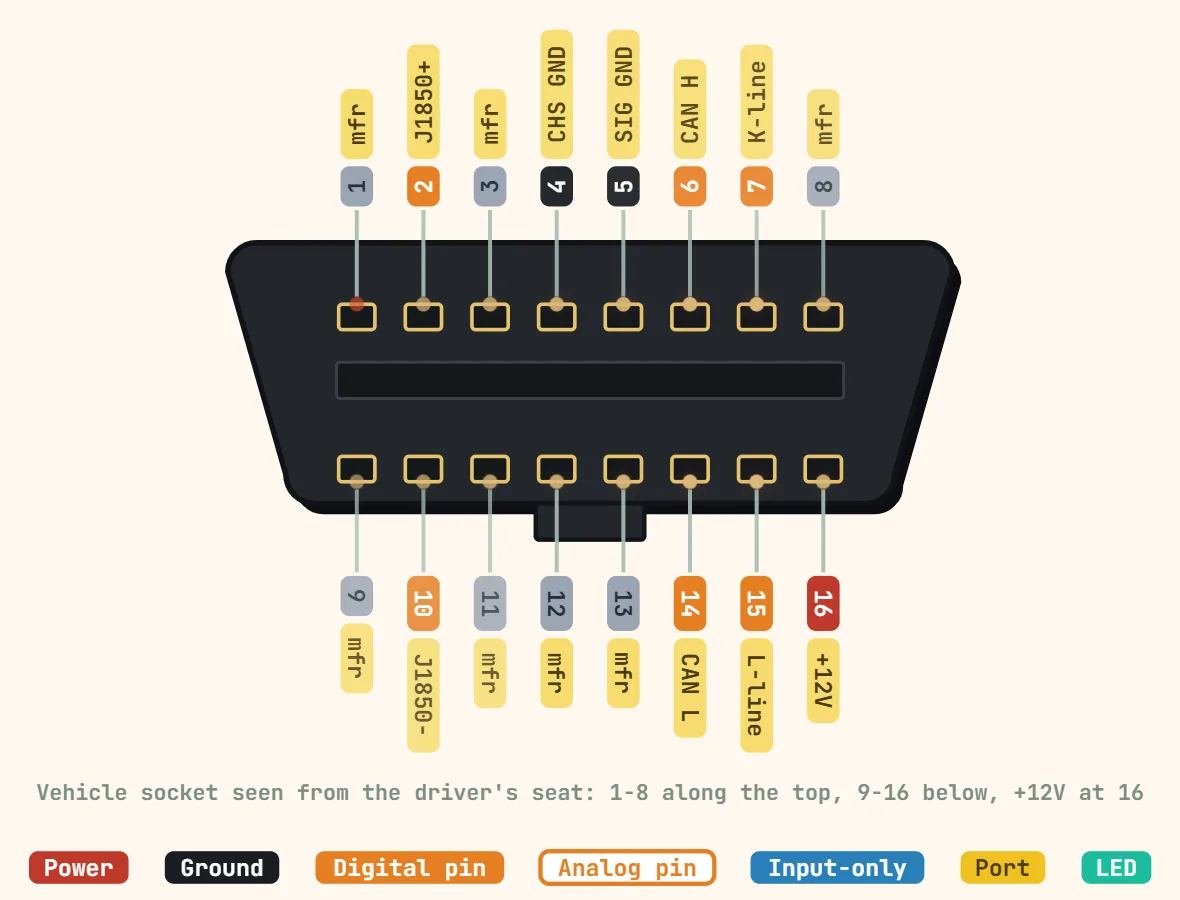
Pins
- 1: Manufacturer-defined (varies by make/model)
- 2: SAE J1850 Bus+ (PWM/VPW — legacy Ford/GM)
- 3: Manufacturer-defined
- 4: Chassis ground
- 5: Signal ground
- 6: CAN High (CAN-H) — ISO 15765-4, mandatory on every vehicle sold new from 2008 (US) / around 2003+ in some EU markets
- 7: K-Line (ISO 9141-2 / ISO 14230 KWP2000)
- 8: Manufacturer-defined
- 9: Manufacturer-defined
- 10: SAE J1850 Bus− (PWM only)
- 11: Manufacturer-defined
- 12: Manufacturer-defined
- 13: Manufacturer-defined
- 14: CAN Low (CAN-L)
- 15: L-Line (optional second K-line, ISO 9141-2)
- 16: Battery +12V — always live, unswitched, fused
Specifications
| Contacts | 16 (2 rows of 8) |
|---|---|
| Standard | SAE J1962 / ISO 15031-3 |
| Supply | Pin 16, battery voltage: 12 V (Type A), 24 V (Type B) |
| Standardized pins | 4, 5, 6, 7, 14, 16 (plus 2, 10, 15 per protocol) |
| CAN (ISO 15765-4) | 250 or 500 kbit/s on pins 6 / 14 |
| K-Line (ISO 9141-2, KWP2000) | 10.4 kbit/s on pin 7 |
| SAE J1850 | 41.6 kbit/s (PWM), 10.4 kbit/s (VPW) |
| Mandatory from | 1996 (US), 2001 petrol / 2004 diesel (EU) |
| CAN mandatory | 2008 (US) |
Notes
- Only pins 4, 5, 6, 7, 14 and 16 are truly standardized across every protocol. The rest are manufacturer-defined and genuinely vary by make, model and year — do not assume a fixed function on any "vendor" pin without checking that specific vehicle.
- A vehicle runs exactly ONE of these bus protocols, never several at once — a CAN-only car has nothing live on pin 7, and a K-Line-only car has nothing live on pins 6/14.
- Type A shrouds (12V passenger vehicles) and Type B shrouds (24V trucks/buses) use this same 16-pin layout with a different key/shape, specifically so a 12V scan tool cannot be forced into a 24V port.