Reference sheet
Capacitor ESR & ripple
What ESR costs you, family by family
Capacitor ESR & ripple current guide
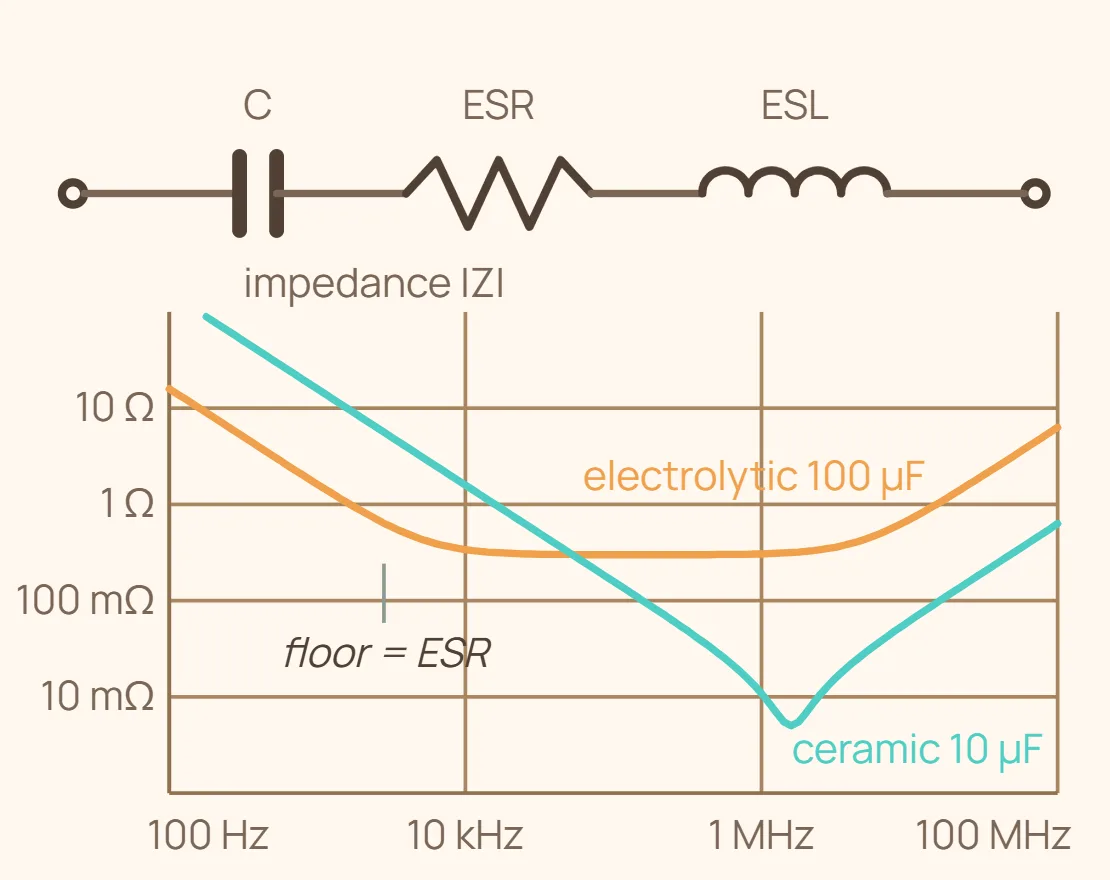
Every real capacitor has a small resistance in series with its capacitance, coming from the electrodes, the electrolyte or dielectric, the internal connections and the leads or terminations. That resistance is the ESR (Equivalent Series Resistance), and it is a separate spec from the capacitance value itself and from the dielectric family covered in the Capacitor types entry - two capacitors with identical microfarad and voltage ratings can have very different ESR depending on how they are built inside.
In a coupling or decoupling cap passing a small signal, ESR is close to irrelevant - the currents involved are tiny, so the I squared R heating and the small series voltage drop it causes barely register. In a switching power supply's output filter, the same capacitor carries the inductor's full ripple current continuously, at the switching frequency, commonly 100 kHz to a few MHz. ESR then does two things that matter: it dissipates real power as heat inside the capacitor, and it adds its own current-times-ESR voltage step on top of the capacitive ripple, which at high switching frequencies is often the larger of the two contributors to output ripple voltage.
Ripple current rating, usually given in amps or milliamps rms at a stated frequency and ambient temperature, is the companion spec: it is the maximum current the part can carry before self-heating raises its internal temperature enough to shorten its life or, in the worst case, cause thermal runaway. Both figures get worse with age and heat on wet electrolytics, and manufacturers usually publish a derating curve for ripple current versus frequency and temperature rather than one flat number, so a datasheet's headline figure should be read at the real operating point, not at the 1 kHz and 25 degree conditions it was likely measured under.
| Capacitor family | Typical ESR (~100 kHz, 25°C) | Ripple-current capability | Practical note |
|---|---|---|---|
| General-purpose aluminum electrolytic | ~0.3–3 Ω for common radial parts (varies a lot with µF and case size) | Low to moderate | ESR climbs 2–3x as the electrolyte dries out with age and heat - the classic cause of an SMPS that used to be quiet and now buzzes or runs hot |
| Low-ESR / "switching-grade" aluminum electrolytic | ~0.02–0.2 Ω | Moderate to high (hundreds of mA to a few A) | Purpose-built for SMPS output filtering; look for an explicit "Low ESR" mark, a 105°C rating, and a stated mA-rms ripple figure on the datasheet |
| Polymer aluminum (e.g. OS-CON, POSCAP) | ~0.005–0.05 Ω | High (several A) | Solid polymer electrolyte, so ESR stays stable over life and temperature; usually rated ≤25–35 V and costs more than wet electrolytic of the same µF |
| Tantalum (solid MnO2) | ~0.1–3 Ω, depends heavily on case size and rated voltage | Moderate | Derate to about 50% of rated voltage in real designs - a faulted tantalum tends to fail as a dead short, sometimes with a spark, not a gentle dry-out like an electrolytic |
| Tantalum polymer | ~0.01–0.1 Ω | High | Fails open or high-resistance far more often than the violent short of MnO2 tantalum; increasingly the default choice where tantalum is used on a power rail |
| Ceramic MLCC (X7R / X5R) | ~0.002–0.02 Ω, essentially negligible | Very high | Capacitance itself can drop 20–80% under DC bias - check the bias-derating curve before counting on the printed µF for ripple duty, ESR is rarely the limiting factor here |
| Ceramic C0G / NP0 | Negligible, similar to X7R | High, but only at small values (pF to low nF) | Not a bulk ripple-filter part - included here mainly to rule it out of that role; used for timing and RF, not power filtering |
| Film (polypropylene, PET) | ~0.01–0.1 Ω | High, very stable with age and temperature | Bulkier and pricier per µF than electrolytic; usually added in parallel with a bulk electrolytic rather than used alone |
| Supercapacitor / EDLC | Low at DC or 1 kHz, rises sharply above a few kHz | Poor at switching frequencies | The low-frequency ESR on its datasheet is not representative at 100 kHz+ - it is an energy-storage part, not a substitute for an SMPS filter capacitor |
Datasheet ESR and ripple-current numbers are measured at one specific frequency and temperature - check the derating curve for your actual switching frequency and worst-case ambient, since both figures can be noticeably worse than the headline spec. When a single capacitor's rating falls short, paralleling two or three smaller ones often beats hunting for one bigger part: ESR combines like parallel resistors and the ripple current splits between them, so both problems shrink at once.