Free online calculator
Sallen-Key filter calculator
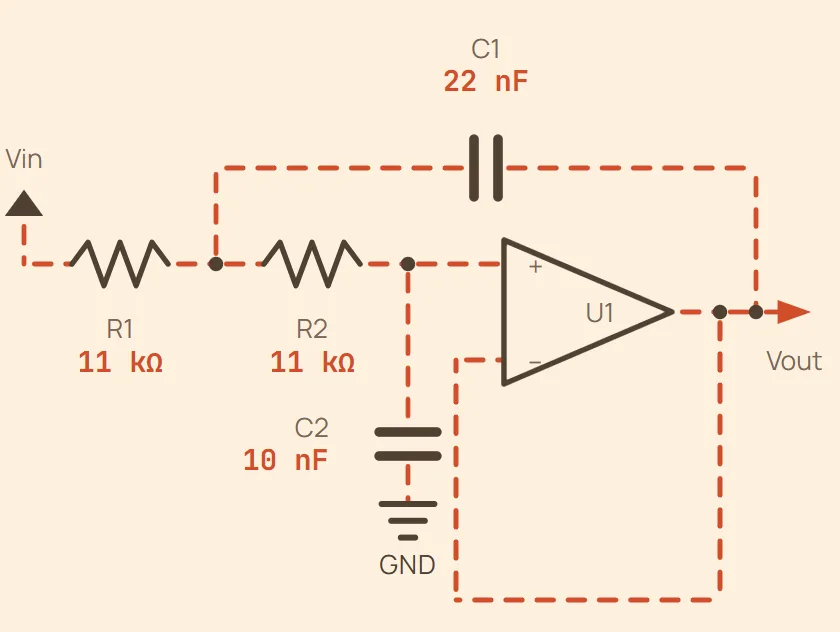
Example Built from the bold column: −3 dB at 1.021 kHz (+2.08 %), Q = 0.7416 (+4.88 %), pole f0 = 975.5 Hz. On the coarser column: 935.7 Hz (−6.43 %) at Q = 0.7416 (+4.88 %).
Example Equal R puts the whole of Q into the capacitor ratio C1/C2 = 4Q² = 2, so C1 is the part to source first — it is the one the E12 grid is least likely to hold. U1 is a unity-gain buffer, so the DC gain is exactly 1 (0 dB) — but 0 dB is not the passband maximum above Q = 0.707: the built Q of 0.7416 peaks +0.036 dB around 294.1 Hz before it rolls off. A Chebyshev alignment buys that bump deliberately; in a Butterworth it is what the part rounding cost you. Pick an op-amp with a gain-bandwidth product of at least 70.71 kHz (≈ 100 × Q × fc), and rail-to-rail inputs if the signal reaches the supplies.
A unity-gain second-order low-pass: sets where it turns, sets the shape. Q is peaking, not frequency — 0.707 is flat to the corner, below that the knee is soft and rounded, above it the response bumps up before it falls.
Seed the design with a capacitor, never a resistor: capacitors are stocked in a dozen values per decade and resistors in twenty-four, so the part you cannot round is the one to fix first. The row that matters is the last one — what the filter really does once the ideal values have been replaced by parts that exist.
What you enter
- Cutoff, −3 dB (Hz)
- Q
- Topology
- C2, to ground (F)
- Standard response (fills in Q):