Electronics quiz
Transistors quiz
BJTs as switches and amplifiers - base, collector, emitter and what turns them on.
18 questions in the app. A few of them, with their answers:
What are the three terminals of a bipolar junction transistor (BJT)?
- Anode, cathode, gate
- Base, collector, emitter ✓
- Source, drain, gate
- Positive, negative, ground
Answer A BJT has three terminals: base, collector and emitter.
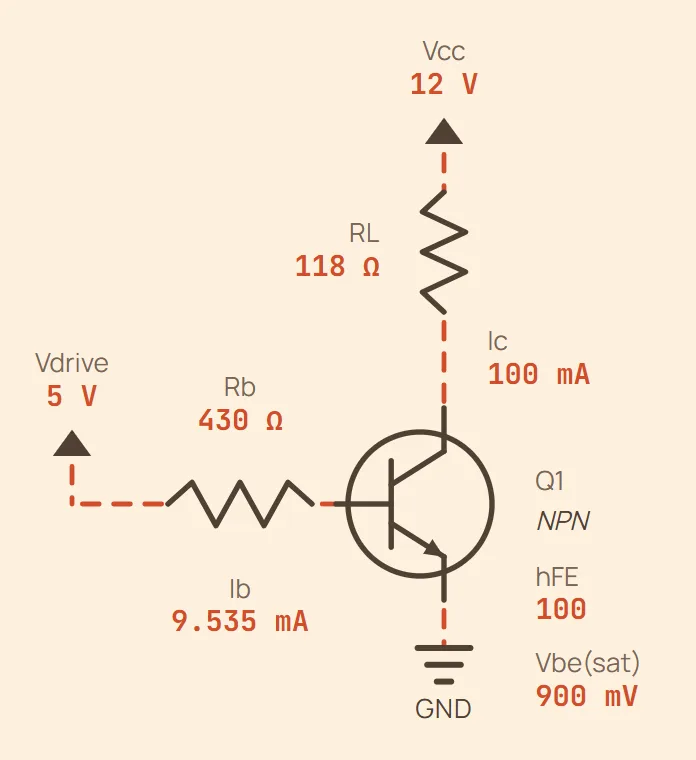
In an NPN transistor used as a switch, a small current into which terminal turns it ON?
- Collector
- Emitter
- Base ✓
- Ground
Answer A small base current controls a much larger collector current - that amplification is what makes it useful as a switch.
What does a transistor's current gain (β, or hFE) describe?
- The ratio of collector current to base current ✓
- The voltage drop across the base-emitter junction
- The maximum voltage it can block
- The transistor's physical size
Answer β = Ic / Ib - how many times larger the collector current is than the base current driving it.
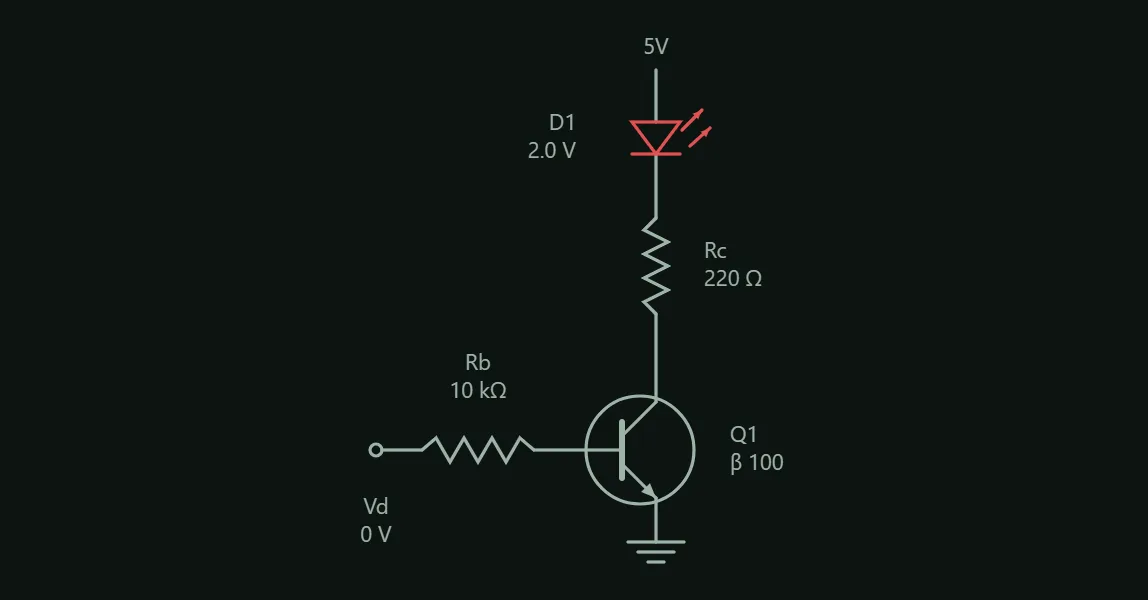
A transistor used as a simple switch (e.g. driving an LED) is normally operated in which two regions?
- Only the active (linear) region
- Cutoff (fully off) and saturation (fully on) ✓
- Only reverse breakdown
- The active region with negative feedback
Answer A switch wants only two states: cutoff (no current) and saturation (as much current as the circuit allows) - not the in-between linear region.
What is "saturation" in a BJT switch?
- The transistor is fully off, no current flows
- The transistor is fully on, and Vce drops to a small residual voltage ✓
- The transistor has overheated
- The base current has reversed direction
Answer In saturation the transistor is driven as hard on as it can go - collector current is set by the external circuit, and Vce sits at a small residual value (often under 0.3 V).