Pinout
Brushless motor + ESC (3-phase, RC-style) pinout
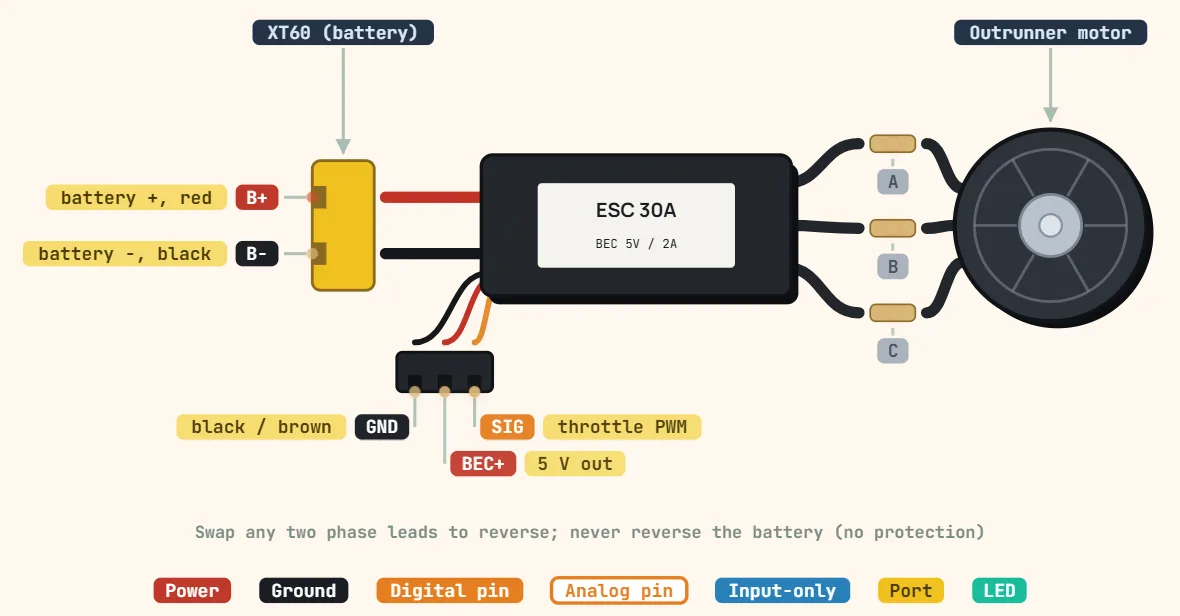
Pins
- Motor A / B / C — the three-phase winding leads to the motor; unlabeled on nearly every RC motor, and swapping any two of them is the standard way to reverse spin direction
- B+ (battery positive, red) — main power in from the battery pack (LiPo/Li-ion), usually through an XT60, XT90, Deans/T, or bare bullet connector sized for the ESC's current rating
- B− (battery negative/ground, black) — battery return; shares a common ground with the 3-pin signal cable's GND
- GND (signal cable, black or brown) — ground reference for the throttle signal, common to the ESC, receiver/flight controller, and battery negative
- BEC+ (signal cable, red) — regulated 5V (sometimes switchable to 6V) fed back out of the ESC to power the receiver and any servos on that rail, present only on ESCs with a built-in BEC
- Signal / throttle (signal cable, white, yellow, or orange) — throttle command in; a standard analog ESC reads a roughly 1000-2000µs pulse every 20ms (50Hz) like a servo, though many modern ESCs also accept digital protocols (OneShot125, Multishot, DShot) on the same wire
Specifications
| Motor type | 3-phase BLDC, usually sensorless outrunner |
|---|---|
| Battery input | Set by the ESC rating, e.g. 2S–4S LiPo (7.4–14.8 V nominal) |
| ESC current rating | Continuous rating printed on the ESC (e.g. 30 A); short bursts above |
| Throttle signal | 1000–2000 µs pulse every 20 ms (50 Hz) |
| Digital protocols | OneShot125, Multishot, DShot (ESC-dependent) |
| BEC output | 5 V (sometimes 6 V) on BEC models; none on opto ESCs |
| Motor KV | rpm per volt, no load (e.g. 1000 KV × 11.1 V ≈ 11 100 rpm) |
| Reversing | Swap any two motor phase wires |
| Connectors | Battery: XT60 / XT90 / Deans (T); motor: bullet connectors |
| Arming | Throttle at minimum when the battery is connected |
Notes
- Any two of the three motor phase wires can be swapped freely to reverse the motor's spin direction — there is no fixed phase-to-winding order to preserve, and swapping wires does not damage the motor or ESC, since a sensorless ESC detects the back-EMF and commutates accordingly regardless of which physical wire carries which phase.
- Reversing the battery input polarity is one of the most common ways to kill an ESC — most RC ESCs have no reverse-polarity protection on B+/B−, and even a momentary reversed connection can blow the input MOSFETs instantly; always check connector polarity and keying (XT60, XT90, Deans/T, bullet connectors) before plugging in a battery, especially on a home-soldered connector.
- An ESC's printed current rating (e.g. '30A', '40A') is a continuous rating, not a hard ceiling — most ESCs tolerate a higher burst current for a few seconds, but sustained current above the continuous rating overheats the FETs and either trips thermal protection or destroys the ESC; size the ESC with real headroom above the motor's actual measured draw, not just its nameplate figure.
- On multi-motor builds (quads and other multirotors) using an ESC marketed as 'opto' or sold without a BEC, the BEC+ pin on the signal connector is intentionally unpowered — but usually not because of true optical isolation: on most modern opto-labeled ESCs the signal ground is still shared with battery negative, exactly as on a BEC-equipped ESC, with no real optocoupler in the signal path. The actual reason the BEC is omitted is that a build with 4 or more ESCs sharing one flight-controller power rail can't have every ESC's onboard 5V regulator trying to supply that rail at once — they would fight each other — so the flight controller must instead get 5V from elsewhere (a separate BEC or a power-distribution board's own BEC). Plugging an opto ESC's signal cable in and expecting it to supply BEC power is a common reason a flight controller won't turn on even though the wiring looks correct.
- Most ESCs require the throttle signal to be at minimum (or the ESC's configured zero point) at the moment the battery is connected in order to arm; connecting the battery with the throttle stick or channel anywhere above zero is a classic cause of a 'won't arm' beep pattern, or on some ESCs, an unexpected motor start — always confirm throttle-low before plugging in the battery.