27 September 2026
Why Decoupling Capacitors Sit Close to the IC, Not Just 'Somewhere on the Rail'
Placement matters as much as value: a decoupling cap a centimeter too far away can fail to do its job because of the wire it's connected through.
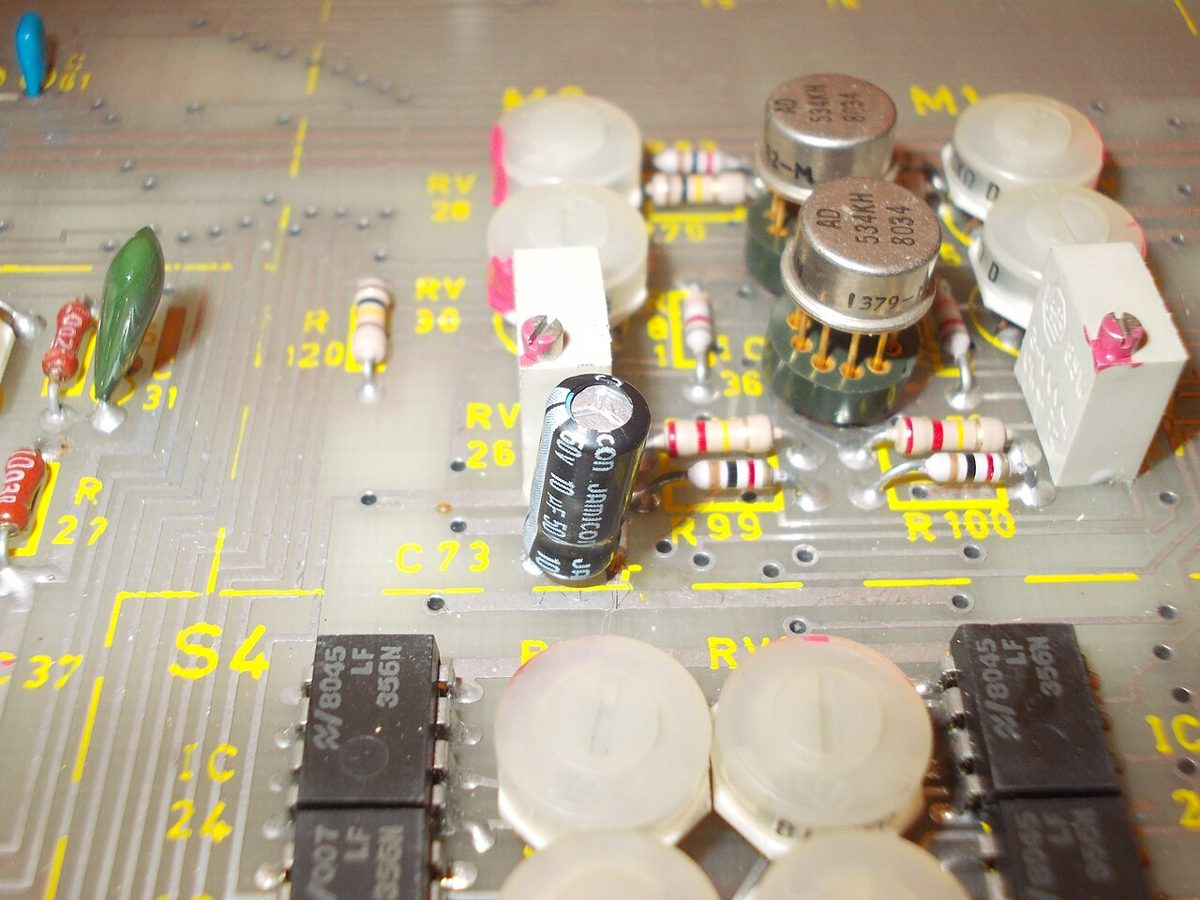
The cap isn't just a filter, it's a local charge reservoir
A decoupling capacitor's job is to supply the sudden bursts of current a digital IC demands when its internal gates switch, often in a fraction of a nanosecond. The power supply and the traces leading to it simply can't respond that fast. Instead, the capacitor sits nearby as a tiny local reservoir of charge, ready to dump current into the chip the instant it's needed, then quietly recharge from the supply during the calmer moments in between.
This only works if the path from capacitor to chip is short. Every bit of wire or trace between them has inductance, and inductance resists fast changes in current. If the cap is inches away instead of millimeters, that inductance becomes the dominant obstacle, and the capacitor might as well not be there for the fast events it's meant to catch.
Why distance turns a good capacitor into a useless one
It helps to think of every trace as having a small series inductance, roughly on the order of a nanohenry per millimeter for typical hookup wire or PCB traces, though the exact number depends on geometry. During a fast switching edge, the chip might need a burst of current that rises in under a nanosecond. Even a few nanohenries of inductance in that path creates a voltage spike, because voltage across an inductor is proportional to how fast current changes, not how much current flows.
That spike shows up as a dip or glitch on the supply pin right at the moment the chip needs stable voltage most. On a breadboard this often shows up as mysterious glitches, resets, or noise that a slower multimeter reading will never catch, because a multimeter averages things out over time and can't see nanosecond-scale sag. An oscilloscope with a fast probe is really the only way to see it directly.
Breadboards make this worse than you'd expect
Standard breadboards are particularly unkind here. The internal strips connecting holes add extra inductance and resistance compared to a solid copper trace, and it's easy to end up with the decoupling cap several centimeters from the IC's power pin just because that's where there was a free row. For most slow logic and simple analog circuits this barely matters, but for fast digital ICs, microcontrollers running at higher clock speeds, or anything driving quick transitions, it can be the difference between a circuit that works and one that resets itself randomly or produces garbled communication.
If you're chasing an intermittent glitch on a breadboard prototype, moving the decoupling cap to sit directly across the power and ground pins, with the shortest leads you can manage, is one of the cheapest experiments you can run before assuming the problem is something more complicated.
What 'close' actually buys you
The practical guideline that shows up again and again, whether in datasheets or layout guides, is to keep decoupling capacitors within a few millimeters of the power pin on a PCB, and directly adjacent on a breadboard or perfboard. This isn't superstition; it's a direct attempt to minimize the loop area and lead length that stands between the capacitor's charge and the pin that needs it right now.
It's also why designs often use multiple capacitor values in parallel rather than one large one. A larger capacitor, like a microfarad-scale ceramic or electrolytic, handles slower, bulkier current demands from further away on the rail, while a small capacitor, often in the nanofarad range, sits right at the pin to handle the fastest transients. Both matter, but only the one placed close enough can react quickly enough to do its part.