2 November 2026
Zener Diodes as a Voltage Reference: What They Do Well and Where They Fall Short
A Zener diode and a resistor make a quick reference rail on the bench. Here is how to size it with real numbers, and where its drift and loading limits will bite.
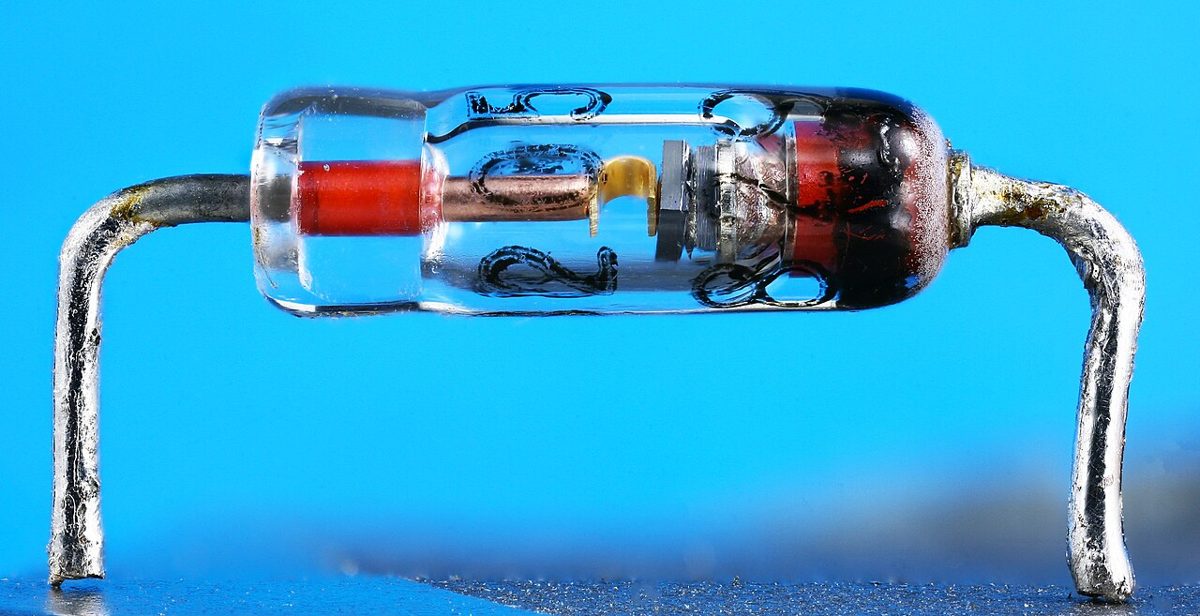
Why a Diode Makes a Reference at All
A normal silicon diode conducts in the forward direction and blocks in reverse, but reverse breakdown is a different regime. A Zener is built to break down at a specific reverse voltage, and past that point its voltage stays close to a fixed value even as the current through it changes. That flat region is what makes it useful as a reference: you can place it across a supply and get a stable-ish voltage to feed a circuit.
On the bench, the usual setup is a resistor from the supply to the cathode and the load connected across the Zener. The resistor drops whatever the Zener does not take, so it limits current and keeps the diode in its breakdown region.
A Worked Example: 5.1 V from a 9 V Supply
Suppose you want a roughly 5.1 V reference from a 9 V supply, using a common 5.1 V Zener. Its exact breakdown voltage varies from part to part and is listed as a tolerance on the datasheet, so treat 5.1 V as nominal. Aim for about 5 mA through the Zener. The resistor must drop 9 V minus 5.1 V, which is 3.9 V. Dividing 3.9 V by 5 mA gives 780 ohms, so a 820 ohm resistor from the next standard value set is a sensible pick.
With 820 ohms, the Zener current at the nominal 9 V input is about 3.9 V divided by 820 ohms, or roughly 4.8 mA. The Zener dissipates about 5.1 V times 4.8 mA, around 25 mW, which is well within a typical 0.5 W part. Now check the worst case: if the input rises to 10 V, the current rises to about 5.9 mA, and the dissipation rises with it, still comfortably in range. If you hang a load that pulls, say, 2 mA from the reference, the Zener current drops toward 2.8 mA. That is where you have to watch the Zener's lower knee, because below it the voltage sags.
Bench tip Calculate the resistor for the lowest input voltage and the highest load draw at the same time, not for each one separately.
Where the Voltage Drifts
Three things move the output. First, the Zener current: because the device has a finite dynamic resistance, its voltage shifts a little as current changes, so a supply that wobbles or a load that switches will show up on your reference. Second, temperature: Zener voltage has a temperature coefficient whose sign depends on the voltage rating. Lower-voltage Zeners, roughly below 5 V, tend to drift negatively as they warm, while higher-voltage ones tend to drift positively, and parts near the middle of the range have the flattest behavior. Third, noise: Zeners generate broadband noise in breakdown, which is audible on a high-gain amplifier and can be reduced with a capacitor across the diode.
The practical upshot is that a Zener gives you a rough, cheap reference. It is good for biasing a transistor, setting a comparator threshold, or clamping a signal, and not good for anything that needs a precise or stable voltage.
Bench tip A 0.1 uF ceramic capacitor across the Zener cleans up much of the noise, and a larger electrolytic in parallel helps with ripple from the supply.
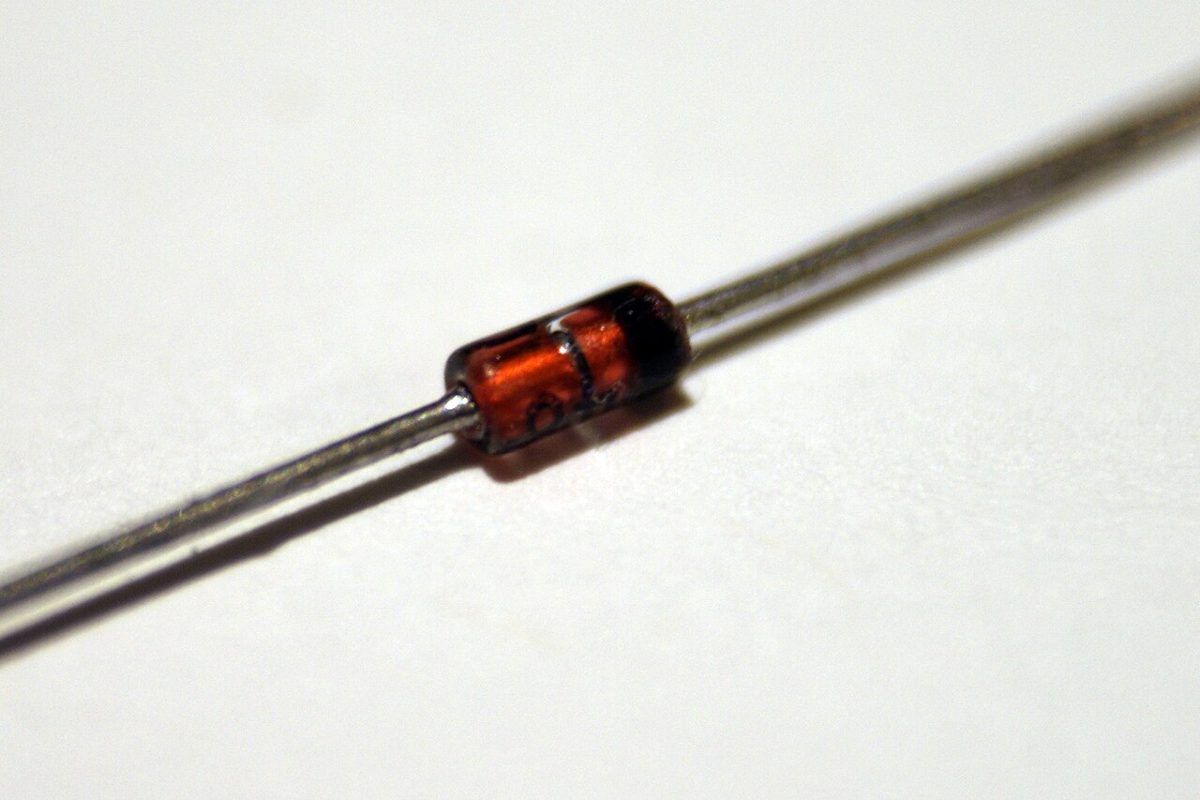
Knowing When to Use Something Else
If you need a reference that holds its value across temperature and load, a Zener alone is the wrong tool. Dedicated shunt and series voltage references, and bandgap-based parts, are designed for that job and usually outperform a Zener by a wide margin in drift and noise. A Zener also cannot source much current on its own. The standard fix is to buffer its output with an op-amp configured as a follower, so the Zener only sees the small current the buffer's input draws.
Be realistic about accuracy too. The tolerance on a Zener's breakdown voltage can be several percent, so two nominally identical reference rails on different boards will not match. If your measurement depends on the exact voltage, calibrate it against your multimeter rather than trusting the nominal part value.
Bench tip Measure the Zener voltage with your multimeter under the same load it will see in the circuit, because the reading at no load is misleadingly high.
Practical Checklist at the Bench
Before you trust a Zener rail, check four things: that the resistor gives enough current at the lowest input and highest load, that the Zener dissipation stays under its rating, that noise and ripple are filtered where your circuit is sensitive, and that the output is buffered if anything beyond a tiny load depends on it. Work through these and a Zener becomes a dependable, inexpensive piece of a larger design rather than a surprise.