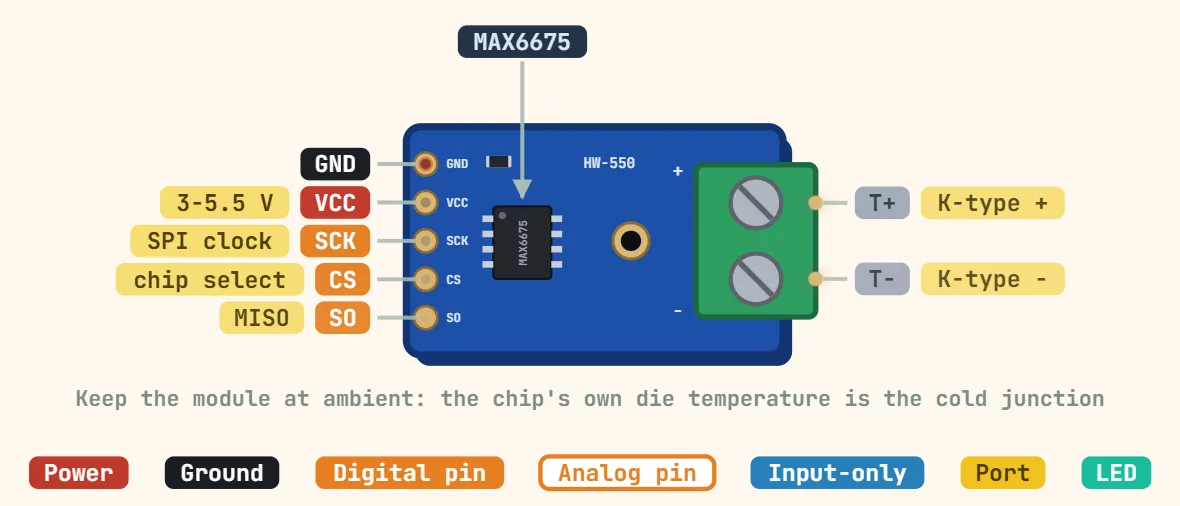
VCC (3.0–5.5V — the chip does its own cold-junction compensation from its own die temperature, so keep the module at ambient and well away from the heat source)
SCK (SPI clock input, 4.3MHz max — the MAX6675 is read-only, there is no MOSI/DI pin and no register to write)
CS (chip select, active low — pulling it low starts a 16-bit read; a conversion takes up to 0.22s, so poll no faster than about 4–5 times a second)
SO (serial data out, wire it to the MCU MISO — it swings to VCC, so a 5V-powered module drives 5V into a 3.3V MCU. Range is 0 to +1024°C in 0.25°C steps: it cannot read below 0°C)
T+ (screw terminal, K-type thermocouple positive — the yellow chromel wire on a standard K probe)
T− (screw terminal, K-type thermocouple negative — the red alumel wire. Reversing T+/T− makes the reading FALL as the tip heats, and the input is not isolated, so a grounded-tip probe ties whatever you are measuring to module ground)