पिनआउट
फ़्लेम सेंसर मॉड्यूल (KY-026, IR) पिनआउट
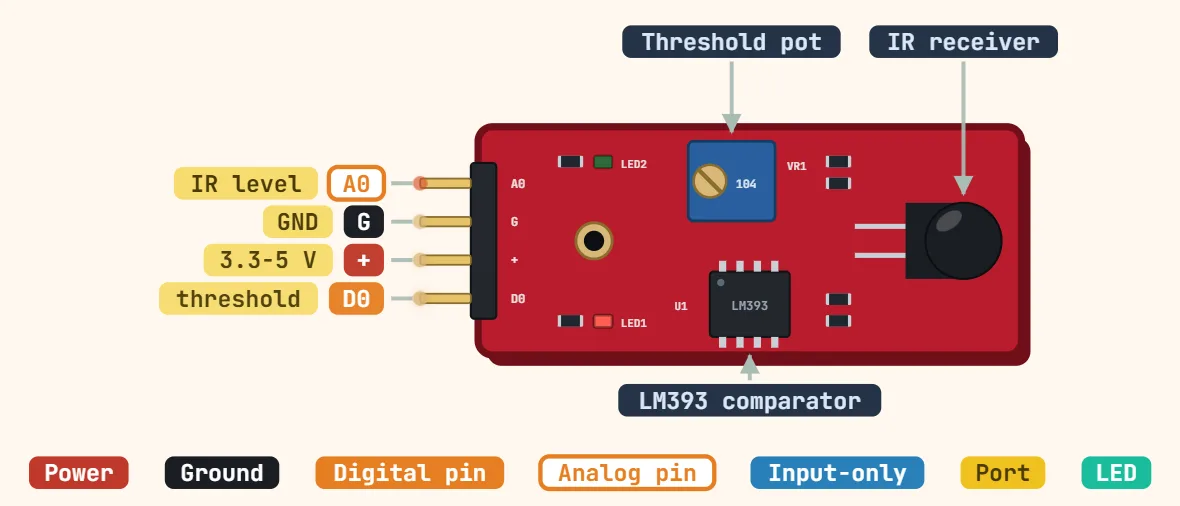
पिन
- A0 — analog output taken straight from the IR phototransistor, ahead of the comparator; a continuous voltage that tracks IR intensity (on most of these boards it drops as the flame gets brighter or closer) — useful for judging flame size/distance rather than a bare yes/no reading
- G — ground
- + — power in, typically 3.3–5V DC on these breakout boards (check the silkscreen; some clones are 5V-only); draw is low, typically just a few mA since there's no heater element like a gas sensor module has
- D0 — digital output through the onboard LM393 comparator, switched at the level set by the trim pot; most boards drive it active-low (LOW when flame is detected) with an onboard LED mirroring the state, but polarity varies between clones — confirm against your own board's LED rather than assuming
- Onboard trim pot (VR1) — sets only the D0 comparator's threshold (sensitivity / trigger distance for the digital output); it has no effect on A0, which stays unfiltered
विनिर्देश
| सप्लाई वोल्टेज | 3.3–5 V (some clones 5 V only) |
|---|---|
| Sensor | IR phototransistor |
| Spectral range | ≈760–1100 nm |
| Detection angle | ≈60° (typical) |
| Detection distance | ≈20 cm (lighter) to ≈1 m (larger flame), ballpark |
| Outputs | AO analog + DO digital (LM393 comparator) |
| DO active level | LOW on flame on most boards (varies by clone) |
| Sensitivity | Trimmer, DO threshold only |
नोट्स
- This is an IR-general sensor, not a true flame sensor: the phototransistor is sensitive across roughly 760–1100nm, so it false-triggers on direct sunlight, incandescent/halogen bulbs, and other IR-rich sources — don't rely on it outdoors or near hot lighting without shielding the sensor head.
- Detection range and angle are modest and size-dependent; commonly quoted typical figures are around 20cm for a small flame (lighter/match) up to roughly 1m for a larger one, within about a 60° cone at default sensitivity — treat these as ballpark numbers to verify against your own setup, not guaranteed specs.
- Pin count and layout aren't standardized across sellers: some boards are a simpler 3-pin VCC/GND/DO version with no analog output at all, and even on 4-pin boards the physical pin order and DO's active level (high vs. low on flame) vary by clone — check the silkscreen and test the onboard LED before wiring rather than assuming it matches a different board you've used.
- The IR phototransistor responds weakly to flames that burn nearly soot-free (e.g. some alcohol or hydrogen flames), since those radiate far less IR than a typical yellow/orange flame — a clear DO/AO reading does not confirm the absence of fire, so this module should not be treated as a sole life-safety sensor.