पिनआउट
कैपेसिटिव मिट्टी नमी सेंसर मॉड्यूल (v1.2) पिनआउट
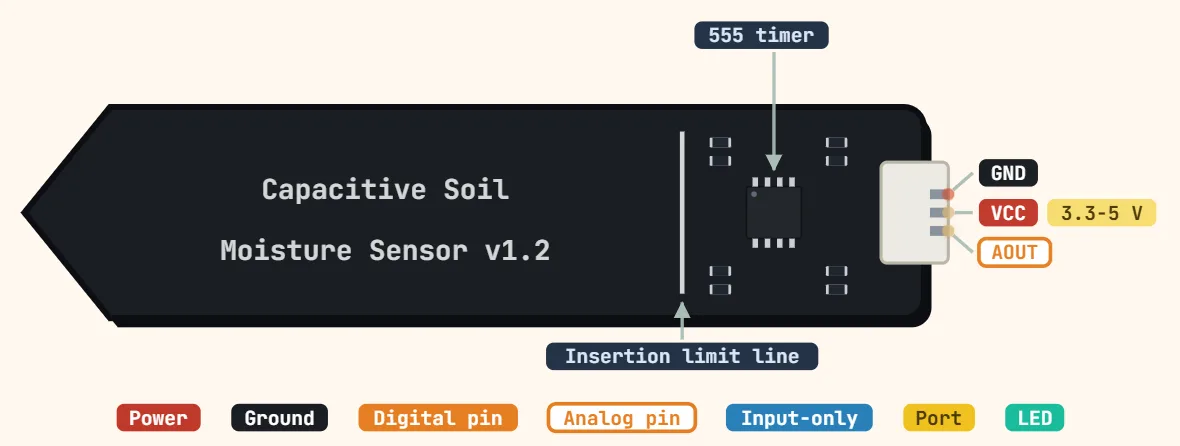
पिन
- GND — ground return, share it with whatever ADC reads AOUT
- VCC — power input, 3.3–5.5V on the common "v1.2" boards; draws only a few mA (typically around 5mA), so it runs fine off a microcontroller's own regulator
- AOUT — analog voltage that rises as the soil dries and drops as it gets wetter; it comes off an on-board oscillator (commonly a 555-timer-style circuit) whose frequency shifts with the probe's capacitance, filtered down to a slow DC level — not a calibrated %, treat it as relative, not absolute
विनिर्देश
| सप्लाई वोल्टेज | 3.3–5.5 V |
|---|---|
| Output voltage | 0–3.0 V analog (higher = drier) |
| Operating current | ≈5 mA |
| Sensing principle | Capacitive (oscillator, typically a 555-type timer) |
| कनेक्टर | 3-pin JST PH 2.0 mm |
| Calibration | Per unit: read dry-air and in-water values |
| आकार | ≈98 × 23 mm |
नोट्स
- This is the capacitive type, not the older bare two-prong resistive kind: the sensing traces sit under solder mask with nothing exposed to the soil, so there's no electrode pair to electrolyze and corrode — it can stay buried for months instead of rusting solid in a couple of weeks like a resistive probe.
- Only the probe below the printed line on the board is meant to go into soil or water; the header/chip end above that line is not conformally coated and will short or corrode if it gets wet.
- The raw voltage varies sensor to sensor and with soil type, so calibrate each unit with its own dry-air and fully-in-water readings rather than trusting an absolute threshold copied from someone else's code.
- Leaving it powered continuously still causes slow reading drift from self-heating even though it can't corrode the way a resistive probe does, so many designs power it from a spare GPIO or MOSFET only for the second or two it takes to sample.