Simulación interactiva
Integrador con amp. operacional
Entra una onda cuadrada, sale una triangular, y el offset DC que lleva poco a poco la salida hasta el raíl.
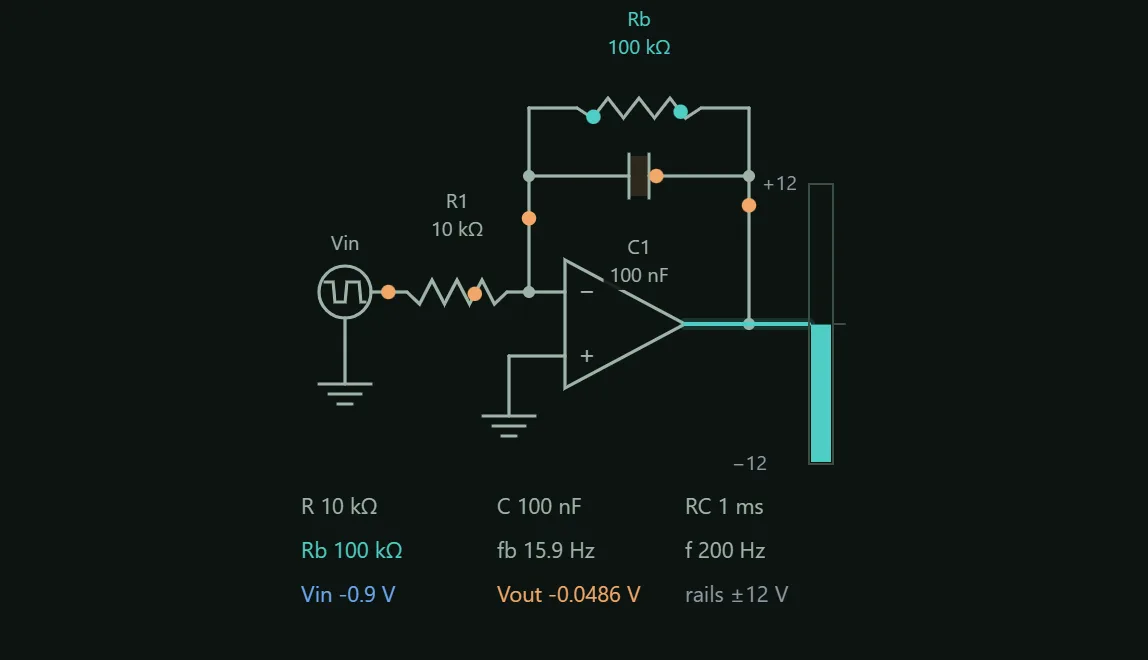
The op-amp holds its − input at 0 V, so the input current is Vin/R whatever the output is doing, and all of it has to go into C: dVout/dt = −Vin/(R·C). A square wave therefore comes out as a triangle of A/(2·f·R·C) volts peak-to-peak — halve the frequency and the ramps get twice as long, so the triangle doubles. Now the catch: C cannot tell a signal from an offset. Dial in an input DC offset and slide the bleed resistor to none (open): the output leaves at −Voff/(R·C) volts per second and parks against the rail, where the integrator is deaf. Rb bleeds that charge away — it makes the stage a lossy integrator with DC gain −Rb/R and a corner at f_b = 1/(2π·Rb·C), so keep f well above f_b and the triangle is untouched.
Lo que puedes cambiar
- R
- C
- Input frequency
- Input amplitude (pk)