Diagrama de pines
Pines de Amplificador operacional doble JFET TL072
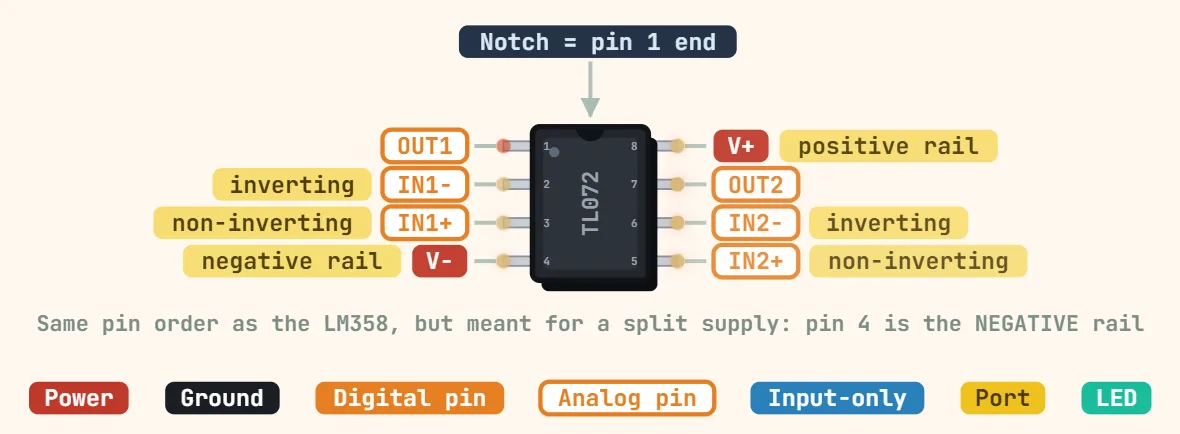
Pines
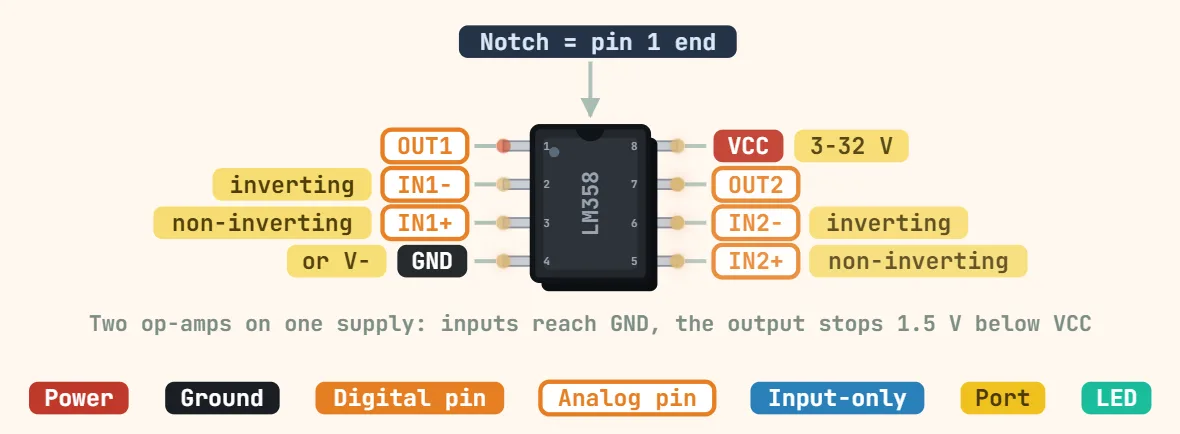
- 1: OUT1 — output of amplifier 1; Class-AB output stage that isn't rail-to-rail, typically needs a couple of volts of headroom from both V+ and V− before it clips
- 2: IN1− — inverting input of amp 1; the JFET gate draws essentially no bias current, so it won't load down a high-impedance source like a piezo pickup or a photodiode the way a bipolar-input part would
- 3: IN1+ — non-inverting input of amp 1
- 4: V− — negative supply rail; on a typical split-supply audio circuit this sits at −9V to −15V, not ground — unlike the LM358, the input stage can't swing down to V−, so this part won't bias correctly if dropped into an LM358-style single 5V-rail circuit
- 5: IN2+ — non-inverting input of amp 2, a fully separate amplifier from amp 1 apart from sharing pins 4 and 8
- 6: IN2− — inverting input of amp 2
- 7: OUT2 — output of amp 2, same Class-AB behavior and headroom limits as OUT1
- 8: V+ — positive supply rail; datasheet-recommended range is ±3V to ±18V split supply (36V absolute max across V+ to V−), commonly run at ±9V or ±15V in audio gear
Especificaciones
| Tensión de alimentación | TL072: ±5–±15 V recommended, ±18 V absolute max; newer TL072H: 4.5–40 V total |
|---|---|
| Supply current | ≈ 1.4 mA typ per amplifier |
| Gain-bandwidth | ≈ 3 MHz |
| Slew rate | ≈ 13 V/µs typ |
| Input bias current | ≈ 65 pA typ (JFET inputs) |
| Input offset voltage | ≈ 3 mV typ, 10 mV max (TL072A/B tighter) |
| Input noise | ≈ 18 nV/√Hz at 1 kHz |
| Salida | Not rail-to-rail; short-circuit protected |
| Operating temperature | TL072C: 0–70 °C; TL072I: −40–85 °C |
| Encapsulado | DIP-8, SOIC-8 |
Notas
- Recommended operating range is a ±3V to ±18V split supply, with 36V total (V+ to V−) as the absolute maximum — most audio and effects-pedal designs run it at ±9V or ±15V rather than the single 3–5V rail an LM358 happily tolerates.
- JFET inputs pull essentially no bias current — typically well under 1nA, commonly cited around tens of pA — versus the LM358's tens-of-nA bipolar input current, which is why the TL072 is the default choice for high-impedance sources (guitar pickups, piezo elements, photodiodes). The tradeoff is that the input common-mode range doesn't reach V−, so unlike the LM358 it isn't suited to ground-referenced single-supply circuits.
- Output is not rail-to-rail: expect roughly 2–3V of headroom lost at each end of the supply before the output clips, more under heavier load.
- TI's datasheet lists output short-circuit protection, but continuous output current is still only in the tens of mA — fine for feeding the next stage or a line-level load, not enough to drive a relay coil or a motor directly.
- With a ~3MHz gain-bandwidth and ~13V/µs slew rate it's noticeably faster than the LM358 (~1MHz, ~0.3V/µs); that extra bandwidth makes supply decoupling matter more in practice — a 0.1µF ceramic capacitor right at pins 4 and 8 is standard practice to keep it from oscillating.
- Same pinout as the TL082 and pin-compatible with several other dual op-amps in this footprint (NE5532, RC4558, etc.), which is why it's a common swap-in ('op-amp rolling') on guitar pedal and preamp boards.
- JFET gate inputs are static-sensitive — use normal ESD handling precautions, more so than with a bipolar-input part like the LM358.