Pinagem
Pinagem Módulo sensor de cor RGB TCS34725 (I2C)
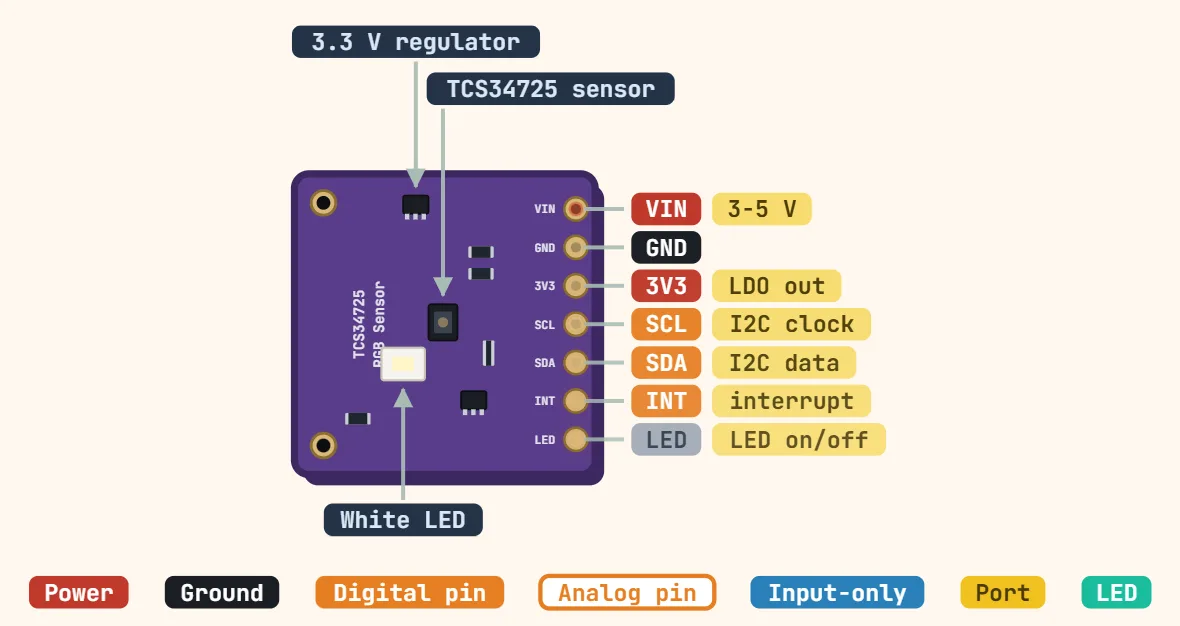
Pinos
- VIN (also silkscreened VCC on some boards — the bare TCS34725 die runs on 2.7–3.3V only, but most breakouts add an onboard LDO so VIN itself takes 3–5V; cheaper clones sometimes skip that regulator, so check your specific board before assuming 5V tolerance)
- GND
- 3V3 (the onboard regulator's output — a few mA for something else, or feed 3.3V in here and leave VIN open on a 3.3V system)
- SCL (I2C clock — many breakouts, Adafruit's included, already carry their own ~10kΩ pull-ups on SCL/SDA, so wiring several of these boards onto one bus stacks pull-ups in parallel; usually harmless, but worth knowing if a bus looks over-pulled)
- SDA (I2C data — 7-bit address is a FIXED 0x29 with no ADDR pin to change it, the exact same default address as a VL53L0X time-of-flight sensor above: the two can't share a bus unless the VL53L0X is moved off 0x29 first via its XSHUT pin, since this sensor has no equivalent way to move)
- INT (interrupt output, open-drain and active-low — needs an external pull-up if your board doesn't already supply one, fires when a channel crosses the threshold registers, and stays latched until cleared with the AICLEAR special-function command, not just by reading the data)
- LED (drives the onboard white illumination LED through an onboard transistor — on the common Adafruit-style layout the pin is pulled up, so leaving it unconnected keeps the LED on, and pulling it to GND turns it off; polarity and default state vary on cheaper clones, so check the silkscreen/schematic for yours)
Especificações
| Board supply (VIN) | 3–5 V on boards with LDO (check clones) |
|---|---|
| Chip supply | 2.7–3.6 V |
| Interface | I2C, up to 400 kHz |
| I2C address | 0x29 (fixed) |
| Channels | Red, green, blue, clear (16 bit each) |
| Integration time | 2.4–614 ms |
| Ganho | 1× / 4× / 16× / 60× |
| Dynamic range | 3 800 000 : 1 |
| IR filter | Yes, on-chip |
| Sensor current | 235 µA active, 2.5 µA sleep (LED extra) |
| Chip package | 2.0 × 2.4 mm |
Notas
- This is the interrupt-pin, clear-glass-IR-filter member of the TCS3472 family (vs. the TCS34721 with no INT pin, or the TCS34723/34727 with a cheaper colored-plastic lid and no glass filter) — it's the variant almost every hobby breakout uses, so this pinout applies to essentially any board sold as a "TCS34725 module."
- The sensor die itself draws well under 1mA (a few hundred µA typical when active, under 3µA in power-down) — nearly all of a lit module's current draw comes from the white LED, not the sensor, so budget for that spike when powering it off a microcontroller's own 3.3V regulator.
- Raw register access requires OR-ing the register address with the COMMAND bit (0x80); forgetting that bit is the most common cause of garbage reads when talking to the chip without a library.
- It has no lens and sits right at the target: readings are dominated by ambient light and distance, so results drift badly unless you keep a fixed, close (few-mm) reading distance with the onboard LEDs as the dominant light source, or otherwise shield the sensor from changing ambient light.