Pinagem
Pinagem Módulo sensor ambiental BME680 (CJMCU-680)
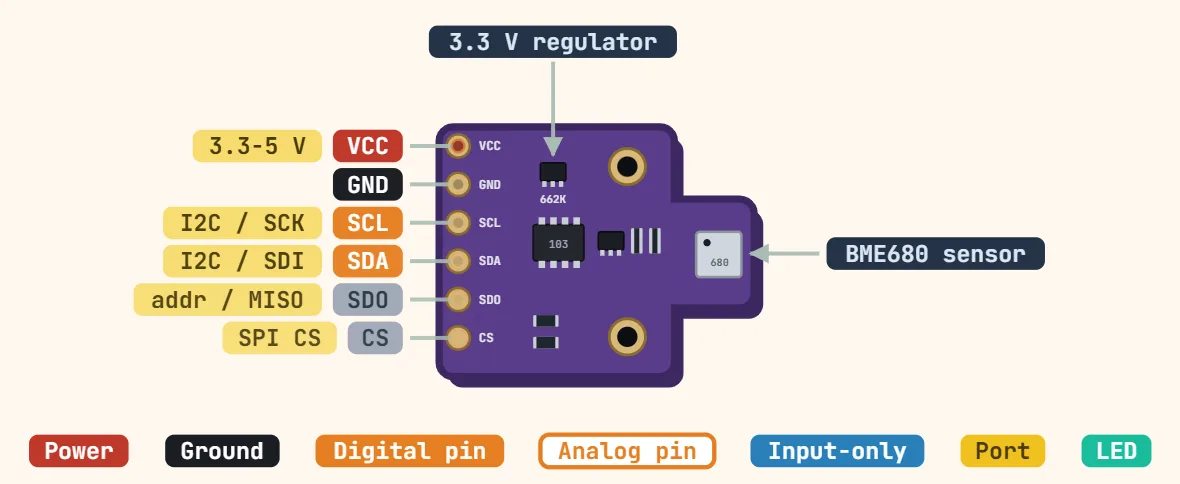
Pinos
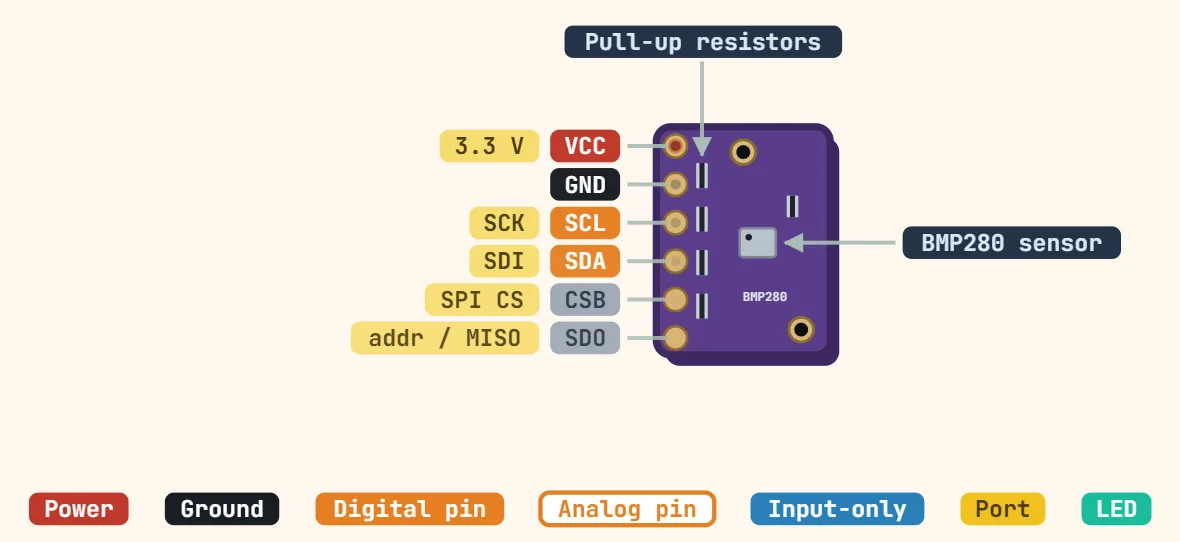
- VCC — power in; the bare die runs on 1.71–3.6V (VDDIO 1.2–3.6V), but the CJMCU-680 carries a 662K 3.3V regulator and a 702 level shifter, so 3.3–5V into this pin is fine — check the silkscreen before assuming 5V tolerance on a different no-name module
- GND — ground return, shared by the digital interface and the gas-sensor heater
- SCL — I2C clock, or SPI SCK once CS is pulled low
- SDA — I2C data (pulled up on the board by the 103 network), or SPI MOSI/SDI
- SDO — sets the I2C address LSB (tie low = 0x76, open or high = 0x77); doubles as SPI MISO
- CS (CSB) — chip select, active low; pulled high on the board so I2C is the default, or drive it from the MCU for 4-wire SPI
Especificações
| Board supply | 3.3–5 V (CJMCU-680 has a 3.3 V regulator) |
|---|---|
| Chip supply | 1.71–3.6 V (VDDIO 1.2–3.6 V) |
| Interface | I2C (up to 3.4 MHz) or SPI (up to 10 MHz) |
| I2C address | 0x77 (0x76 with SDO LOW) |
| Chip ID | 0x61 |
| Pressure | 300–1100 hPa, ±0.6 hPa |
| Temperatura | −40–85 °C, ±1 °C (0–65 °C) |
| Humidity | 0–100 %RH, ±3 %RH |
| Gas sensor | MOX, raw resistance output (VOC); heater 200–400 °C |
| Supply current | 0.15 µA sleep; ≈0.09–12 mA with gas heater (mode-dependent) |
| Chip package | 3.0 × 3.0 × 0.93 mm |
Notas
- The gas/VOC output is a raw metal-oxide sensor resistance in ohms, not a calibrated ppm or air-quality number — turning it into an actual IAQ index needs Bosch's BSEC library (closed-source, license-gated) or a community equivalent, and even that gives a relative index rather than an identified gas or exact concentration.
- The gas sensing element has an internal heater that must reach roughly 200–400°C for each reading and its baseline drifts while it settles — expect noisy gas readings for the first several minutes after power-up, and Bosch/community guidance points to a burn-in on the order of 24–48 hours (some sources say several days) before the baseline is trustworthy for air-quality use.
- Powering the heater pulls noticeably more current than the temperature/humidity/pressure path alone — typical gas-measurement current draw is on the order of 10–20mA versus well under 1µA in sleep — so battery-powered projects should budget for that duty cycle rather than treating this like a low-power BME280.
- Same I2C/SPI footprint and 0x76/0x77 addressing as the BMP280/BME280 (set by SDO), but it is not register-compatible for the gas feature — BME280 driver code will happily read temperature/humidity/pressure from a BME680 and simply never touch the gas sensor.