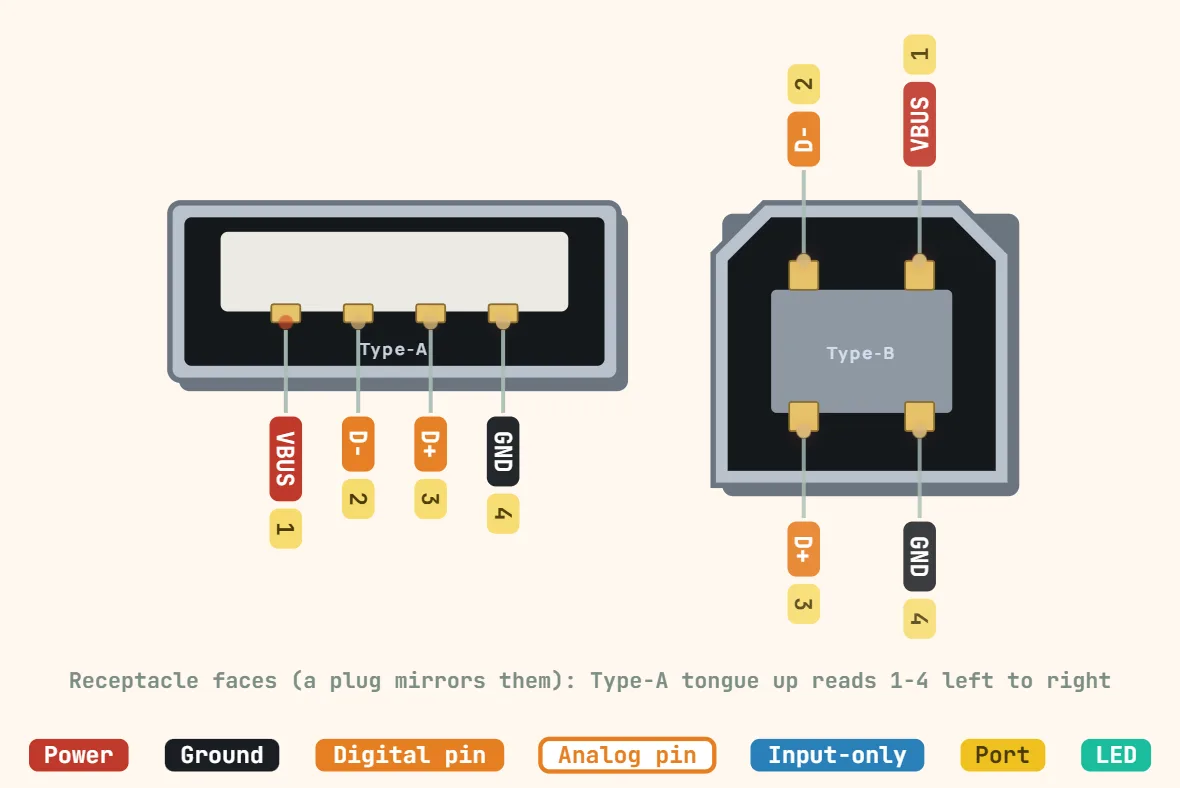
مخطط الأطراف
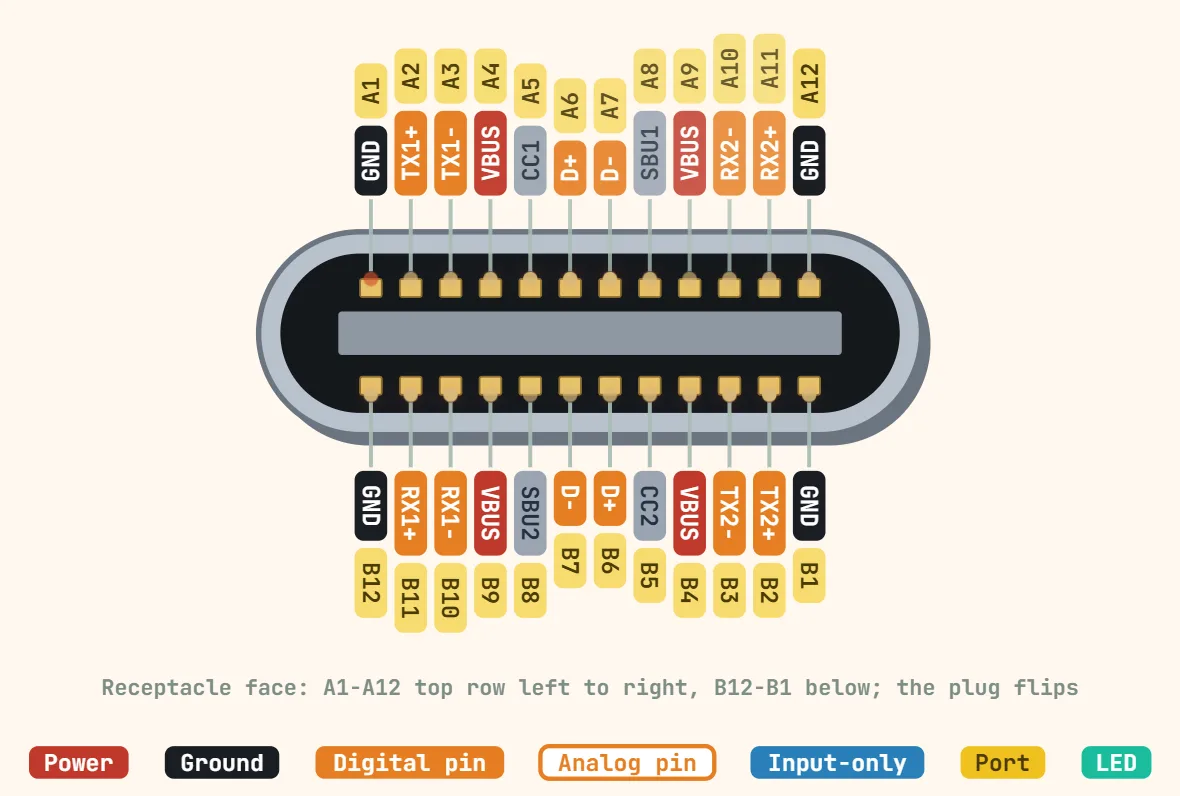
مخطط أطراف USB Type-C (مقبس يدعم USB-PD)
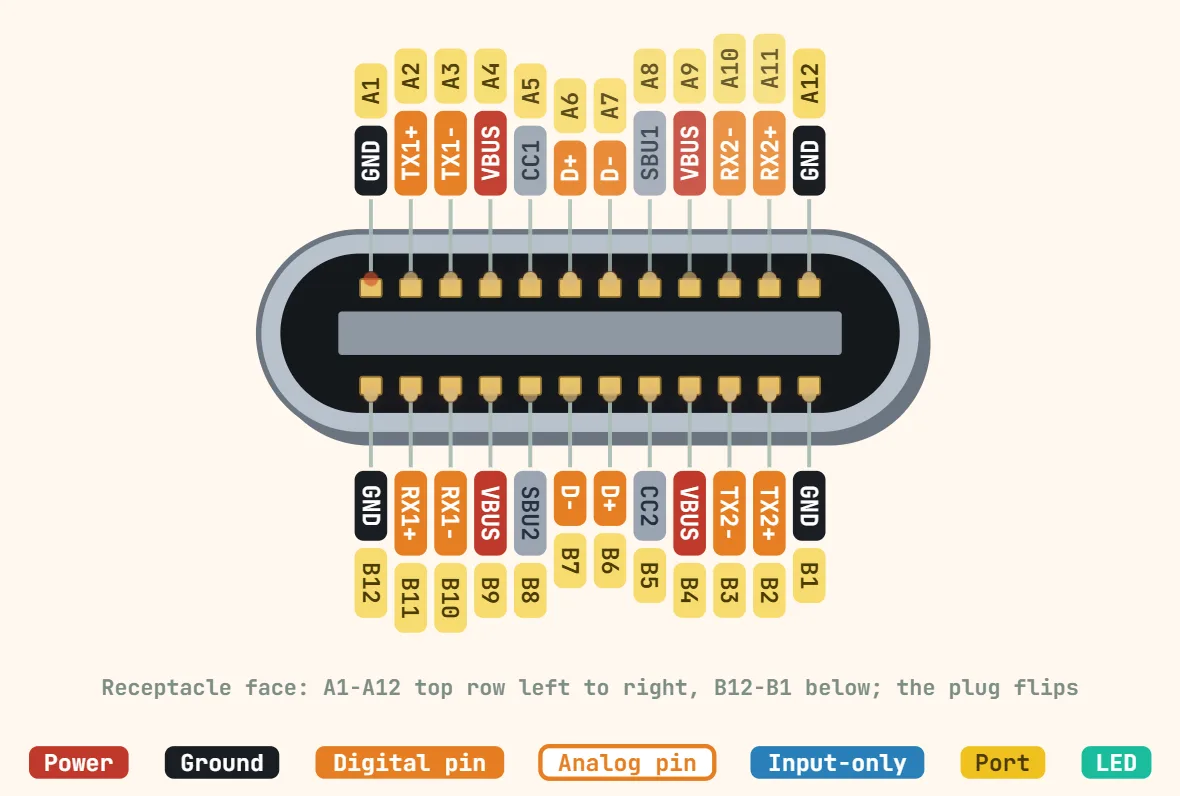
الأطراف
- A4/B4, A9/B9 — VBUS: four pins tied to one net, not four separate rails, so the current is split across more contact area; sits at a fixed 5V by default and only rises once a PD contract is actually negotiated over CC.
- A1/B1, A12/B12 — GND: the return path for VBUS and for both SuperSpeed pairs, likewise duplicated across four pins for current capacity, not wired as separate grounds.
- A5 — CC1, B5 — CC2: only whichever pin actually mates carries the Configuration Channel (the other is left floating or becomes VCONN — see below). Its DC level, set by an Rd/Rp resistor pair, is how the two ends first sense that something is even plugged in and which side is the power source, before any data moves.
- That same mated CC pin then carries the actual USB-PD protocol: Biphase Mark Coded (BMC) messages at a nominal 300 kb/s (±10%), built from a preamble, a message header, a data payload and a CRC — a real serial link, not a DC level, so a multimeter on CC only ever shows the idle Rp/Rd voltage and never the negotiation traffic.
- The CC pin that did NOT mate becomes VCONN whenever a cable needs it — an electronically-marked ("e-marked") cable, any USB 3.x/4 cable, or any link sourcing over 3A: the source or sink switches roughly 5V onto it, spec’d at a minimum of 1W (about 200mA) to run the cable’s ID chip and any signal redrivers inside it.
- A6/A7 and B6/B7 — two mirrored USB 2.0 D+/D− pairs; only one pair is actually driven per insertion, selected by which CC line mated. The second pair exists purely so the plug works either way up, not to add bandwidth.
- A2/A3+A10/A11 and B2/B3+B10/B11 — SSTX/SSRX SuperSpeed differential pairs (USB 3.x); same reasoning as D+/D−, only one full A-side or B-side set is live per orientation.
- A8/B8 — SBU1/SBU2: idle on plain USB and on PD itself, these are handed to an Alt Mode’s sideband channel (e.g. DisplayPort’s AUX line) once a Vendor-Defined Message negotiated over CC puts the port into that mode.
المواصفات
| نقاط التلامس | 24 (المقبس) |
|---|---|
| VBUS الافتراضي | 5 V حتى يتم التفاوض على عقد PD |
| جهود PD الثابتة (SPR) | 5, 9, 15, 20 V |
| جهود PD الثابتة (EPR، PD 3.1) | 28, 36, 48 V |
| أقصى تيار | 3 A؛ 5 A مع كابل 5 A مزود بشريحة تعريف (e-marked) |
| أقصى قدرة | 100 W (SPR, 20 V × 5 A), 240 W (EPR, 48 V × 5 A) |
| PPS (PD 3.0) | 3.3–21 V بخطوات 20 mV |
| التفاوض | BMC على CC، 300 kbit/s |
| VCONN | 5 V، 1 W على الأقل، للكابلات المزودة بشريحة تعريف (e-marked) |
| دارات تفعيل المستهلك المتكاملة | STUSB4500, CH224, IP2721, FUSB302 |
الملاحظات
- اتصال USB-C عارٍ لا يضمن إلا 5V. كل درجة أعلى في "Standard Power Range" (9V، 15V، 20V، و12V في بعض الشواحن) وكل درجة في "Extended Power Range" المضافة في PD 3.1 (28V، 36V، 48V، حتى 5A/240W) هي شيء يجب أن يطلبه المستهلك صراحة ويمنحه المصدر عبر بروتوكول بيانات CC — لا توجد حيلة مقاومة تعطي 9V فأكثر بالطريقة التي تنجح بها بعض أنظمة الشحن السريع الخاصة دون PD حقيقي.
- الجهاز الذي يكتفي بسحب CC إلى الأسفل عبر Rd ثابتة 5.1 kΩ، دون منطق PD خلفها، يحصل مع ذلك على تغذية (هذا هو "USB Type-C Current" العادي، المحدود بـ 5V/3A ≈15W حسب قيمة مقاومة الرفع التي اختارها المصدر) — لكنه لن يرى أبداً أي شيء فوق 5V، لأنه لا يوجد ما ينفّذ مصافحة BMC.
- لسحب أكثر من 5V من شاحن PD دون كتابة مكدس USB-PD خاص بك، استخدم دارة متكاملة مخصصة لاستهلاك/تفعيل PD تجري تفاوض CC نيابة عنك (مثل STUSB4500، CH224، IP2721، FUSB302) وتوفر واجهة بسيطة عبر ضبط الأطراف أو I2C لطلب جهد ثابت بمجرد أن تُبلغ عن إبرام عقد.
- المصدر لا يعرض إلا PDOs التي ينفّذها فعلاً — شاحن أساسي 5W/10W قد يتوقف عند 5V أو 9V، بينما شاحن الحاسوب المحمول قد يصل إلى 20V أو، في شواحن EPR الأحدث، 48V — لذا تحقق من Source_Capabilities المعلنة بدلاً من افتراض أن كل "شاحن PD" يصل إلى كل جهد.
- توزيع VBUS وGND على أربعة أطراف لكل منهما هو إجراء لسعة التيار ومقاومة التلامس، لا أربع شبكات مستقلة — مثلاً، لا تعامل VBUS في A9 على أنه قابل للتحويل بشكل منفصل عن A4.