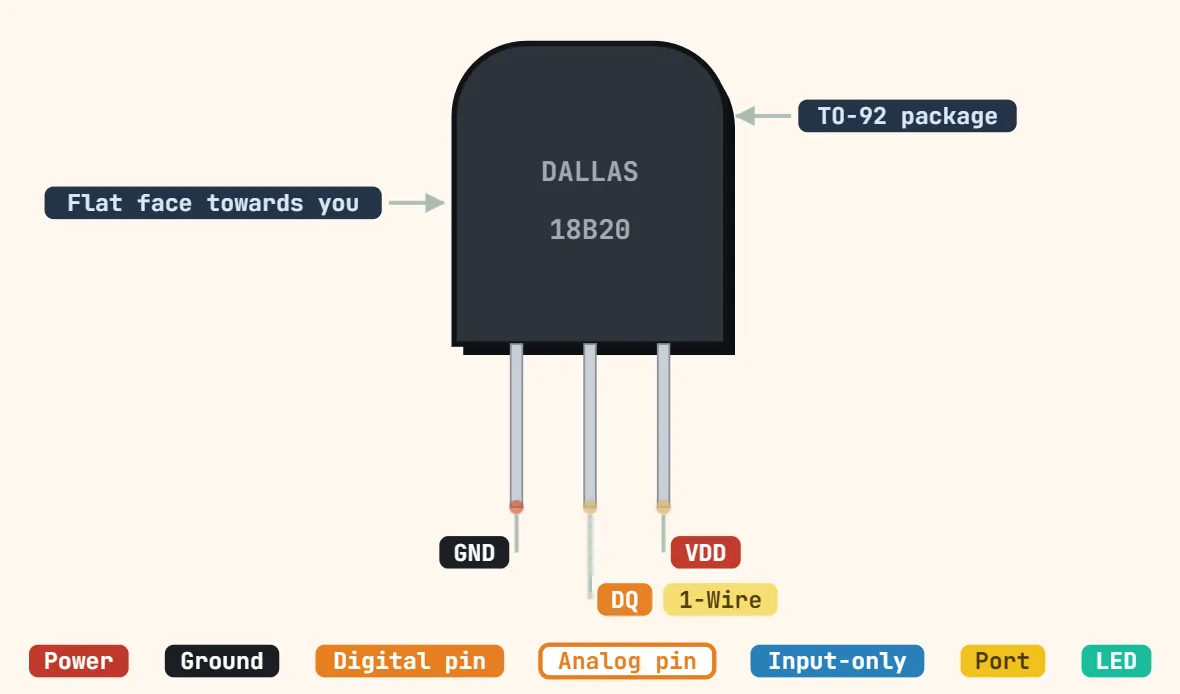
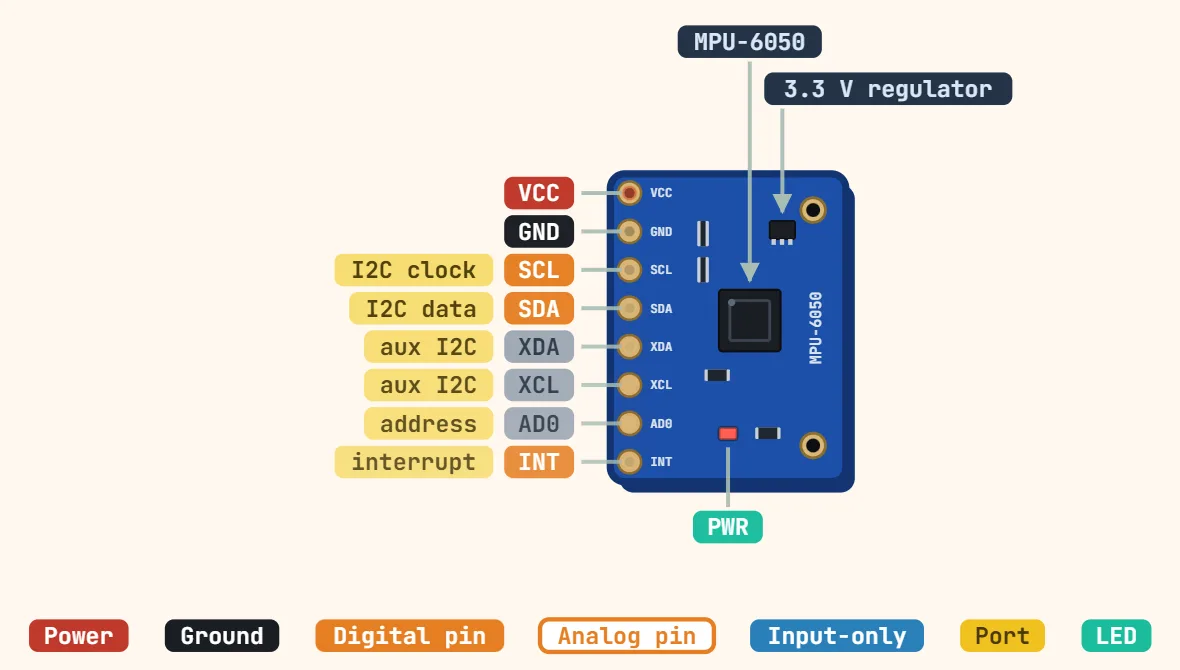
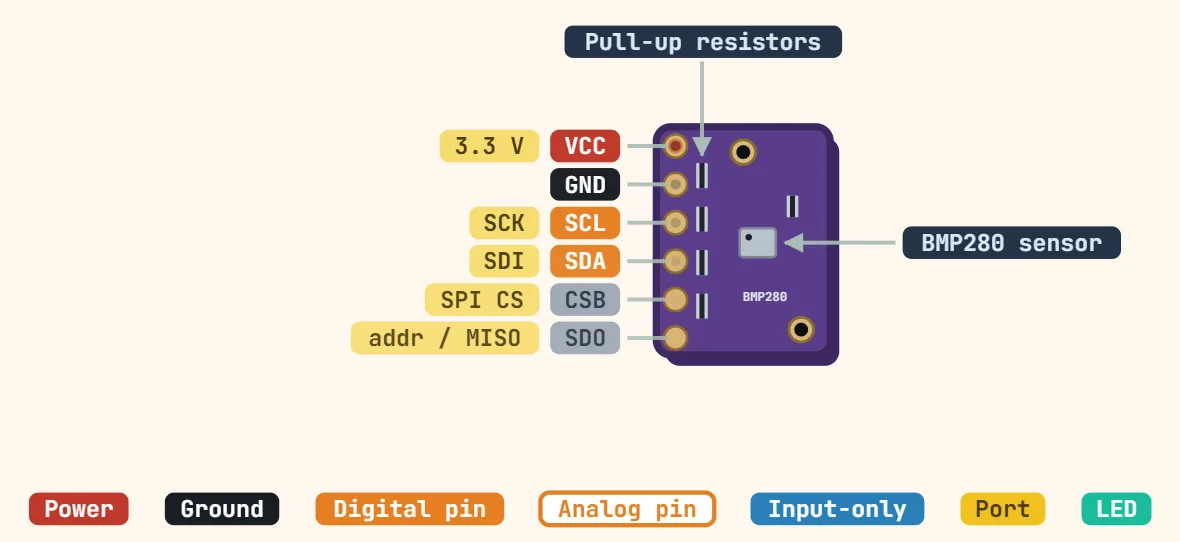
Diagrama de pines
Pines de Sensor de temperatura IR sin contacto MLX90614 (GY-906)
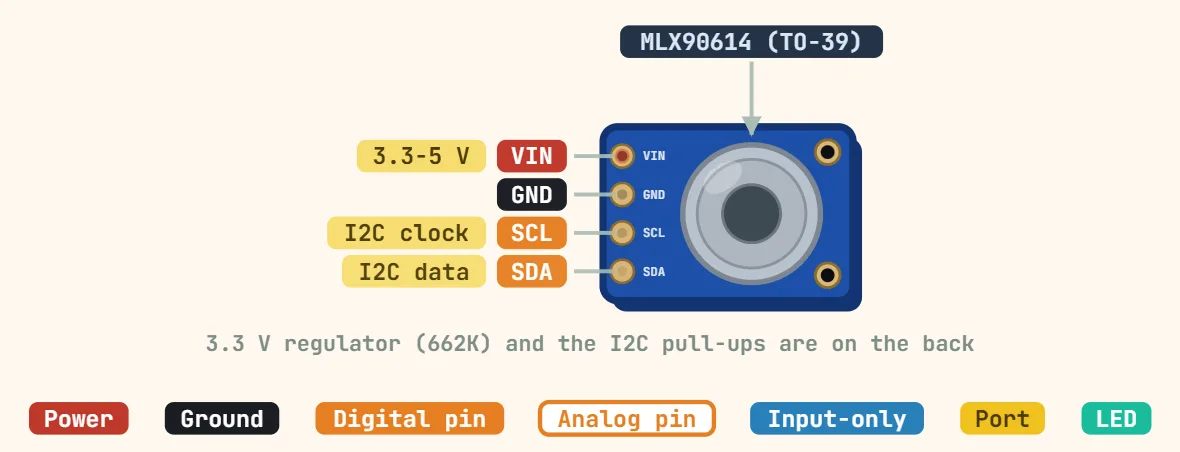
Pines
- VIN — board supply pin, usually fed 3.3–5V (up to ~6V) on common breakouts like the GY-906; the bare MLX90614 die itself is sold in two separate voltage grades rather than one wide range — a 3V-rated version (Vdd 2.6–3.6V) and a 5V-rated version (Vdd 4.5–5.5V) — and most breakout boards use the 3V-grade die behind their own small onboard regulator
- GND
- SCL — SMBus/I2C clock, open-drain like a normal I2C bus; needs a pull-up resistor, which most breakout boards already carry onboard
- SDA — SMBus/I2C data at a fixed default slave address of 0x5A; on factory-configured PWM-output parts this same pin instead carries a duty-cycle-encoded temperature signal rather than I2C data
Especificaciones
| Board supply | 3–5 V (GY-906 with regulator) |
|---|---|
| Chip supply | 3 V grade: 2.6–3.6 V; 5 V grade: 4.5–5.5 V |
| Interfaz | SMBus/I2C up to 100 kHz, or PWM |
| I2C address | 0x5A (EEPROM-changeable) |
| Object temperature range | −70–380 °C |
| Ambient temperature range | −40–125 °C |
| Accuracy | ±0.5 °C (0–50 °C); ±0.2 °C on medical grades near body temperature |
| Resolution | 0.02 °C |
| Field of view | 90° (standard); narrower variants down to ≈5° |
| Supply current | ≈1.5 mA typical; 2.5 µA sleep |
| Encapsulado | TO-39 can |
Notas
- The I2C address (0x5A by default) has no address-select pin — it's set once in EEPROM at the factory, so putting two MLX90614s on the same bus needs either reprogramming one module's address or adding an I2C multiplexer.
- Unlike a contact sensor such as the DS18B20, it reads radiated infrared rather than touching the target. The standard part has roughly a 90° field of view and about a 1:1 distance-to-spot ratio, so at any given distance it averages the temperature over a circle about that wide — background included, if the target doesn't fill the spot. Narrower-FOV variants (down to roughly 5° on some part numbers) exist specifically to shrink that spot for small or distant targets, like the ones used in no-touch clinical forehead thermometers.
- Accuracy on standard modules is typically quoted around ±0.5°C over a 0–50°C object range; the medical-grade variants used in actual clinical thermometers are tighter (around ±0.2°C) but only over a narrow band centered on body temperature, not across the sensor's full range.
- Active current draw is small (roughly 1.5–2mA typical) and the sensor can be dropped into a ~2.5µA SMBus sleep mode, but waking it back up isn't a normal I2C transaction — it needs SDA held low for tens of milliseconds first, so a driver that skips that sequence just gets no response instead of a reading.
- If the module's logic runs at 5V, SCL/SDA idle near 5V too; wiring it straight into a 3.3V-only I2C bus (an ESP32, for example) without level shifting is a common mistake — feeding the module 3.3V instead is usually the simpler fix, since the chip itself works fine well below 5V.