مخطط الأطراف
مخطط أطراف وحدة LoRa (RFM95W / عائلة SX1276)
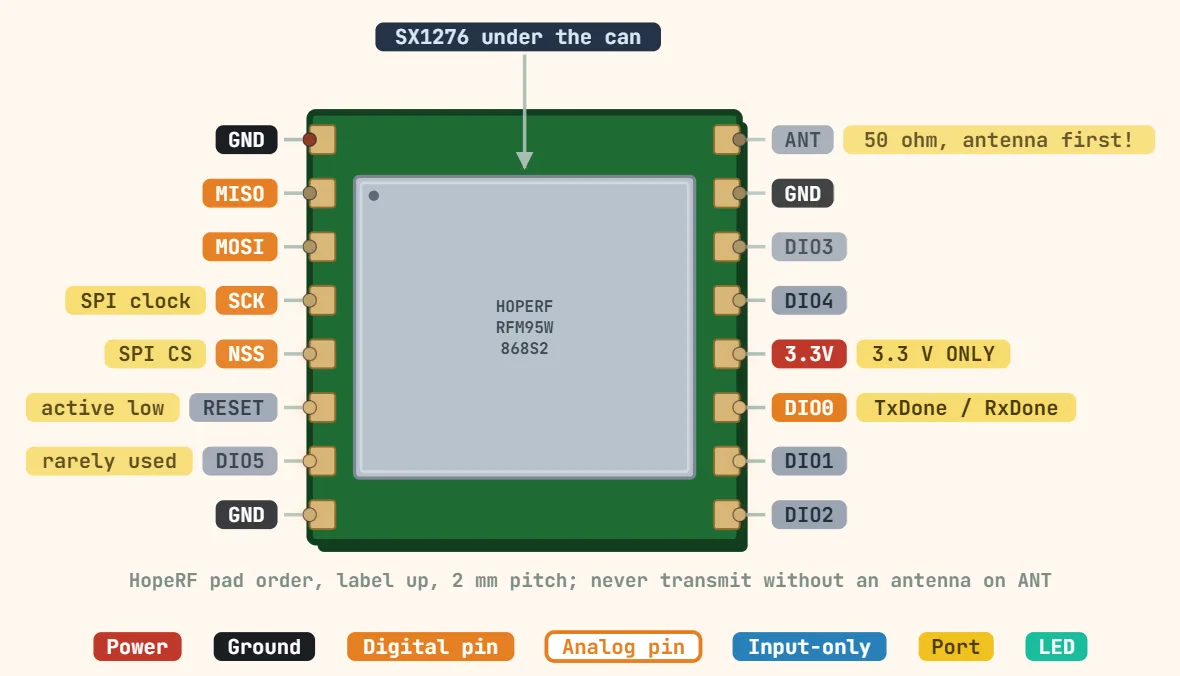
الأطراف
- 3.3V / VDD — most bare HopeRF modules have no onboard regulator: feed a clean, dedicated 3.3–3.6V rail, not the raw 5V from an Uno/Mega
- GND — several ground pins/pads on the real module; tie them all
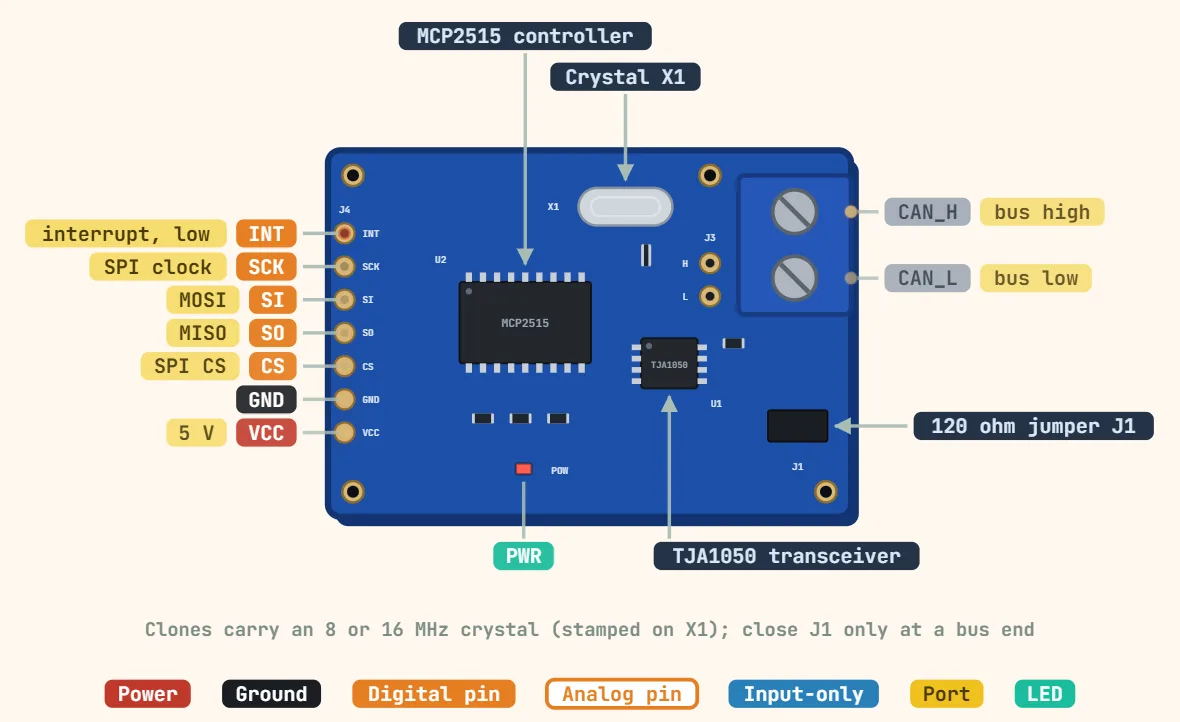
- NSS (also silkscreened CS on many breakout boards) — SPI chip select, active low; idle it HIGH between SPI transactions
- MOSI — SPI data into the module
- MISO — SPI data out of the module
- SCK — SPI clock
- RESET — active-low chip reset; most library begin() functions pulse this low briefly at startup, so it needs to reach an actual MCU pin rather than being left floating
- DIO0 (often labeled G0 on breakout boards) — the one interrupt line almost every LoRa library wires up: TxDone in transmit, RxDone in receive, CadDone in channel-activity-detect mode
- DIO1–DIO5 — extra status/interrupt outputs (FHSS channel change, valid-header, CAD-done, plus FSK-mode extras) whose exact meaning depends on the DIO-mapping registers; most sketches leave these unconnected and wire DIO0 only
- ANT — 50Ω RF port; needs a matched antenna (a cut quarter-wave wire is enough for bench testing) or a dummy load
المواصفات
| المرسل-المستقبل | Semtech SX1276 (RFM95W) |
|---|---|
| التردد | 868 / 915 MHz (RFM95W); 433 MHz on RFM96/98W |
| جهد التغذية | 1.8–3.7 V (no onboard regulator) |
| المستوى المنطقي | 3.3 V (لا يتحمل 5 V) |
| TX power | Up to +20 dBm |
| Sensitivity | Down to −148 dBm |
| التيار | ≈ 120 mA TX at +20 dBm, ≈ 10 mA RX, ≈ 0.2 µA sleep |
| LoRa bit rate | ≈ 0.018–37.5 kbps |
| الواجهة | SPI، حتى 10 MHz |
| Antenna | 50 Ω, required before transmitting |
| الأبعاد | 16 × 16 mm |
الملاحظات
- Attach an antenna — or at minimum a length of wire cut to a quarter-wavelength for the module's band — before ever keying up a transmission. Driving the PA_BOOST power amplifier into an open or badly mismatched load is the classic way a first LoRa module gets damaged, and it can happen on the very first test transmit.
- The bare SX1276 die and most raw RFM9x modules are 3.3V logic only, with no 5V tolerance and no onboard regulator: wiring NSS/MOSI/SCK/RESET straight to a 5V board like an Uno or Mega needs a level shifter or a resistor divider. Breakout boards such as Adafruit's RFM9x add a regulator and often some level shifting — a bare HopeRF module does not.
- These ship as separate factory-tuned SKUs per ISM band rather than one radio retuned in firmware — commonly RFM95(W) for 868MHz (EU) / 915MHz (US and others), and RFM96/97/98(W) for 433MHz. The wrong SKU for your region, or an antenna cut for the wrong band, is a common reason a link only "sort of" works at a few meters and nowhere else.
- Typical current draw is roughly 120mA at the maximum +20dBm PA_BOOST transmit setting, dropping to microamps in sleep — worth sizing a supply against if a board resets specifically during a transmit burst rather than at any other time.
- Regional duty-cycle and power rules sit on top of the hardware limits and the radio does not enforce them for you — EU868, the band most RFM95 modules ship for, is commonly duty-cycle limited to around 1% on the sub-bands typically used for LoRaWAN, even in a raw point-to-point sketch.