Brochage
Brochage Adaptateur USB-série CP2102 / CH340 (6 broches)
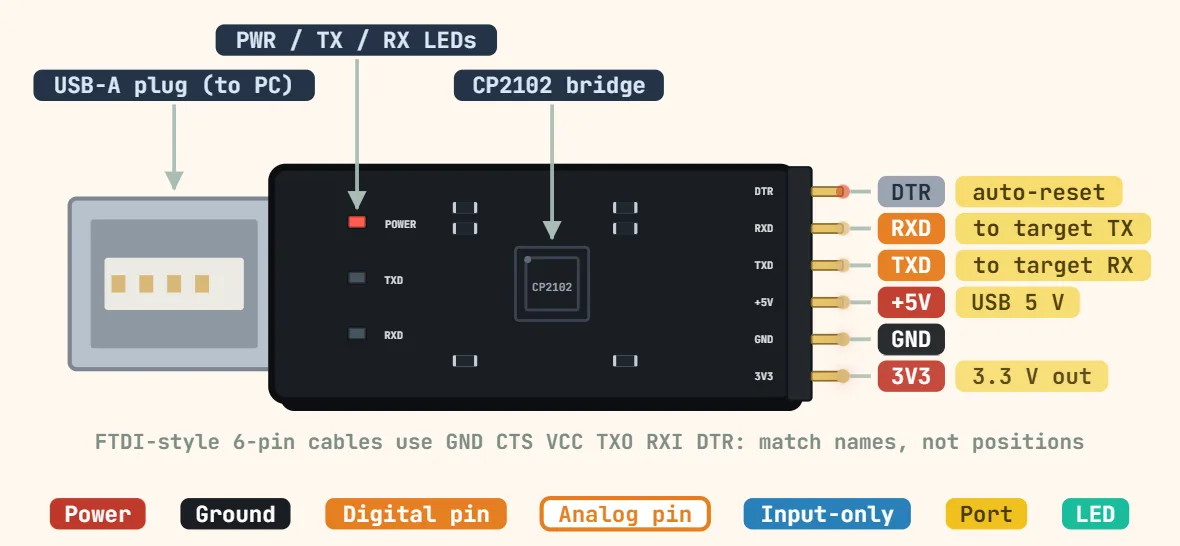
Broches
- DTR (auto-reset — DC-coupled straight out of the adapter; the 100nF series capacitor that turns it into a reset pulse sits on the TARGET, between its DTR pad and RESET; without it you have to press reset by hand at the right moment on every upload)
- RXD (the adapter RECEIVES here, so it goes to the target's TX — RX and TX always cross)
- TXD (the adapter TRANSMITS here, so it goes to the target's RX)
- +5V (USB bus voltage straight through, up to ~500mA)
- GND (must be common with the target ground even when the target has its own supply, and in that case leave +5V/3V3 disconnected rather than back-feeding it)
- 3V3 (the CP2102's own regulator output, ~100mA — note the LOGIC level of TXD/DTR is 3.3V on this stick regardless of which supply pin you use)
Caractéristiques
| Puce | Silicon Labs CP2102 or WCH CH340 |
|---|---|
| USB | USB 2.0 full speed (12 Mbit/s) |
| Baud rate | CP2102: 300 bps–1 Mbps; CH340: 50 bps–2 Mbps |
| Niveau logique | CP2102: 3.3 V (5 V tolerant inputs); CH340: 3.3 V or 5 V depending on board |
| 5V pin | USB bus voltage, up to ≈ 500 mA |
| 3V3 pin | CP2102 internal regulator, ≈ 100 mA |
| Signaux | TXD, RXD, DTR (auto-reset) |
| Drivers | CP210x VCP or CH34x (built into recent OSes) |
Notes
- FTDI-style 6-pin adapters (FT232RL boards, SparkFun FTDI Basic) use a different order — GND (BLK), CTS, VCC, TXO, RXI, DTR (GRN) — and a jumper or switch that sets VCC to 5V or 3.3V; on many cheap CH340 clones that switch only moves VCC while TXO and DTR stay at 5V, which is what kills 3.3V targets: measure TXO against GND before trusting it. Match pin NAMES, never positions.
- CTS, where present, is unused by the Arduino IDE — tie it to GND only if your target demands flow control.