Calculadora en línea gratuita
Thévenin / Norton
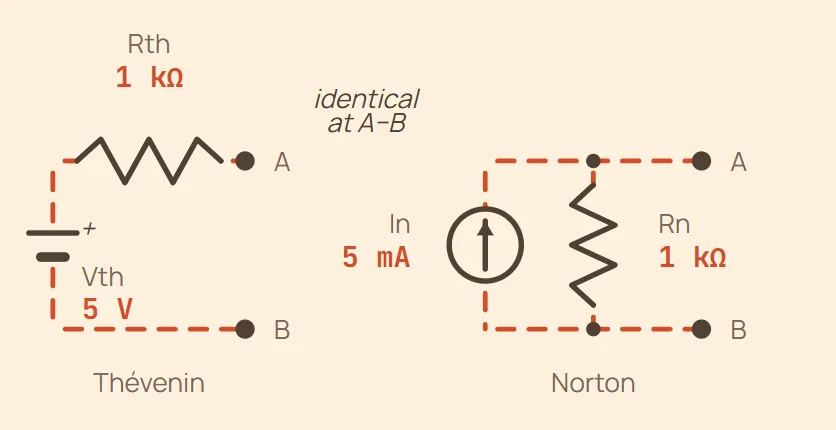
Ejemplo Thévenin 5 V behind 1 kΩ ≡ Norton 5 mA across 1 kΩ. Open-circuit the terminals and you measure 5 V; short them and 5 mA flows.
Ejemplo Into 1 kΩ: 2.5 V across the load, 2.5 mA through it, 6.25 mW delivered while the source resistance wastes 6.25 mW (50 % efficient). You are sitting on the match point.
Any linear source, however many parts are inside it, behaves at one pair of terminals exactly like a voltage source behind a series resistance — or, just as truthfully, like a current source across a parallel resistance. The two swap in either direction with one way, the other, and both ways: the resistance never changes, only how the source is written. Edit either the voltage or the current below and the other follows.
Hang a load on the terminals and the equivalent tells you what it gets: . The delivered power peaks when the load matches the source resistance — — and the classic mistake is reading that as "best". At the match point the source resistance burns exactly as much as the load, so it is 50 % efficiency: matching is what you want from an antenna or a sensor, never from a power supply.
Lo que introduces
- Source resistance (Ω)
- Thévenin voltage (V)
- Norton current (A)
- Load resistance (Ω)