Calculateur en ligne gratuit
Snubber RC
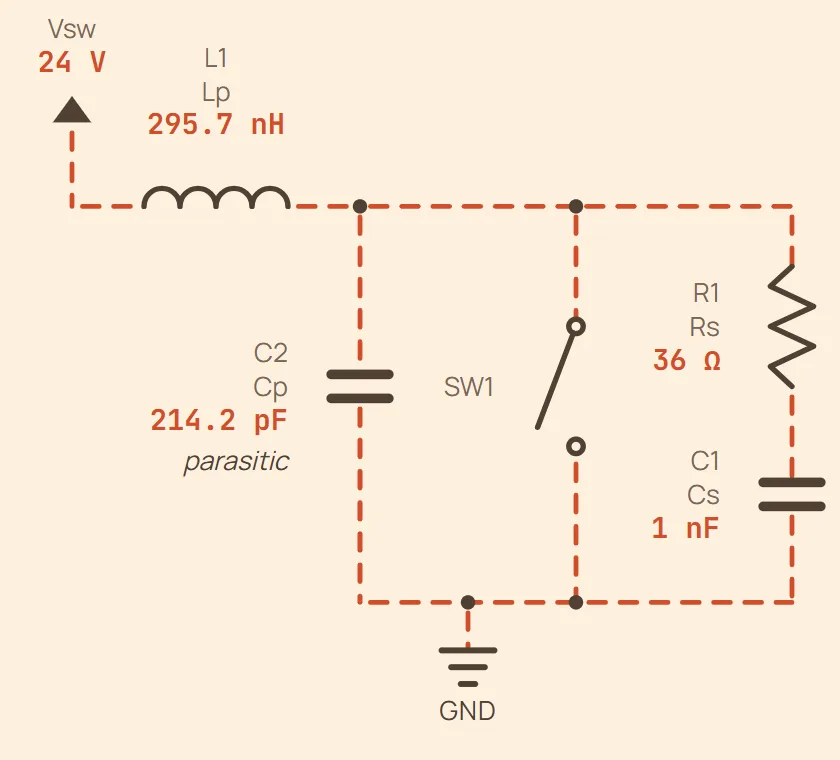
Exemple Parasitics: C = 214.2 pF, L = 295.7 nH, ringing at 20 MHz with Z₀ = 37.15 Ω — fit R = 36 Ω (nearest E24 to 37.15 Ω) in series with C = 1 nF (first E12 above 4× the parasitic)
Exemple R burns 57.6 mW on average at 100 kHz, but every edge dumps 288 nJ into it in one go, at 666.7 mA peak (Vsw/R) — that pulse is small enough for an ordinary part, so a 0.125 W non-inductive resistor covers it (twice the average, because the heat still arrives in bursts). R·C = 36 ns against a 50 ns ring period, which is what "damped in about one cycle" looks like
Two-measurement method. You are giving the ring as the scope sees it, then again with a known capacitor clipped across the switch. comes out of the two frequencies alone — the probe's own capacitance cancels — and follows from the first reading.
is the ring's characteristic impedance — the number of ohms the tank is missing. Set and the ringing is gone in about one cycle; keeps the snubber capacitor large enough to dominate the parasitic it is fighting instead of joining it.
The price is heat: on average. But the average is not what the resistor has to survive — the whole lands in it in one shot on every edge, together with a spike, which is why the wattage below is only offered once that pulse is small enough for an ordinary part. The other classic mistake is reaching for a wirewound resistor, whose own inductance is exactly what the snubber is there to remove.
Ce que vous saisissez
- Measured from
- Ringing f0, nothing added (Hz)
- Capacitance added Cadd (F)
- Ringing f1, with Cadd (Hz)
- Parasitic inductance Lp (H)
- Parasitic capacitance Cp (F)
- Voltage across the switch (V)
- Switching frequency (Hz)